What are prop firms: definition and how they work

A proprietary trading firm (prop firm) is a company that provides capital to retail traders to trade financial markets. Traders undergo an evaluation process to prove profitability and risk management discipline, and if successful, receive a funded account to trade with the firm's money. The firm profits from a share of the trader's profits, while the trader keeps a percentage of earnings, typically ranging from 70% to 90%, without risking personal capital in live markets.
Prop firms appeal to traders who lack sufficient capital to scale their strategies, want to reduce personal financial risk, or seek infrastructure and execution services they can't afford independently. Joining requires passing strict evaluation phases, adhering to rigid risk rules, and accepting lower profit splits in exchange for market access and funding.
Key takeaways: what to expect from a prop firm model
- A prop firm provides capital and infrastructure; you receive a percentage of profits, not the full amount.
- Evaluation phases test your ability to hit profit targets while staying within daily loss limits and maximum drawdown caps.
- Rules are strict. Account termination is immediate if you breach them.
- Profit splits typically favor the trader (70-90%), but comparison across firms requires checking each firm's specific payout terms and fee structure.
- Scaling opportunities exist if you trade consistently and profitably over time, allowing capital to grow with performance.
What it means: defining proprietary trading and funded accounts
A proprietary trading firm connects retail traders to capital markets by fronting trading capital in exchange for a profit share. Unlike a retail broker, where you trade with your own money, a prop firm funds the account, sets the trading rules, and takes a cut of profits.
Core Components
Funded Account: A live trading account backed by the firm's capital, granted after you pass the evaluation phase. You trade with this money, not your own, in real market conditions.
Evaluation Phase: A structured challenge, often multi-stage, where you must demonstrate consistent profitability and adherence to risk parameters. You typically pay a fee upfront; if you pass, that fee may be waived or refunded depending on the firm. Fail and the fee is forfeited.
Profit Split: The percentage of your trading profits you keep versus what the firm keeps. An 80/20 split means you receive 80% of profits; the firm takes 20%. Ranges typically span 70/30 to 90/10 in favor of the trader.
Risk Parameters: Drawdown limits (maximum loss from account start or peak equity), daily loss limits (max loss per trading day), and profit targets define the boundaries of acceptable trading behavior. Breach any one and the account is closed.
Why it matters: access, capital efficiency, and risk trade-offs
Prop firms solve a specific problem: traders with proven strategies but insufficient capital or risk appetite to scale alone. By eliminating personal capital risk in live markets, a prop firm lets you focus on execution rather than preservation.
Why Traders Use Prop Firms
- Access to Capital: Trade positions 5-50× larger than your personal savings would allow.
- No Personal Capital at Risk: Live market exposure without risking your own money; evaluation fees are the only personal cost.
- Professional Infrastructure: Access to institutional trading platforms (MetaTrader 4, MetaTrader 5, cTrader, Rithmic, NinjaTrader), low-latency execution, and support.
- Payout Potential: An 80/20 split on a $100,000 account generating $10,000 profit nets you $8,000, capital gains without initial equity contribution.
Why It Matters for Your Decision
The trade-off is discipline.
Prop firms impose strict rules to protect their capital. If you can't follow them consistently, or if you find the constraints psychologically challenging, a prop firm won't work for you. The evaluation fee is sunk cost if you fail, and the funded account terminates immediately if you break a rule.
How it works: the step-by-step process from evaluation to payout
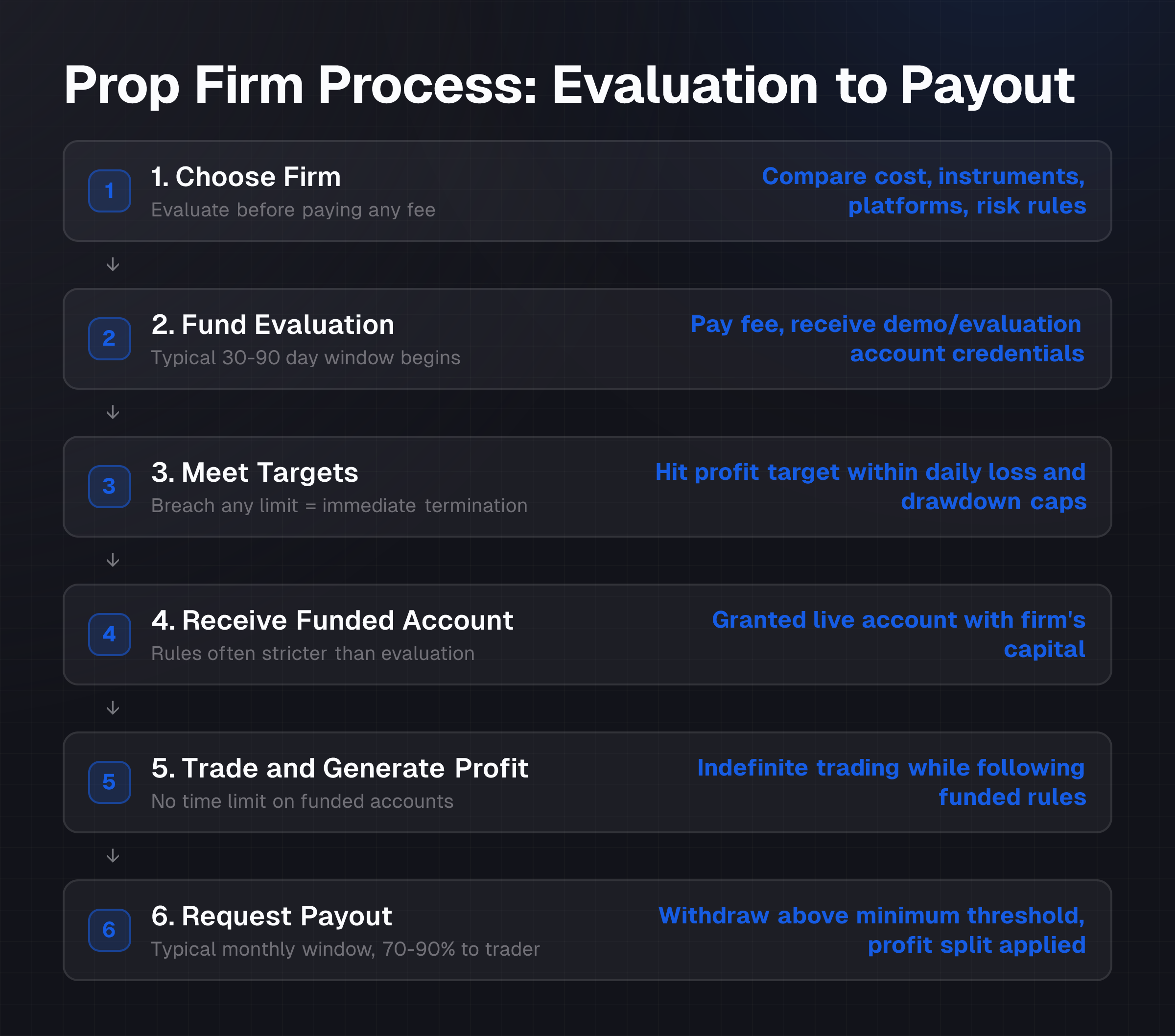
Step 1: Choose a Prop Firm
Before paying any fee, evaluate firms on these criteria:
- Evaluation Cost: One-time fee or subscription? Refund if funded? Typical costs vary; research before committing.
- Trading Instruments: Forex pairs, indices, commodities, futures, crypto, pick a firm offering your target markets.
- Platform Compatibility: MetaTrader 4/5, cTrader, NinjaTrader, Rithmic, ensure it supports your tools and Expert Advisors (EAs) if you use them.
- Risk Rules: Compare daily loss limits, maximum drawdown (initial and trailing), and profit targets. Tighter rules are harder to pass but may indicate more conservative firm culture.
- Payout Terms: Profit split percentage, payout frequency, minimum profit threshold before withdrawal, withdrawal method (bank transfer, crypto).
- Scaling Availability: Can your capital grow with consistent profitability?
- EA and News Trading Policies: Some firms permit EAs on MT5 but prohibit news trading during evaluation; others have different rules. Check firm documentation explicitly.
See Prop Firm Discount Codes: A Curated List of Verified Offers for current entry-point deals and fee structures.
Step 2: Fund and Begin Evaluation
- Pay the evaluation fee and receive login credentials for a demo or funded evaluation account.
- You now have a defined time window (typically 30-90 days) to meet the profit target (e.g., 10% return).
- You must stay within daily loss limits (e.g., max $500 loss per day) and maximum drawdown caps (e.g., max 10% loss from starting balance or peak equity).
Step 3: Meet Evaluation Targets
- Hit the Profit Target: Generate the required % return within the time limit.
- Respect Daily Loss Limits: A single day's loss exceeding the limit terminates the account immediately.
- Observe Maximum Drawdown: Cumulative losses from the start (initial drawdown) or your highest equity point (trailing drawdown) can't exceed the cap, typically 10%.
- Follow Consistency Rules: Some firms require consistent lot sizes across trades or profit distribution across days; read the fine print.
Step 4: Receive a Funded Account
If you pass all phases, you're granted a live funded account with the firm's capital. Rules typically become stricter: funded accounts often have lower daily loss limits and tighter drawdown parameters than evaluations.
Step 5: Trade and Generate Profit
Trade according to the funded account rules. The goal is sustainable, profitable trading while adhering to risk constraints. There's no time limit on funded accounts, you trade indefinitely as long as you follow the rules.
Step 6: Request a Payout
- Accumulate profit above the firm's minimum payout threshold (e.g., $500).
- Submit a withdrawal request during the firm's payout window (e.g., monthly).
- The profit split is applied: if you earned $2,000 and the split is 80/20, you receive $1,600; the firm takes $400.
- Funds arrive via bank transfer, crypto transfer, or the firm's chosen method.
Step 7: Scale the Account (Optional)
If available, consistent performance can unlock capital increases. A $10,000 account might scale to $15,000 after three months of profitable trading without significant drawdowns.
Example or scenario: walking through an evaluation and first payout
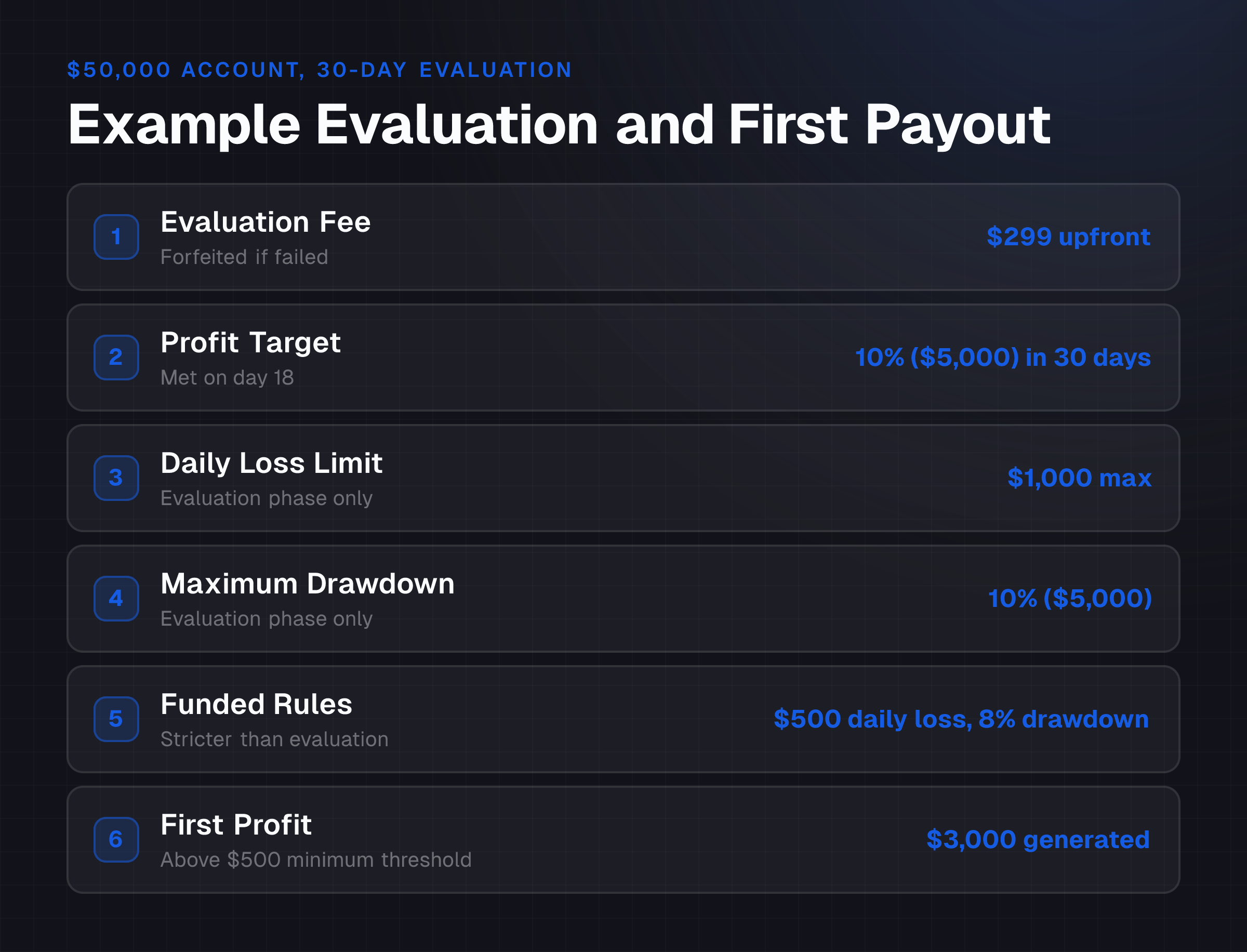
Trader Profile: You're a swing trader using MetaTrader 5, trading EUR/USD and GBP/USD with a proven strategy. You have $5,000 in savings but want to trade a $100,000 position size to accelerate returns. You find a prop firm offering a 30-day evaluation with a $299 fee.
Evaluation Phase:
- You pay $299 and receive a $50,000 funded evaluation account.
- Your profit target is 10% ($5,000) within 30 days.
- Daily loss limit: $1,000. Maximum drawdown: 10% ($5,000).
- Day 5: You generate a $2,000 profit. Still well within limits.
- Day 12: A losing streak costs you $3,000. You're at $2,000 cumulative profit, $3,000 down from peak. Still within drawdown limits.
- Day 18: You hit $5,000 profit (10% target). Evaluation complete.
Funded Account:
- The firm approves you and grants a live $50,000 funded account.
- Rules are now stricter: daily loss limit is $500 (not $1,000), maximum drawdown is 8% (not 10%).
- You trade for two weeks, generating $3,000 profit. Minimum payout threshold is $500, so you request a withdrawal.
- Profit split is 85/15 (you get 85%). Your payout: $3,000 × 0.85 = $2,550.
- Funds transfer to your bank in 3-5 business days.
- Your account remains open; you continue trading the $50,000.
Outcome: You paid $299 upfront, earned $2,550 in payout, and now have access to a $50,000 account to trade indefinitely, without risking your own capital.
Common mistakes or risks: what to avoid
Evaluation-Phase Mistakes
- Ignoring Drawdown Rules: Traders often underestimate the impact of daily and maximum drawdown caps. A 10% max drawdown sounds loose until a bad week wipes out 9% and one poor trade ends the evaluation.
- Over-Leveraging: Chasing quick profits by taking outsized positions accelerates losses and triggers account termination.
- Chasing Losses: After a drawdown, increasing position size to "recover" quickly is a high-risk pattern that breaches limits fast.
- Treating Evaluation as Live: Demo/evaluation accounts may have different spreads, slippage, or liquidity than live funded accounts. Don't assume evaluation performance translates 1:1.
- No Trading Plan: Entering evaluation without a tested strategy and risk management rules. Prop firm rules are rigid; your strategy must be too.
Funded-Account and Operational Risks
- Account Termination: Any single breach (drawdown, daily loss, consistency rule) closes the account permanently. You lose the ability to trade but keep accumulated profits paid out before termination.
- Scam or Unreliable Firms: Unregulated firms may have unfair rules, slow or refused payouts, or poor execution. Research firm reputation and payout transparency before funding an evaluation.
- Execution Discrepancies: Live execution may differ from evaluation. Spreads, slippage, and commission structures change with market conditions and position size. Understand the firm's raw spread plus commission pricing model, not just advertised tight spreads.
- Psychological Pressure: Strict rules and the risk of account termination can induce stress, leading to impulsive decisions or overtrading.
- Hidden Rule Complexity: Rules may include exceptions or nuances (e.g., news trading allowed in funded account but not evaluation, or EA restrictions on certain strategies). Read the full terms of service and contact support with questions.
How to choose or what to do next: evaluating firms and starting
Firm Selection Framework
-
Define Your Trading Model: Are you a scalper, day trader, or swing trader? Do you use EAs or manual trading? This narrows firm choices immediately.
-
List Must-Haves:
- Specific instruments (Forex, futures, indices)
- Platform (MetaTrader, cTrader, Rithmic)
- EA support (yes/no)
- News trading permission (if important to your strategy)
-
Compare Rule Sets: Use What 1,000+ prop firm rules reveal about risk caps in 2026 to benchmark daily loss limits and drawdown caps. Tighter rules aren't necessarily worse, they match different trading styles.
-
Check Payout Transparency: Look for firms that clearly state profit split %, payout frequency, minimum thresholds, and withdrawal methods. Ambiguity is a red flag.
-
Read Reviews and Verify Payouts: Check independent sources for user feedback on payout speed and consistency. Data study: prop firm payout speed 2026 provides comparative payout timelines.
-
Start with a Demo (Optional): Many firms offer free demo accounts to practice before funding an evaluation. Use this to test platform, rules, and your strategy's fit.
Entry Strategies by Account Size
- Under $500 Budget: Evaluate prop firms with low evaluation fees.
- Scalping Approach: Check prop firms optimized for scalpers, which typically offer tight spreads and fast execution.
- Swing Trading: Evaluation methodology for swing traders outlines how to select firms matching longer holding periods.
Next Steps
- List 3-5 firms matching your criteria.
- Simulate one evaluation phase on a demo to test rule compliance and your strategy.
- Pay the evaluation fee only after you've confirmed platform compatibility and rule clarity with support.
- Treat your first funded account as a trial; if payouts are smooth and the experience matches expectations, you can scale or commit longer-term.
See TradeLocker Funded Accounts: What Changes After You Pass? for an example of rule changes post-evaluation.
Frequently asked questions
What is the difference between a prop firm and a retail broker?
A retail broker lets you trade with your own capital; you keep 100% of profits (and losses). A prop firm funds the account; you keep 70-90% of profits and the firm takes the remainder. Prop firms impose strict rules (daily loss limits, drawdown caps); brokers typically don't. Prop firms are suited to traders seeking larger capital and professional infrastructure without personal risk; brokers suit traders comfortable managing their own capital.
Do I need a specific trading strategy to join a prop firm?
Yes. Prop firms evaluate your ability to generate consistent profit within their rules. An untested or overly complicated strategy is unlikely to pass evaluation. Your strategy should be simple, rules-based, and tested on historical data before you apply. The evaluation fee is non-recoverable if you fail, so practice on a demo first.
Can I use Expert Advisors (EAs) with a prop firm?
Rules vary by firm. Some permit EAs on MetaTrader 5 but restrict them on MT4; others prohibit EAs entirely. Check the firm's documentation and ask support explicitly before paying the evaluation fee. If EAs are critical to your strategy, confirm permission in writing.
What happens if I breach a rule during evaluation?
The evaluation account is terminated immediately. Your trading stops, and you lose the evaluation fee. You may reapply to the same firm after a waiting period (if allowed), but you'll pay the evaluation fee again. Understanding and respecting the rules is non-negotiable.
How long does it take to get paid after passing evaluation?
This varies by firm. Typical payout cycles are monthly, and funds arrive 3-7 business days after a withdrawal request is approved. The comparison at Data study: prop firm payout speed 2026 benchmarks firms on payout speed. Confirm payout frequency and method before joining.
Can I lose the evaluation fee if I am funded?
Typically, no. The evaluation fee is separate from the funded account. If you pass evaluation, you're funded; the fee is gone but you're not penalized further. However, if you breach rules on the funded account later, the account closes but you keep any profits withdrawn before termination. Check each firm's policy explicitly.