Prop firm demo accounts: free practice before funding
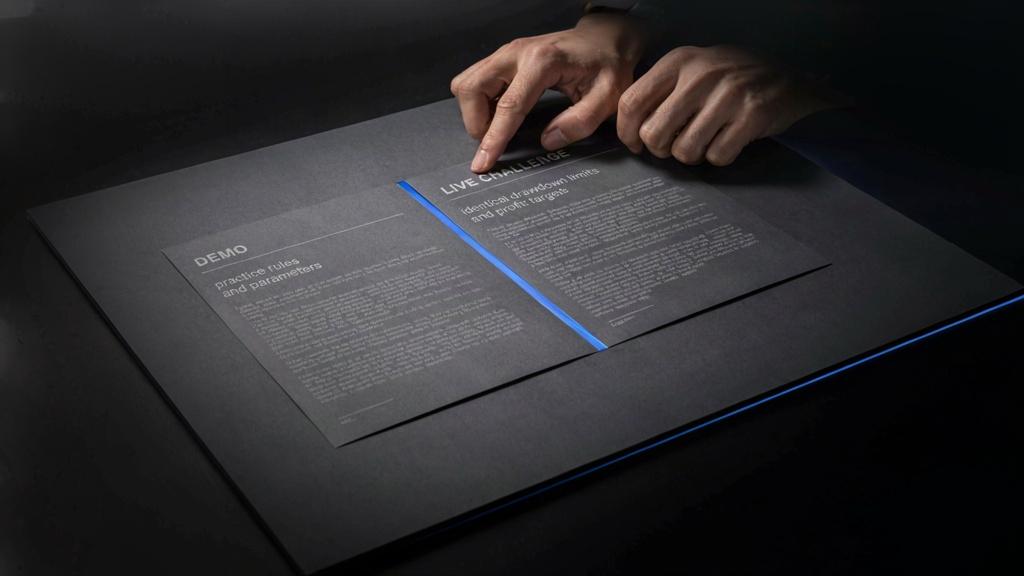
Demo accounts from prop firms let you test strategies and learn platform mechanics before you risk actual evaluation fees. But here's the catch: not every demo mirrors the live challenge environment. Spreads may differ. Data feeds might lag. Psychological pressure is absent. The firms that provide genuine demo-to-live parity, matching drawdown rules, leverage, instruments, and platform, give you a legitimate rehearsal. The rest hand you a sandbox that teaches habits you'll need to unlearn when money's on the line.
This guide walks through what separates useful demo practice from time-wasting simulation, how to verify rule alignment before you invest hours in testing, and how long access typically lasts.
Quick verdict: Demo Trading for Challenge Preparation
Choose demo accounts if you're new to a firm's platform, want to validate your strategy under its specific drawdown limits, or need time to internalize risk management rules before paying an evaluation fee.
Best for:
- Traders unfamiliar with a firm's platform or trading environment
- Those testing strategies against specific profit targets and drawdown rules
- Traders wanting to confirm they can trade the instruments and leverage they plan to use
- Anyone using the practice phase to reduce psychological pressure before a real challenge
Avoid if:
- You expect a demo to perfectly replicate live market conditions (they cannot)
- You need to trade exotic instruments not offered in the demo
- You require leverage or account sizes not available in the demo environment
- You believe unlimited demo resets remove the need to understand your strategy's real failure points
Main pros:
- Free access to test strategies without financial risk
- Insight into platform interface and order-entry workflow
- Opportunity to practice adherence to drawdown and profit-target rules
- Some firms allow resets, enabling multiple practice runs
Main cons:
- Demo lacks the psychological pressure of real capital, leading to overconfidence
- Rules, spreads, or data feeds may not exactly match live challenges
- Some demos expire or have strict time limits
- Overreliance on resets can prevent genuine learning from mistakes
- Demo performance does not predict live challenge success
Pricing/rules snapshot:
- There is no universal industry standard for demo access duration or rule consistency
- Some firms offer time-limited demos, while others provide indefinite access
- Ideally, demo rules should align with live challenge rules (profit targets, daily and overall maximum drawdowns, allowed instruments, leverage), but verification is necessary on a per-firm basis
Last verified: 5 November 2026
Source confidence: Moderate. This article draws on industry-standard definitions of prop firm demo accounts and challenge parameters. Specific data on which firms currently offer rule-matching demos and their exact access durations requires real-time research of individual firm websites and terms; this article does not name specific firms offering demos.
Pricing and account sizes: Demo Costs and Capital Requirements
Prop firm demos cost nothing. Unlike funded challenge evaluations, which run anywhere from under $100 to several hundred dollars, demo environments open without entry fees.
You're trading simulated capital. Account balances range from $5,000 to $100,000, depending on the firm's standard sizes. That play money stays separate from any fee you'd later pay for a live evaluation.
Start with the evaluation fee and refund policy before you compare leverage. Knowing what you'll pay to enter a real challenge, and whether that fee is recoverable if you fail, should guide whether you spend days in a demo or move straight to paid evaluation. The demo's value hinges not on cost but on whether its rule set and platform fidelity justify the time you'll invest.
Evaluation and trading rules: What to Verify Before You Practice
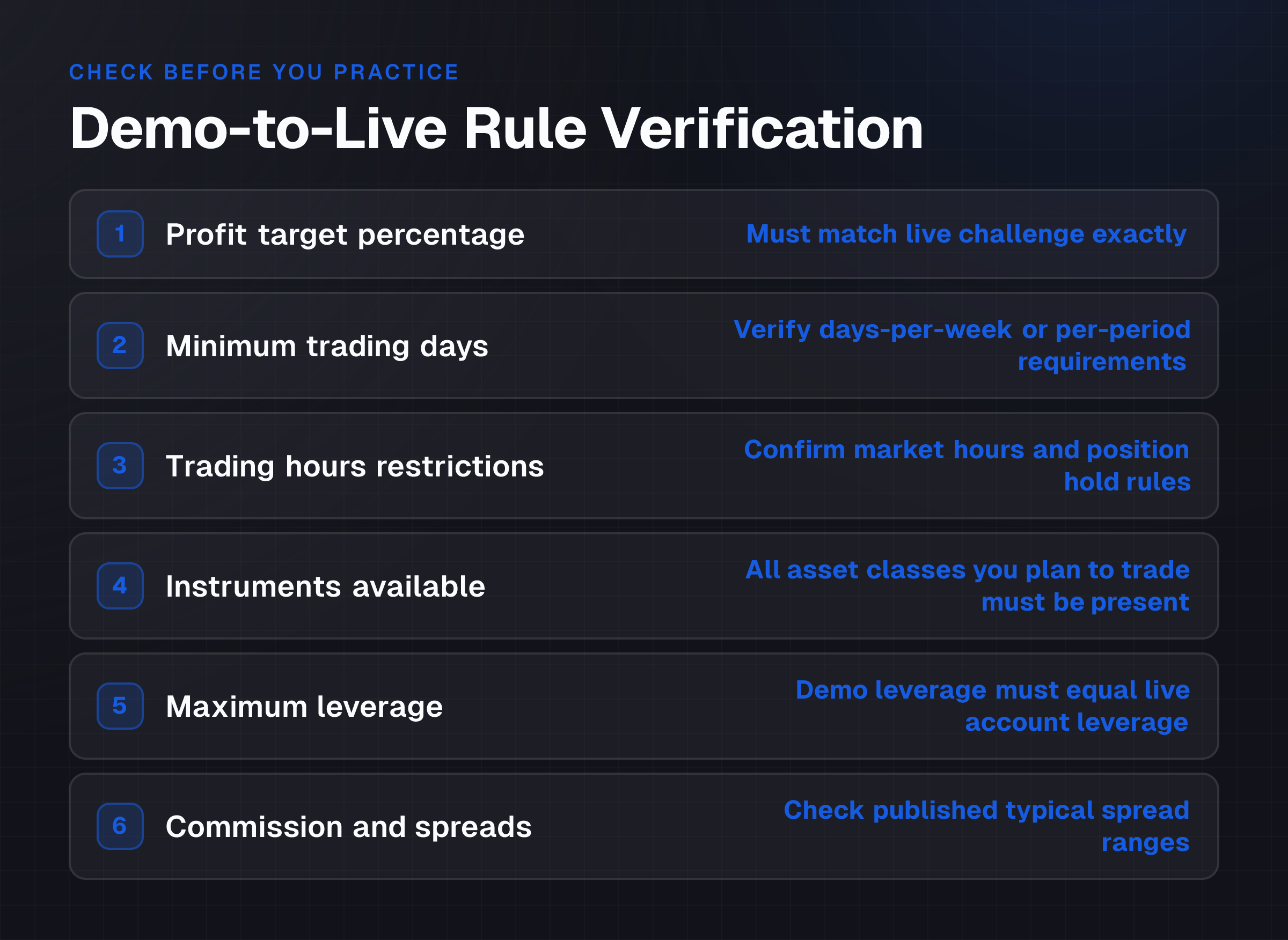
Demo practice delivers value only when the demo's constraints match the live challenge you're preparing for. This alignment is demo-to-live parity, and it's non-negotiable for serious preparation.
Rule Set Matching
Cross-check these parameters between demo and published live challenge rules:
- Profit target: The percentage gain required to pass evaluation. If the live challenge demands 10% profit, the demo must enforce the same target.
- Minimum trading days: Any requirement to trade a set number of days per week or per evaluation period.
- Trading hours: Whether the demo reflects actual market hours and restrictions on position entry or holds.
- Instruments available: Confirm the demo supports the exact asset classes, forex, indices, crypto, commodities, you intend to trade live.
- Leverage: Verify maximum leverage in the demo matches live account leverage.
- Commission and spreads: Demos can't perfectly replicate live spreads, which shift with market conditions. Check if the firm publishes typical spread ranges for demo reference.
Platform and Data Feed
The trading platform, MetaTrader 4, MetaTrader 5, cTrader, should be identical in demo and live.
Different platform means learning a new interface mid-flight when you switch to the live challenge.
Data feeds matter. Delayed or synthetic price data in the demo won't prepare you for live market dynamics.
Account Reset and Practice Cycles
Some firms let you reset a demo account and restart evaluation multiple times. Useful for repetition. Dangerous for complacency. Unlimited resets can teach you that failure has no cost, which is the opposite lesson you need before risking real evaluation fees. Treat each reset as a diagnostic, not a mulligan.
Drawdown and risk rules: Core Constraints to Practice Under
Achieving profit targets is the ultimate goal, while adhering to drawdown limits is the ongoing challenge. Many participants struggle with challenges primarily due to violations of drawdown rules rather than failing to meet profit objectives.
Maximum Daily Drawdown (MDD)
The maximum loss your account can absorb in a single trading day, measured from either starting balance or an intraday high. Breach this limit and your challenge ends instantly.
Use the demo to wire this rule into muscle memory. Practice position sizing and stop-loss placement to stay under the daily cap, even when that means walking away from a setup that looks promising.
Overall Maximum Drawdown
Total loss permitted across the entire challenge phase, measured from starting balance to lowest account point. Breach it and you're out, regardless of how many winning days came before.
Simulate breaching the overall drawdown in the demo. Watch how fast it happens. Learn which trading frequency or position size accelerates you toward it.
Why Demo Practice Matters for Drawdown Adherence
Real capital creates urgency demo capital can't replicate. You may trade more conservatively in demo than you will when fees are at stake, or you may overtrade because play money feels consequence-free. Use the demo to establish position-sizing rules and test your actual risk tolerance under simulated pressure. Prop firm psychology coaching: does it help profits? explores how mindset shapes adherence to these constraints.
Payouts and profit split: Understanding Earnings After You Pass
Demo accounts generate zero payouts.
They're rehearsal spaces. Any profit you make in a demo stays in the demo or vanishes when you reset the account.
Payouts arrive only after you pass a live challenge and receive a funded account. At that point, the firm's profit-split structure, 80/20, 90/10, whatever they publish, determines how your trading profits divide between you and the firm.
A 90/10 split only matters after you pass, weight the challenge rules first. Before you compare profit splits across firms, verify that the evaluation fee, profit target, drawdown limits, and platform quality meet your needs. The split is a secondary consideration that applies only after you've cleared the evaluation.
For context on how quickly firms process payouts after you qualify, see our data study on prop firm payout speed 2026.
Platforms and instruments: What You Can Trade in Demo
Most prop firms offering demos use the same platform as their live challenges: MetaTrader 4, MetaTrader 5, or cTrader. The demo should let you master order entry, position management, and the firm's charting tools before fees are on the line.
Instrument Access
Confirm the demo environment includes the instruments you plan to trade:
- Forex: Major and minor currency pairs
- Indices: S&P 500, FTSE 100, DAX
- Cryptocurrencies: Bitcoin, Ethereum, other digital assets (if the firm offers them)
- Commodities: Crude oil, natural gas, gold, agricultural products
If an instrument is missing from the demo, assume you can't trade it in the live challenge either. Check the firm's official platform or rules document to be certain.
Leverage and Lot Size
Demo leverage should mirror live account leverage. If you plan to scale position sizes in a live account, learn how lot sizing works in the demo first. Trading unfamiliar lot sizes or leverage in a live challenge is expensive trial and error.
How it compares: Demo Parity and Common Gaps
No prop firm demo perfectly replicates its live challenge environment. The closer the alignment, the more valuable the practice.
High-Parity Demo Attributes
A demo that closely mirrors the live challenge offers:
- Identical profit targets and drawdown limits
- Same platform and data feed
- Access to all instruments available in the live challenge
- Matching leverage and account sizes
- Duration of at least 7-14 days to test multiple strategies
Common Gaps Between Demo and Live
- Psychological pressure: Real money creates urgency and fear demo capital can't simulate.
- Slippage and fills: Demos often show instant fills; live markets deliver slippage, especially during high volatility.
- Spread variability: Demos use fixed or average spreads; live spreads widen and narrow with market conditions.
- Data quality: Demo data may be delayed, synthetic, or misaligned with live market data.
- Time limits: Seven-day expiration doesn't give you time to test strategies across trending, ranging, and volatile markets.
Decision Framework
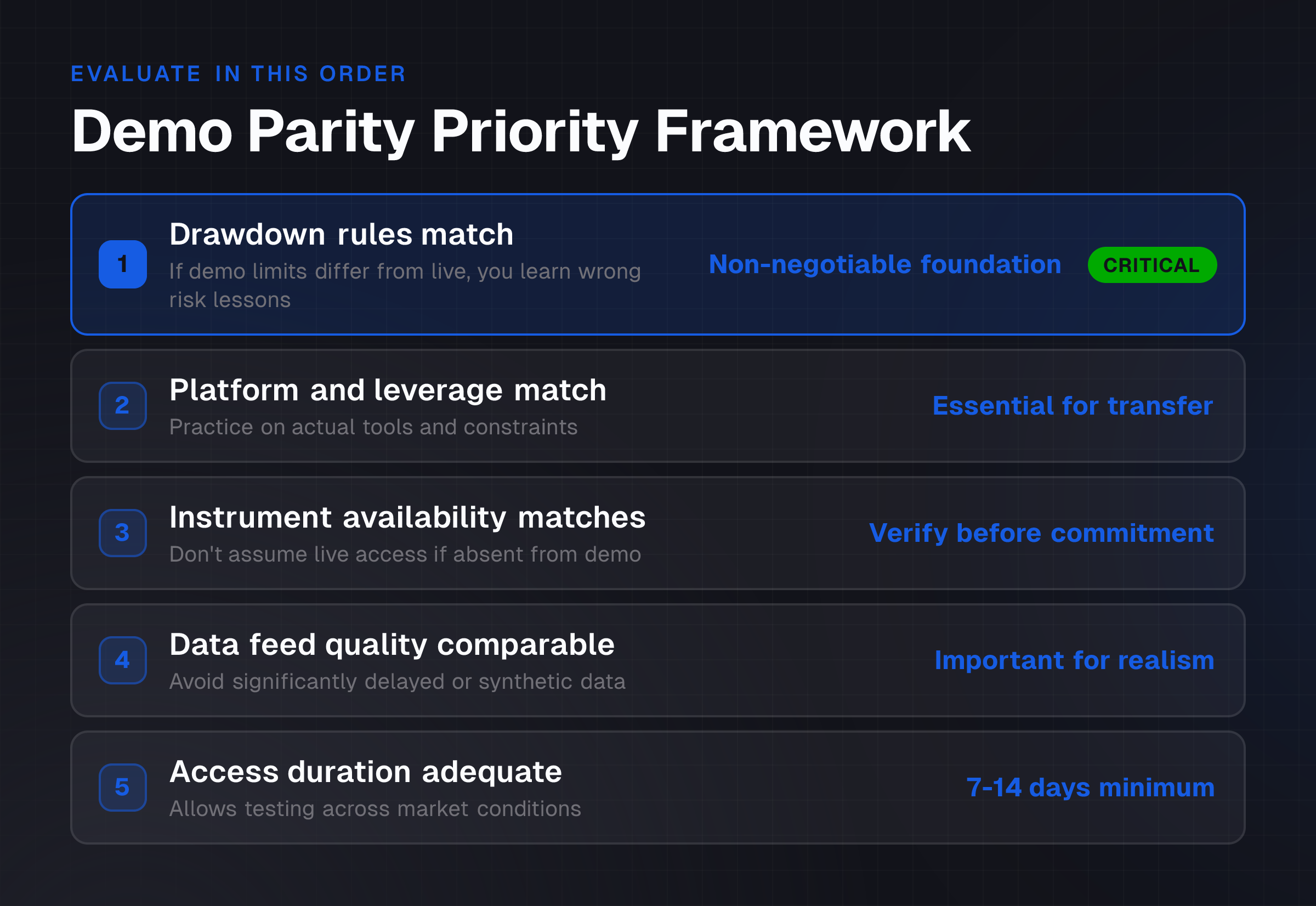
Prioritize demo parity in this order:
- Drawdown rules match. Non-negotiable. If demo drawdown limits differ from live, you're learning the wrong risk lesson.
- Platform and leverage match. You need to practice on the actual tools and constraints.
- Instrument availability matches. Don't assume you can trade an instrument live if it's absent from the demo.
- Data feed quality is comparable. The demo shouldn't use significantly delayed or synthetic data.
- Access duration is adequate. Seven to fourteen days allows meaningful practice; fewer than seven is too tight.
For comparison of how different firms structure their challenges, see best prop firms for scalpers 2026 and best prop firms under $500 minimum.
Frequently asked questions
Can I use a demo account indefinitely, or does it expire?
This article doesn't cover individual firms' expiration policies. Some demos run 7-14 days; others offer extended or indefinite access. Check the firm's terms and support documentation before you start. Most firms allow demo resets if you breach rules, but verify your specific firm's reset policy.
If I pass the demo, do I automatically pass the live challenge?
No. Strong demo performance doesn't guarantee live success. Demo trading lacks the psychological weight of real money, which changes decision-making and risk management. Treat the demo as practice, not as a reliable predictor.
What should I focus on in the demo: hitting the profit target or staying within drawdown limits?
Drawdown adherence comes first. Most challenge failures stem from breaching drawdown limits, not missing profit targets. Use the demo to drill position sizing and stop-loss discipline until staying under drawdown caps becomes automatic, even under pressure.
Do demo spreads and commissions match the live challenge?
This article does not cover the comparison of individual firms' spread or commission structures between demo and live accounts. To determine if the demo employs live spreads or fixed demo spreads, reach out to the firm's support team. If the demo utilizes fixed spreads, be sure to account for realistic spread variability when evaluating your strategy.
Can I trade the same instruments in demo that I'll trade in the live challenge?
Most firms offer the same instruments in demo and live. Verify this on the platform itself or in the firm's rules document before assuming. Some firms restrict certain instruments, cryptocurrencies, exotic pairs, in the live challenge that appear available in the demo.
How long should I practice in a demo before entering a live challenge?
Depends on strategy complexity and experience level. Seven to fourteen days of active trading is the minimum recommended to test your strategy across different market conditions and internalize drawdown rules. Overusing demo resets without analyzing mistakes wastes time; focus on learning from failures, not just resetting and trying again.