Prop firm psychology coaching: does it help profits?

Some prop firms now offer psychology coaching as part of their support packages. The promise: coaching will help you stick to your plan, manage emotions, and reduce impulsive mistakes. But there's a gap between what's claimed and what's proven. No independent peer-reviewed research establishes that prop firm psychology coaching increases trader profits directly, though decades of behavioral finance work confirms that fear, overconfidence, and loss aversion distort trading decisions in predictable ways. Coaching addresses real psychological problems. Whether it solves your problem depends on three things: whether your issue is truly emotional execution rather than a flawed strategy or rule confusion, what support is actually provided versus what's marketed, and whether you'll commit to implementing what you learn.
This guide frames coaching as a tool to evaluate, not a guaranteed fix.
Key takeaways: Psychology coaching and trading performance
- No independent proof of P&L gains. Firms report fewer rule breaches and improved consistency among coached traders, but peer-reviewed studies linking coaching to measurable profit increases in prop trading don't exist in public research.
- Emotional biases wreck execution. Behavioral finance establishes that fear, overconfidence, and loss aversion distort financial decisions. Coaching targets these vulnerabilities directly.
- Coaching won't generate trade signals. It fixes how you execute a strategy you already have. It won't provide entries, exits, market timing, or risk parameters.
- Results scale with your effort. Coaching impact depends on whether you reflect, implement feedback, and track your own metrics over weeks or months. Passive attendance produces nothing.
- Cost is certain; benefit isn't. Weigh any fee against your current emotional execution problems and whether coaching specifically addresses them.
What it means: Trading psychology and emotional execution
Trading psychology examines how emotions and cognitive biases affect trading decisions and performance. Three distortions commonly harm traders:
Fear and loss aversion. You exit winning trades too early to lock in small gains, or hold losing positions hoping they'll reverse, rather than following your stop-loss rule.
Overconfidence and greed. After a win, you oversize positions, overtrade, or revenge-trade, opening larger positions to recover losses immediately after a drawdown.
Confirmation bias and impulsivity. You seek information that validates an existing position while ignoring contrary signals, or deviate from your plan due to impatience or external pressure.
Emotional execution means making trading decisions based on feelings in the moment rather than adhering to a predefined strategy. The result: inconsistent rule-following, missed exits, enlarged losers, cut winners. These patterns erode P&L even when the underlying strategy has an edge.
Prop firm psychology coaching typically aims to identify recurring emotional patterns, help you recognize them in real time, and build habits to stick to your plan when emotions spike. This is distinct from learning a trading strategy or understanding market mechanics. It's behavioral change within the context of an existing plan.
Why it matters: How emotional discipline affects trading outcomes
Behavioral finance has established for decades that psychological biases are systematic and measurable. Research by Kahneman, Tversky, and others on prospect theory, loss aversion, and overconfidence demonstrates that traders and investors consistently make suboptimal financial decisions under emotional pressure.
This matters in prop trading because account rules set tight profit targets and drawdown limits. A trader with a sound strategy can fail the evaluation or blow a funded account not because the strategy is flawed, but because emotional breaches, a revenge trade, an oversized position, a rule violation, trigger a breach of the firm's parameters. The ability to manage emotions and remain consistent becomes directly tied to survival in the prop trading pipeline.
Coaching exists because the problem is real. Whether a specific coaching program solves that problem for you individually remains an open question. The evidence is mostly anecdotal and not independently audited.
How it works: Coaching formats and approaches
Prop firms and independent coaches offer psychology support in several formats. Understanding the structure matters because effectiveness and accessibility vary:
Individual coaching
One-on-one sessions with a dedicated coach, typically via video call or phone. The coach reviews your trading logs, discusses emotional patterns, and provides personalized feedback and strategies. This format offers the most customization and accountability but often costs more and requires scheduling coordination.
Group workshops
Sessions with multiple traders, often focusing on common psychological challenges like managing drawdowns, dealing with losing streaks, or handling winning streaks without overtrading. Group settings foster peer learning and community but provide less personalized attention.
Self-paced courses
Pre-recorded videos, readings, and exercises you complete at your own pace. This format offers flexibility and covers psychological concepts systematically but lacks real-time interaction and specific feedback on your trades.
Community discussion
Forums, chat groups, or live Q&A sessions where traders share experiences and insights. These peer-led spaces can be supportive and normalize common struggles but aren't a substitute for expert coaching. Community access and motivational content alone don't constitute psychology coaching.
Assessing whether coaching fits your problem
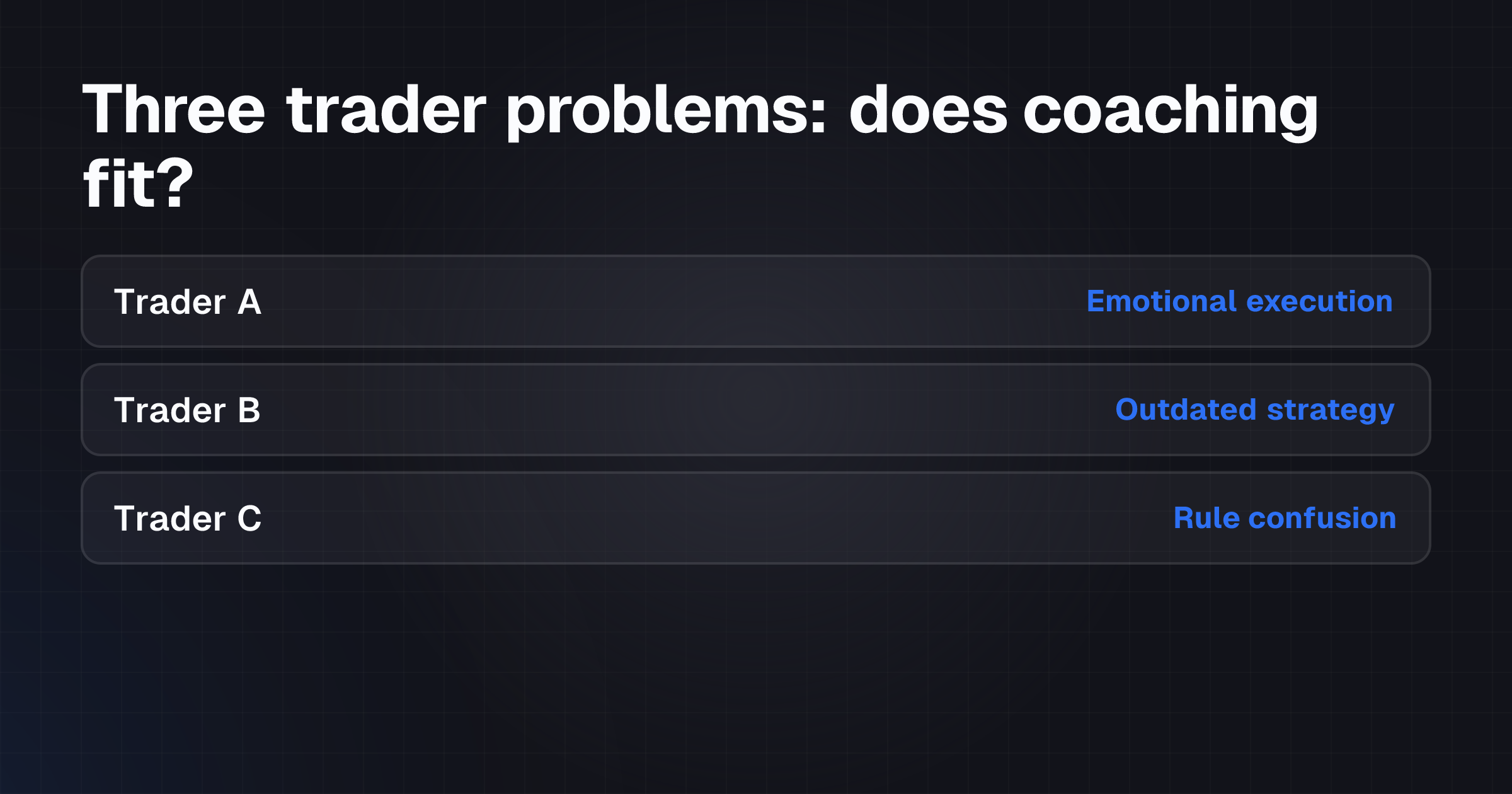
Consider three traders, each facing performance issues:
Trader A has a profitable strategy on simulator with a 55% win rate and consistent risk management. But in live funded accounts, she cuts winners at the first sign of profit and lets losers run, hoping to break even. She hits her drawdown limit within two weeks every time.
Her problem is emotional execution, not strategy. Psychology coaching to address loss aversion and fear would likely help her follow her own plan.
Trader B trades a mean-reversion strategy that worked well from 2022-2024 but is no longer profitable in the current market regime. He's taken every psychology course available and follows his plan consistently. His losses are steady and mechanical, not emotional.
His problem is an outdated strategy, not psychology. Coaching won't fix this. Market adaptation or a new approach will.
Trader C is new to prop firm rules and keeps violating the overnight holding restrictions or position size limits. She understands the rules cognitively but forgets them under pressure.
Her problem is partially behavioral, stress and memory under pressure, and partially educational. A coaching session clarifying the rules and a simple checklist before each trade might be more effective than deep psychological work.
These examples show why diagnosing your specific problem is the first step before committing to coaching.
Common mistakes: What coaching cannot and should not be
Coaching isn't a magic bullet. It addresses behavioral issues, not strategic flaws. If your trading plan has no edge, coaching won't manufacture one.
Passive participation yields nothing. Effectiveness depends entirely on your willingness to engage, reflect, implement feedback, and track your own metrics over weeks or months. Attending sessions without applying what you learn will show no results.
Cost is certain; benefit isn't. Coaching fees are real and immediate. Any improvement in consistency, win rate, or drawdown reduction is uncertain and will vary by person. An illustrative scenario might involve reducing average daily drawdown from 2% to 1.5%, or increasing your win rate by 5% through better trade management, but these outcomes aren't guaranteed and are hypothetical examples only.
Misidentifying "coaching" as marketing. General community access, motivational quotes, references to available coaches, or peer support forums aren't psychology coaching. Verify that the service includes actual coaching, structured sessions, personalized feedback on your trades, accountability check-ins, not just access to a community space.
No independent verification of P&L impact. While behavioral finance research confirms that emotions distort decisions, there's no public, peer-reviewed research specifically linking prop firm psychology coaching programs to quantifiable increases in trader P&L. Firms may report internal metrics such as "traders using coaching had fewer rule breaches" or "improved consistency," but these are provider-reported and not independently audited.
A decision framework: Three questions before you commit
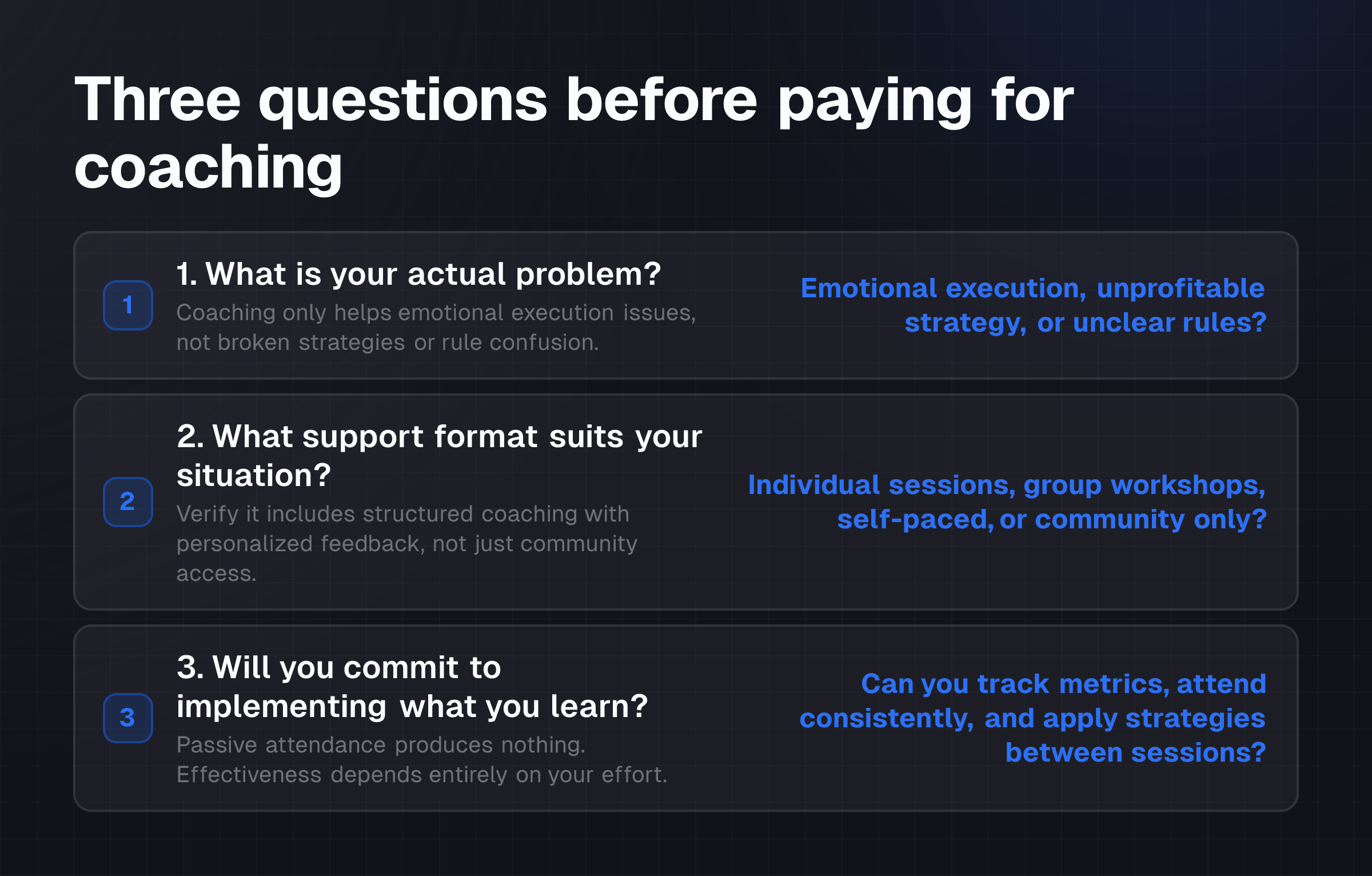
1. What is your actual problem?
Diagnose the root cause of your underperformance:
Emotional execution. Do you have a profitable strategy, proven on simulator or in small live trades, but consistently fail to follow it due to fear, greed, impulsivity, or impatience? Examples: exiting winning trades too early, holding losing trades too long, overtrading after a loss, or deviating from your risk rules.
Coaching may help: Yes, if you can identify the specific emotional pattern and are willing to work on it.
Unprofitable strategy. Is your trading plan fundamentally flawed, lacking an edge, or misaligned with current market conditions? Does it lose money when executed perfectly and objectively?
Coaching may help: No. Coaching doesn't fix a broken strategy. You need to revise your approach or learn a new one first.
Unclear account rules. Are you struggling to understand or consistently adhere to the specific drawdown limits, profit targets, position size restrictions, or other parameters set by your prop firm?
Coaching may help: Partially. You may benefit more from rule clarification and a trading checklist than from psychology coaching. Check your firm's FAQ or contact their support first.
2. What support format suits your situation?
Review what the firm or coach offers:
- How is coaching delivered: individual sessions, group workshops, self-paced content, or community only?
- How often can you access it: weekly, monthly, on-demand, or one-time?
- Who is eligible: all traders, only funded traders, or only after reaching milestones?
- What is the cost: included in your challenge fee, or an add-on charge?
If the coaching is community discussion or general motivational content with no structured coaching component, it's not a substitute for actual psychology coaching.
3. Will you commit to implementing what you learn?
Coaching effectiveness isn't passive. Before paying for a program, ask yourself:
- Can you attend sessions or complete content consistently?
- Are you willing to track your own metrics, win rate, average loss, rule breaches, emotional triggers, before and after coaching?
- Can you implement specific strategies like trading checklists, breathing exercises, or rule reviews between sessions?
- Are you open to challenging your own beliefs about why you trade the way you do?
If the answer to most of these is no, coaching won't work, and the cost will be wasted.
Next steps
Identify your problem using the diagnostic questions above. Write it down.
Research what your prop firm offers or find an independent coach. Ask directly: Is this structured coaching with personalized feedback, or community access?
Set a baseline metric before starting. What's your current win rate, average daily loss, or rule breach rate? Track this over 10-20 trades so you have a clear before-and-after comparison.
Commit to a trial period of 4-8 weeks with the coaching program, following all recommendations.
Re-measure your metric after the trial. Did your win rate improve by 3% or more? Did your emotional trading patterns change? Did you breach rules less often?
Decide whether to continue based on data, not on how you feel about the coach or the program.
Frequently asked questions
Can psychology coaching guarantee I'll make more money trading?
No. No coaching program can guarantee profits. Coaching addresses emotional execution, helping you follow your plan consistently, but it can't create an edge if your strategy lacks one. It may improve your adherence to rules and reduce impulsive losses, which can indirectly support profitability, but results depend on your strategy quality, market conditions, and your commitment to implementation.
Is psychology coaching worth the cost?
That depends on your specific problem and the cost structure. If you have a proven profitable strategy but consistently violate your own rules due to emotion, coaching may offer a positive return on investment. If your strategy is unprofitable or you haven't yet diagnosed your problem, you're likely wasting money. Compare the coaching fee to independent psychology coaching rates, typically $100, $300 per session, and the value of your trading account. If the fee is low relative to your account size and you commit to implementation, it may be worth testing for a trial period.
How long does it take for psychology coaching to show results?
Results vary, but most practitioners suggest tracking progress over 4-8 weeks of consistent engagement. You may notice emotional awareness or behavioral changes within days, but measurable changes in win rate, drawdown reduction, or rule adherence typically require sustained practice. Set a baseline metric before starting and re-measure after 8 weeks to assess real impact.
What if I've already tried psychology coaching and it didn't help?
Common reasons include: you have an unprofitable strategy, coaching can't fix that, you didn't implement the coach's recommendations, the coaching format didn't suit your learning style, or the problem was rule confusion rather than emotional execution. Before trying another coaching program, revisit your root cause diagnosis. If the issue is strategy, focus on backtesting and market research. If the issue is rules, ask your prop firm for clarity. If you believe the issue is emotional but coaching didn't help, consider whether you were ready or willing to change your behavior at that time.
Can I tell if a prop firm's coaching service is legitimate?
Ask directly: What does the service include, structured sessions with a coach, group workshops, or just community access? Who is the coach, and what are their credentials? Is there a defined schedule or is it on-demand? What's the additional cost, if any? Verify that the service isn't just motivational content or peer discussion branded as "coaching." Request a trial session or a sample if available. Check whether the firm discloses coaching success metrics independently or relies only on testimonials.
Does my prop firm offer psychology coaching?
This article doesn't cover coaching offerings for all firms. You can find information about individual prop firms in our directory. For specific firms, check their website FAQ or contact support directly to ask whether psychology coaching is available, in what format, at what stage of your account, and at what cost.