Prop firm fees and payouts: the real math
By Tomas Rieder

Most prop firms charge an upfront challenge fee (typically $100, $500+) to access a simulated trading account. After you pass, you keep a percentage of profits, often 70-90%, while the firm takes the rest. Beyond the visible split, you'll absorb trading commissions, may face monthly subscription fees, and lose money to withdrawal charges. The total cost of ownership compounds quickly: a $300 challenge fee plus per-trade commissions plus a 20% profit split can easily consume 40-50% of your gross trading returns before you see a payout. This article breaks down every cost layer so you can calculate your actual take-home before you commit.
Quick answer: understanding total cost of ownership
Prop firm pricing works in layers. You pay upfront to enter a challenge, then you share profits with the firm, then you pay to withdraw.
The challenge fee is the cost of entry. Non-refundable. It grants you access to a simulated trading environment to demonstrate your skill. Monthly subscription fees may also apply after you pass the challenge, though not all firms charge them. The profit split, the percentage of profits you keep versus what the firm takes, is where the largest chunk of earnings goes. On top of that sit commissions per trade, data feed charges (sometimes bundled, sometimes separate), and withdrawal fees when you request a payout.
Most traders focus only on the challenge fee and advertised profit split. Then they get surprised. Commissions eat 10-30% of gross returns. Withdrawal fees claw back another slice of actual payouts. The math doesn't work backward from your profit split; it works forward from your gross edge, minus all costs.
The objection: "I don't know what I'll actually take home"
This is the core blocker.
A firm advertises an 80/20 profit split and a $200 challenge fee. That sounds clean. But it leaves critical questions unanswered:
- Are commissions taken before or after the split? If you make $1,000 in profit but pay $150 in commissions, is the firm taking 20% of $1,000 or 20% of $850?
- What about data feeds? Real-time market data can cost $50, $200 per month. Is that bundled, or does it come out of your account?
- How much does withdrawal actually cost? Some firms charge fixed fees ($25, $50 per payout); others take a percentage (1-3% of the amount withdrawn).
- Are there monthly fees after I pass? A handful of firms charge recurring subscription fees on top of the profit split.
- What if I don't trade much? Some firms impose inactivity fees if your account sits idle.
Without these answers, the 80/20 split is marketing fiction. Your actual take-home depends on how the firm layers fees and what hidden costs exist. This uncertainty stops people from funding.
What is actually true: the complete cost breakdown
Challenge fees and evaluation access
The challenge fee is your entry cost. Non-refundable. You pay it once to access a simulated trading environment and prove your trading skill before the firm grants you access to real capital (or a live-funded account).
Typical ranges:
- Small accounts ($10k, $25k simulated capital): $100, $200
- Mid-tier accounts ($25k, $100k): $200, $500
- Large accounts ($100k+): $500, $2,000+
You pay this regardless of whether you pass or fail. It isn't credited toward your first payout or deducted from your funded account balance.
Profit splits and commission structure
Once you pass the challenge and receive funding, you split profits with the firm. This split is expressed as a ratio, for example, 80/20 means you keep 80% and the firm keeps 20%.
What matters: the order in which costs are subtracted.
Most firms follow this sequence:
- Your gross trading profit (or loss) is calculated.
- Trading commissions are subtracted from that gross profit (or sometimes absorbed by the firm; this varies).
- The profit split is applied to the remainder.
- Data feed fees (if separate) may also be deducted.
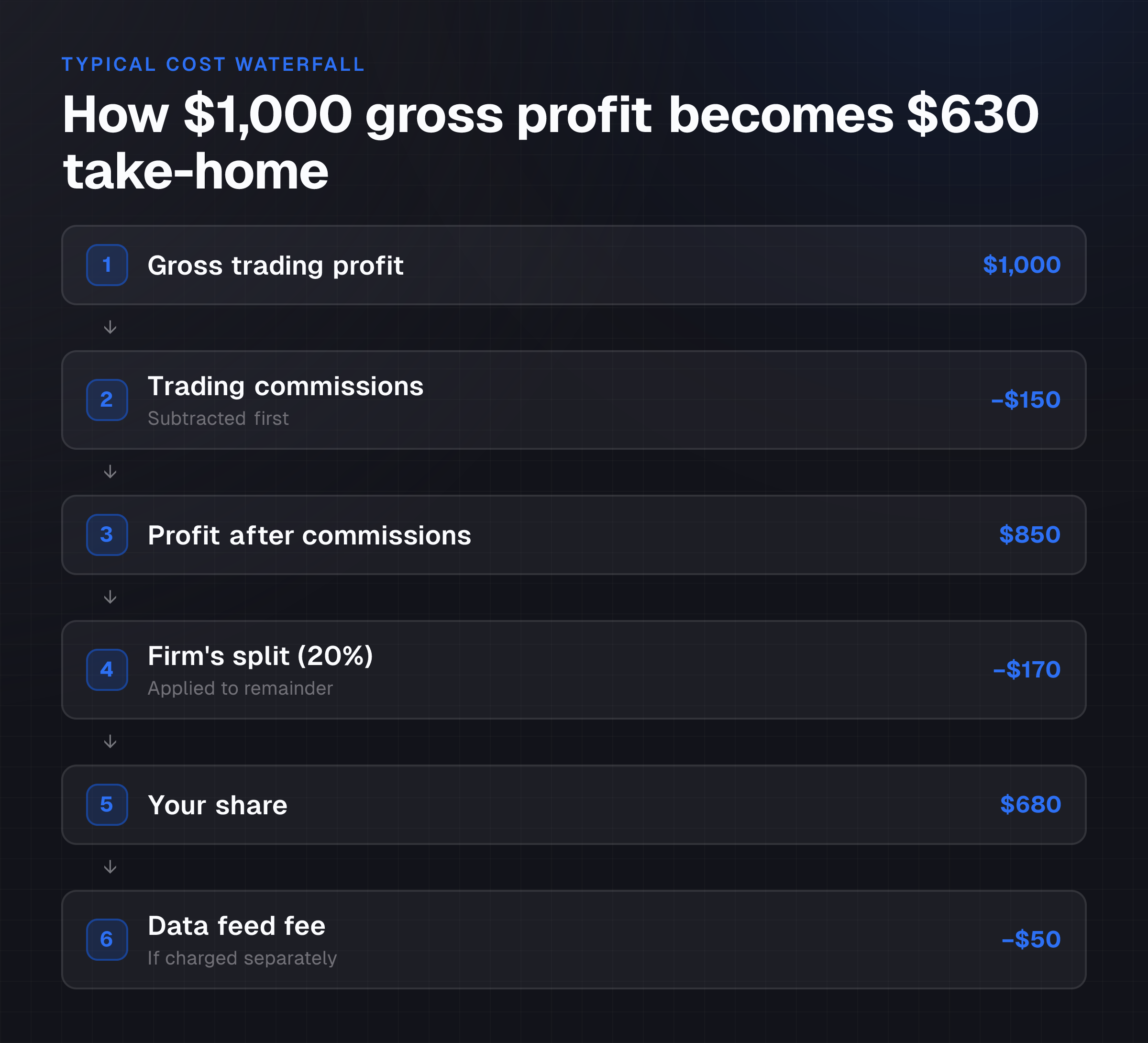
Example:
- Gross trading profit: $1,000
- Trading commissions: −$150
- Profit after commissions: $850
- Firm's split (20%): −$170
- Your share: $680
- Data feed fee (if separate): −$50
- Your take-home: $630
This is roughly half of your gross profit, not 80% of it. The advertised 80/20 split is accurate but incomplete.
Commission rates typically run per trade or per lot, varying by asset class and firm. Forex and CFD firms may charge 1-5 pips per trade; futures firms may charge $2, $10 per contract.
Monthly subscription and ongoing fees
After passing the challenge, most firms don't charge a separate monthly subscription. However, some platforms may include platform access fees or data feed costs as part of their service structure.
Data feed fees (if charged separately) range from $0 to $200 per month depending on whether the firm includes real-time market data, historical data, or advanced tools. Some firms bundle this; others pass it to the trader.
Inactivity fees exist at a small number of firms. If your funded account shows no trading activity for 30-90 days, some firms may impose a monthly charge (typically $10, $50). Check the account terms before funding.
Withdrawal mechanics and payout costs
When you request a payout, the firm processes your profits through a payment processor (bank transfer, cryptocurrency, etc.). Hidden costs bite here.
Withdrawal fees can be:
- Fixed: $25, $50 per withdrawal
- Percentage-based: 1-3% of the amount withdrawn
- Free: Some firms absorb this cost
Minimum withdrawal thresholds typically range from $100 to $500. You can't withdraw below this amount.
Payout frequency varies: some firms allow weekly or bi-weekly withdrawals; others limit you to monthly. Frequent small withdrawals multiply your fee exposure, while large infrequent withdrawals reduce it proportionally.
Example:
- Your profit available for payout: $1,000
- Withdrawal fee (2%): −$20
- Your bank receives: $980
If you take weekly $200 payouts instead (5 withdrawals), you pay $20 per withdrawal ($100 total), five times the cost.
Indirect costs: commissions, slippage, and spreads
Beyond explicit fees, two factors erode your net return.
Trading commissions are subtracted from your gross profit before the profit split. Even small per-trade costs accumulate. A trader executing 100 trades per month at $5 per trade pays $500 in commission, which reduces the pool of profit before the firm's split. If that trader's gross profit was $1,500, commissions cut it to $1,000, and then the firm takes its 20%, leaving $800 instead of $1,200.
Slippage and spreads aren't direct fees but have a direct cost. Slippage is the difference between your intended trade price and the actual executed price. On a prop platform with wider spreads or slower execution, slippage can reduce your per-trade edge by 5-50 pips (or more in volatile markets), which directly reduces gross profit and therefore the profit available to split.
What to do next: calculate your actual cost of ownership
Use this framework to evaluate a specific firm before funding.
Step 1: Identify all upfront costs
- Challenge fee: $___
- Monthly subscription (if any): $___/month
- Data feed fee (if separate): $___/month
- Total to pass the challenge: $___
Step 2: Map the profit split math
- Advertised profit split: ___%
- Commission per trade: $___
- Expected trades per month: ___
- Estimated monthly commissions: $___
- Data feed (if deducted from profit): $___/month
- Total monthly costs before the split: $___
Step 3: Project your take-home
Assume a realistic monthly profit target (e.g., $2,000 in gross profit):
- Gross profit: $2,000
- Commission and fees: −$300
- Profit after costs: $1,700
- Firm's split (e.g., 20%): −$340
- Your gross take-home: $1,360
- Withdrawal fee (e.g., 2%): −$27.20
- Your net take-home: $1,332.80
This is 67% of your gross profit, not the advertised 80%.
Step 4: Compare breakeven across firms
Some firms charge lower challenge fees but take a higher profit split (or charge higher commissions). Others charge higher entry fees but offer better payout terms. Calculate total cost of ownership across 3-6 months of trading, not just the challenge fee.
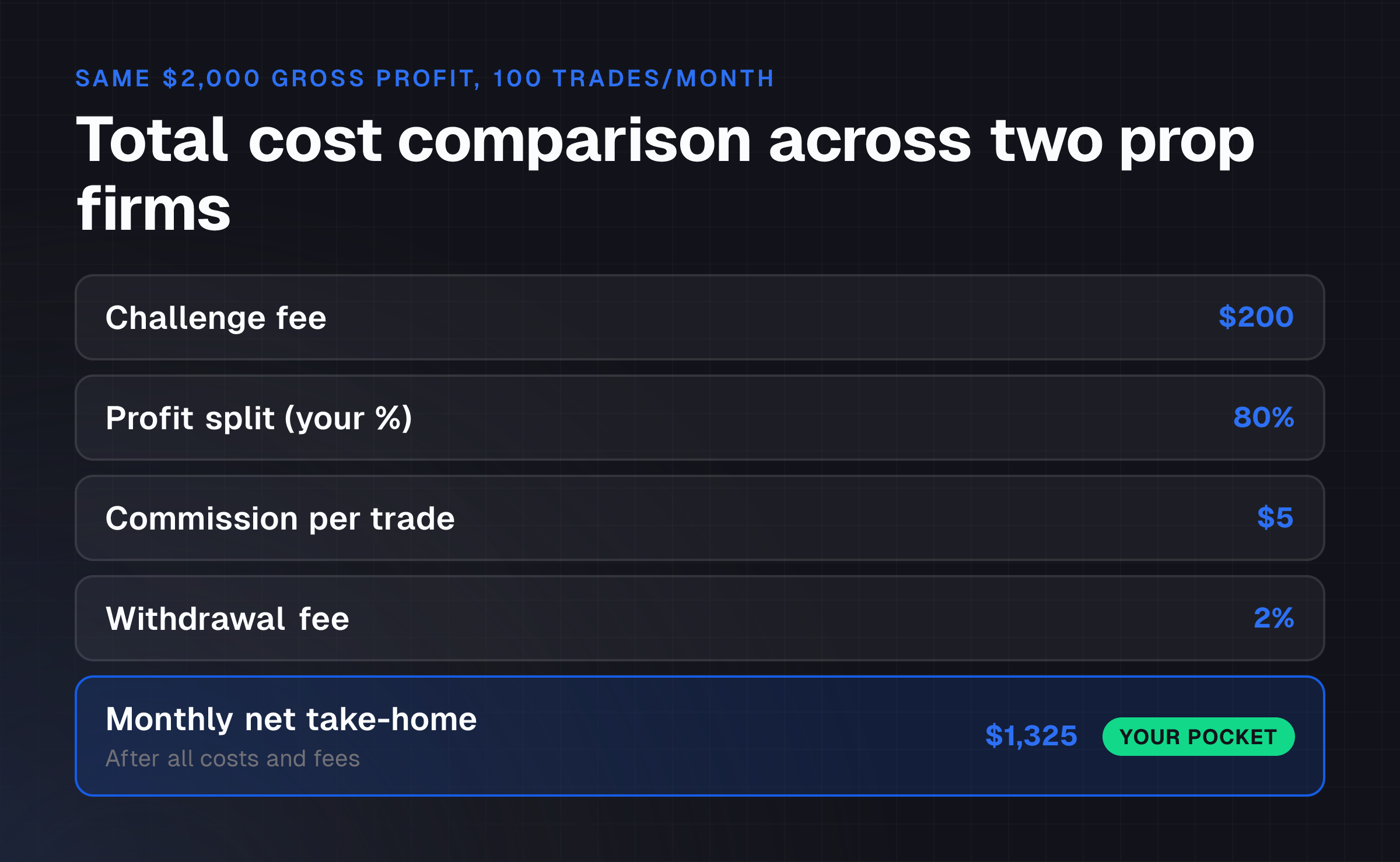
Example comparison:
| Firm A | Firm B |
|---|---|
| $200 challenge | $400 challenge |
| 80/20 split | 85/15 split |
| $5/trade commission | $3/trade commission |
| 2% withdrawal fee | Free withdrawal |
| Monthly net (100 trades, $2k gross): $1,325 | Monthly net (100 trades, $2k gross): $1,485 |
Even though Firm B costs more upfront, it pays out more over time.
Step 5: Verify the actual rules
Before funding, ask or check the firm's support documentation for:
- Exactly when commissions are deducted (before or after the split)
- Whether data feed costs are bundled or separate
- Minimum withdrawal amount and frequency limits
- Any inactivity or maintenance fees
- Whether the profit split changes based on performance tiers
The TradeLocker Funded Accounts: What Changes After You Pass? article covers how profit terms can shift after you move from challenge to live funding, which is worth reviewing before committing.
Frequently asked questions
Do all prop firms charge commissions, or do some cover it?
Most prop firms pass trading commissions to the trader. These are subtracted from gross profit before the profit split is applied. A few firms advertise that they absorb commissions, but this is rare and usually applies only to specific account tiers or asset classes. Always verify in writing whether commissions are taken before or after the profit split calculation.
What happens if I don't withdraw every month?
If you don't withdraw, your profits typically remain in your trading account and can be used as additional capital for future trades (up to your account rules). This avoids withdrawal fees but also means you don't realize the profits in your pocket. Withdrawal frequency is a strategic choice: frequent withdrawals reduce risk but increase fee exposure, while letting profits compound reduces fees but concentrates capital in one account.
Can the firm change the profit split or fees after I pass?
This depends on the firm's terms. Some firms lock in your split and fee structure once you pass the challenge; others reserve the right to adjust terms with notice. Read the account agreement carefully. If terms can change, ask whether they apply only to new challenges or also to existing funded accounts.
Is slippage the same as a withdrawal fee?
No. Slippage is the difference between your intended trade price and the actual executed price, it reduces your profit directly. Withdrawal fees are flat charges or percentages taken when you request a payout. Both reduce your net return, but slippage is baked into execution quality, while withdrawal fees are transparent charges you can plan for.
How do I know if a firm's cost structure is actually competitive?
Calculate your three-month total cost of ownership (challenge fee + expected commissions + profit split impact + withdrawal fees) and compare it across 3-5 firms. The cheapest challenge fee often loses to a firm with a better split and lower commissions when you model 90 days of realistic trading. Ask each firm for a sample calculation based on your expected trading volume.
Should I choose a higher profit split over lower commissions?
It depends on your trading frequency. High-frequency traders (100+ trades per month) are hit harder by commissions, so lower per-trade costs matter more. Lower-frequency traders (10-20 trades per month) benefit more from a higher profit split. Model both scenarios with your expected trade count and compare the net result, not the headline split.