Do Prop Firms Allow Copy Trading? Rules to Check

There is no universal prop-firm rule for copy trading. A firm may permit copying between accounts held by the same verified trader while prohibiting third-party signals, shared strategies, account management or copying trades from another person.
Before using a trade copier, identify exactly where the original trade comes from, who controls both accounts and whether the firm applies different rules during evaluation and funded stages. This guide explains the distinctions to verify before activating any copying software. This guide walks you through the decision checklist in the order you should work through it: permissions first, provider assessment second, technical readiness third, and risk configuration last. It covers the rules that matter, the trade-offs you face, and the mistakes that most commonly derail accounts.
Key takeaways: What to verify before activating copy trading
- Confirm your prop firm explicitly allows copy trading during challenges; many firms prohibit it or restrict it to specific conditions.
- Assess the strategy provider's historical performance, drawdown profile, and risk consistency over at least 6-12 months, not just short-term gains.
- Evaluate your trading infrastructure for latency and slippage; execution delays can quickly erode profits in a tight challenge.
- Configure copy trading risk controls to align with and protect against breaching your firm's daily and overall drawdown limits.
- Verify that the provider's trading style complies with all of your challenge's rules, consistency minimums, restricted instruments, and position holding periods.
What it means: Copy trading, challenges, and the strategy provider
Copy trading is the automated replication of another trader's trades into your own account. When you enable it, your broker or copy trading platform watches the strategy provider's account and mirrors their orders, entry, exit, and lot size, into your account, typically with minimal delay.
A prop firm challenge (or "funding challenge") is a simulated trading period lasting days or weeks, with specific profit targets, maximum daily and overall drawdown limits, and other rules you must follow to pass and gain access to funded trading capital. It's an evaluation phase designed to assess your trading discipline and risk management.
The strategy provider is the trader whose account you're copying from. The subscriber is you, the trader receiving the copied trades.
Drawdown measures peak-to-trough loss from your account's highest point. Most prop firms set a maximum daily drawdown (5% per day, for instance) and an overall drawdown limit (say, 10% over the entire challenge). When you copy trades, the provider's losses become your losses, so their drawdown directly affects your ability to stay within your challenge limits.
Slippage is the difference between the price at which a trade is expected to execute and the price at which it actually executes. In copy trading, slippage occurs twice: once when the provider enters or exits, and again when your platform replicates that trade. Fast-moving markets and high-frequency strategies amplify this cost.
Why it matters: How copy trading changes your challenge risk
Copy trading appeals to traders because it promises faster challenge completion without the burden of developing a strategy from scratch. You inherit a proven track record and can focus on execution and compliance rather than market analysis.
But copy trading introduces layers of risk that solo trading doesn't.
Control and Accountability
When you copy another trader, their performance becomes your performance, but you remain accountable for all breach rules. If the strategy provider's trades violate your firm's consistency rules, restricted instruments list, or overnight holding limits, your account gets penalized or closed, not theirs. You're taking on their risk profile while bearing the full compliance burden.
Drawdown Compounding
A strategy provider's drawdown tolerance and your prop firm's drawdown limits are often misaligned. Research from The Journal of Financial Markets (Chen, Gao, and Li, 2018) on social trading platforms found that followers frequently experience lower returns than the provider due to slippage, fees, and execution delays. More critically, their drawdowns can spike unpredictably.
If the provider hits a streak of losses, your account may breach the challenge drawdown ceiling within hours, before you have time to react or stop copying.
Execution Quality and Cost
Slippage in copy trading is often substantial. Your copied trades may execute at worse prices than the provider's, especially if the copy trading software or your broker introduces latency, market conditions are volatile (wider bid-ask spreads), the strategy is high-frequency or scalp-oriented, or your VPS or internet connection introduces delays.
Over dozens or hundreds of trades, this slippage accumulates and can turn a profitable strategy into a marginal or losing one. In a tight challenge with a 10% overall profit target, slippage alone can be the difference between passing and failing.
How it works: The verification checklist, step by step
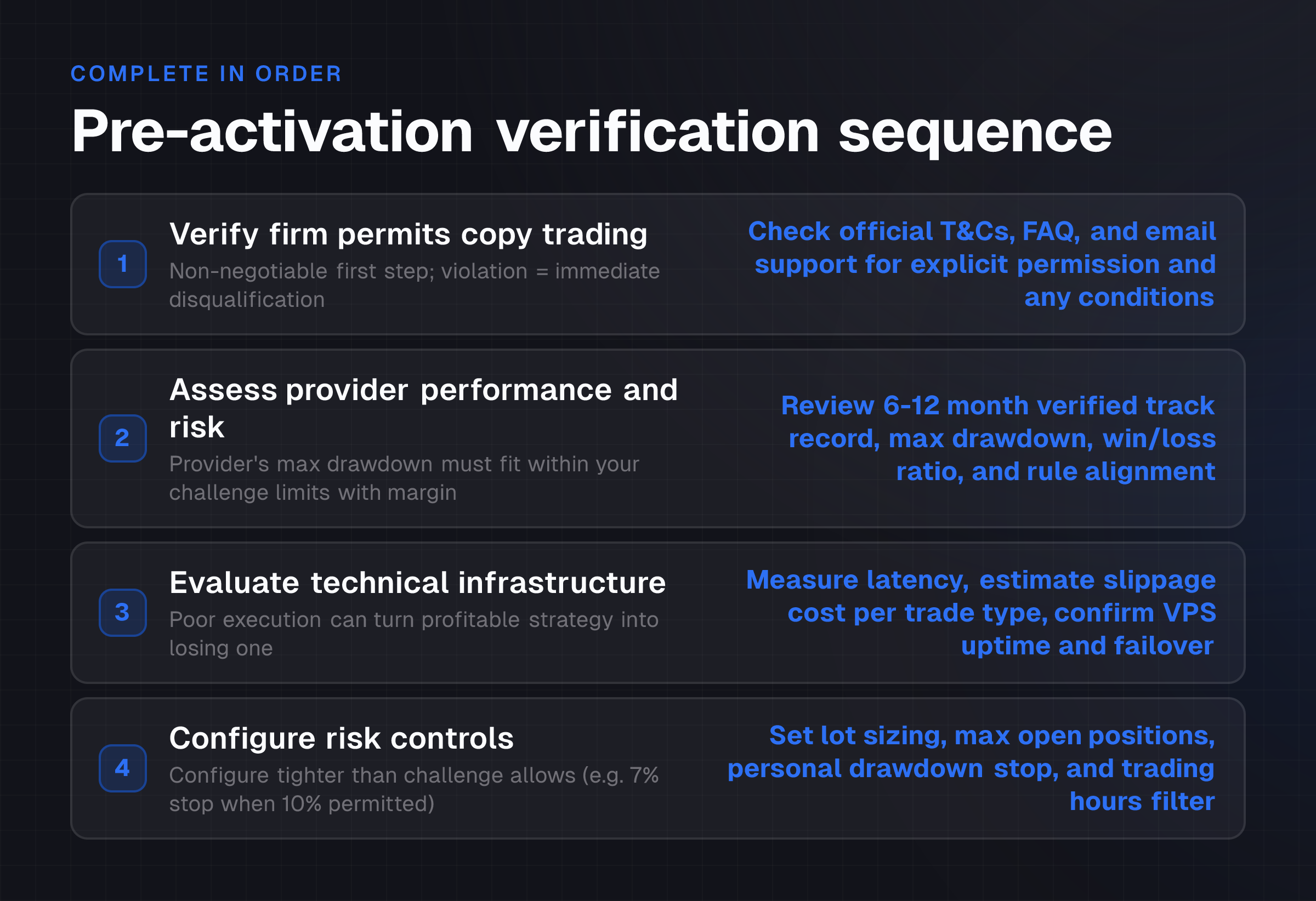
Step 1: Verify the prop firm permits copy trading
Your first action is to confirm that your specific prop firm allows copy trading during the challenge phase. This is non-negotiable.
Where to check:
- Official terms and conditions document
- FAQ section on the firm's website
- Copy trading or social trading policy page (if dedicated)
- Direct email to support
What to look for:
- Explicit statements like "Copy trading is permitted" or "Copy trading is prohibited."
- Conditions, such as "Copy trading from your own other accounts only" or "Copy trading from verified platforms only."
- Restrictions on types of providers (professional traders only, for example, or only from within the firm's own network).
Why this matters:
Many prop firms don't allow copy trading because they want to assess your trading decisions, not a provider's. Others allow it only under narrow conditions, copying from your own funded account into a new challenge account, for instance, but not from external traders. If you violate this rule, your account will be flagged for breach of terms, and you'll lose your challenge and any deposit.
Step 2: Assess the strategy provider's performance and risk profile
Once you confirm copy trading is permitted, evaluate whether the provider's trading record actually fits your challenge constraints.
Performance metrics to examine:
- Track record length: Look for at least 6-12 months of verifiable history, not 3 months. Short-term exceptional returns often don't persist.
- Maximum drawdown: What's the largest peak-to-trough loss the provider has experienced? If the provider's maximum drawdown is 8% and your challenge allows only a 10% overall drawdown, there's almost no margin for error.
- Win/loss ratio and average win size vs. average loss size: A 60% win rate sounds good but is worthless if average losses are 3× the size of average wins. Look for consistency in position sizing and risk per trade.
- Profit curve smoothness: Does the provider's equity curve show steady, gradual growth, or are there sharp spikes followed by crashes? Volatile providers are riskier in a challenge.
Verification sources:
- Third-party verification services: Myfxbook, FXBlue, or similar platforms allow traders to link live or demo accounts and display verified performance. Far more reliable than screenshots.
- Independent reviews: Search trading forums and social media for unfiltered discussion about the provider. Be skeptical of only positive or only negative feedback; seek balanced perspective.
- Direct communication: Ask the provider for their strategy details, typical holding periods, average trades per day, and risk per trade. Evasive or vague answers are a red flag.
Alignment with challenge rules:
Review your challenge rules and compare them to the provider's trading style:
- Holding period: Does the provider hold trades overnight or over weekends? If your challenge prohibits overnight holding, this provider is incompatible.
- Consistency rules: Some firms require a minimum number of trading days per week or a minimum number of trades. Does the provider's typical trade frequency meet this?
- Restricted instruments: If your challenge restricts certain currency pairs, commodities, or indices, confirm the provider doesn't rely heavily on those.
- News trading and volatility: If your firm restricts trading during news events, and the provider scalps around economic calendar releases, that's a conflict.
Step 3: Understand your technical setup and latency risk
Copy trading depends entirely on infrastructure. Poor execution can negate a good strategy.
Key questions:
- Platform compatibility: Does the copy trading system support your prop firm's trading platform (MT4, MT5, cTrader, etc.)? Some copy trading services work only on specific brokers or platforms.
- Latency: How many milliseconds pass between the provider's trade execution and yours? A 500ms delay is acceptable for swing trades; it's catastrophic for scalping. Research by Hitsch, Hortaçsu, and Sukul (2016) on information aggregation in social trading networks underscores that execution timing directly influences return quality relative to the master trader.
- VPS or local execution: Are you running copy trading software on your local computer (subject to internet outages and shutdowns) or on a dedicated Virtual Private Server (VPS)? A VPS is strongly recommended to ensure 24/5 uptime and minimal latency.
- Backup and failover: If your primary connection fails, is there an automatic failover, or do open trades sit unmanaged?
Estimate slippage impact:
For each trade type the provider executes, estimate the likely slippage:
- Scalp trades on liquid pairs: 0.5-2 pips slippage
- Day trades on major pairs: 1-3 pips
- Swing trades on less liquid pairs: 2-5 pips
Multiply average slippage by typical trades per month to estimate total slippage cost. If the provider averages 100 trades per month at 1.5 pips average slippage on a standard lot, that's approximately $150 in slippage cost per month per lot copied. In a 4-week challenge, that could reduce net profit by $150, $300 depending on lot sizes.
Step 4: Configure copy trading risk controls
Before you enable copying, set up protective limits within the copy trading platform or your broker.
Essential controls:
- Lot sizing: Can you copy at a fixed lot size (0.1 lots regardless of provider size, say), or proportionally (50% of the provider's size)? Use a lot size that keeps your maximum single-trade risk well below your daily drawdown limit.
- Maximum open positions: Set a limit on how many concurrent copied trades you'll hold. If the provider opens 20 positions at once and you copy all of them, a sharp reversal could blow your drawdown ceiling instantly.
- Copying pause/stop-loss: Can you set a personal drawdown threshold independent of the provider's account? For example, "Stop copying if my account drops 7%, even though my challenge allows 10%." This gives you a margin of safety and time to assess.
- Trading hours filter: If the provider trades during hours when slippage is worst (thin liquidity) or when you're offline, can you exclude those trades?
Alignment check:
Verify that your configured lot size and position limits keep your account's risk profile tighter than your challenge allows. If your challenge allows a 10% drawdown, configure your copy trading to stop at 7%. If your challenge allows 5 concurrent trades, copy only 3. This buffer protects you from edge cases, unexpected slippage, system delays, or a sudden strategy provider drawdown.
Example or scenario: A common copy trading challenge scenario
You're a swing trader with 2 weeks to pass a $10,000 challenge with a 10% profit target ($1,000) and a 10% overall drawdown limit ($1,000 loss maximum).
You find a strategy provider with an impressive 18-month track record: 62% win rate, average win $500, average loss $200, maximum historical drawdown 7.5%. You confirm your firm allows copy trading.
You enable copying with these settings:
- 0.2 lot size (provider trades 1 lot, you copy 0.2)
- Maximum 4 concurrent positions
- Stop copying if you hit -7% drawdown
- Trade only on EUR/USD and GBP/USD (your challenge restriction)
Week 1: You copy 24 trades. Seventeen win (average +$100 each), seven lose (average -$40 each). Net: +$1,260. You hit your profit target and pass in 7 days.
Hypothetical failure scenario (Week 1, alternative):
Same settings, but the provider hits an unexpected drawdown. By mid-week, you've copied 18 trades: 10 winners (+$1,100 combined) but 8 losers (-$920 combined). You're at -$820 and approaching your 7% stop threshold (-$700). On Day 9, the provider enters three new positions during illiquid Asian hours. Slippage widens the entry prices by 3 pips each. One position moves against you immediately. Combined loss: -$240. You hit -7% drawdown, copying pauses. But the provider holds the trades, and they eventually reverse to +$180 per trade, a move your copied positions never see because you stopped copying.
Lesson: Your protective stop prevented catastrophic loss but also locked in an opportunity cost. This is the trade-off of copy trading in a challenge: you gain speed and strategy access, but you lose control of individual decisions.
Common mistakes or risks: What derails copy trading accounts
Mistake 1: Not reading the copy trading policy before enabling
Many traders assume copy trading is allowed because it's a standard feature on their broker's platform. They don't verify the prop firm's specific stance. Result: Account flagged for breach, challenge forfeited, deposit lost.
Prevention: Email your prop firm's support with a simple question: "Does your challenge allow copy trading?" Get a written answer before enabling anything.
Mistake 2: Choosing a provider based only on recent high returns
A provider who gained 40% in the last 3 months looks attractive, until you realize they also hit a 15% drawdown in month 2. You copy them, your account breaches your challenge drawdown in week 1, and you're disqualified.
Prevention: Copy Trading: the Rules That Get Accounts Breached covers the common compliance issues that disqualify accounts. Demand at least 12 months of track record and examine the worst month, not the best.
Mistake 3: Ignoring slippage and latency
You copy a scalping strategy with 20-50 trades per day. Average slippage is 1.5 pips per trade due to your VPS latency and broker spread. Over 200 trades in a 4-week challenge, that's 300 pips of slippage cost, roughly $300 on a 0.1 lot, or $1,500 on a 0.5 lot. Your $1,000 profit target is now unreachable.
Prevention: Test the copy trading setup with the provider for 1-2 weeks in a live demo account (same broker, same copy trading settings). Measure actual slippage and confirm the strategy remains profitable at your expected lot size.
Mistake 4: Not aligning the provider's strategy with challenge rules
The provider trades news events and holds positions over weekends. Your challenge prohibits overnight holding and restricted trading during economic announcements. Their trades breach your rules within days. Account closed.
Prevention: Review your challenge rules in full before selecting a provider. Confirm their trading style complies with Prop Firm Overnight holding Rules: A Trader's Checklist and Overnight Holding: What Breaches an Account if overnight holding is a concern.
Mistake 5: Misconfiguring risk controls
You enable copy trading without adjusting lot sizes or setting drawdown stops. The provider hits a 10% single-day drawdown. Your account hits your challenge's 10% overall limit in one day. No buffer, no reaction time. Disqualified.
Prevention: Set your copy trading controls to operate at 70-80% of your challenge's limits. If your challenge allows 10% drawdown, configure copying to pause at 7%. This gives you headroom for unexpected slippage or provider drawdown spikes.
Mistake 6: Not understanding the underlying strategy
You copy a provider but don't know their methodology, market assumptions, or risk triggers. When their returns plateau or dip, you panic and stop copying. Result: You exit at the worst time, lock in losses, and miss the recovery.
Prevention: Before copying, ask the provider:
- What's your core strategy (mean reversion, trend following, arbitrage)?
- What are your typical holding periods?
- What's your average risk per trade?
- Under what market conditions does your strategy underperform?
If they can't or won't explain, don't copy them.
How to choose or what to do next: Your decision workflow
-
Confirm permission (Day 1)
Email your prop firm: "Does your challenge allow copy trading?" Request written confirmation or direct you to the policy.
-
Define your challenge constraints (Day 1-2)
List all rules: profit target, drawdown limits (daily and overall), minimum trading days, restricted instruments, overnight holding rules, news trading restrictions.
-
Identify and vet 2-3 candidate providers (Day 2-5)
Search for providers on verified platforms (Myfxbook, FXBlue). Filter by minimum 12 months track record, maximum drawdown under 8%, win rate above 50%. Read independent reviews and forum discussions. Contact each provider directly; ask about their strategy alignment with your challenge rules.
-
Assess technical readiness (Day 5-6)
Confirm your broker and copy trading platform are compatible. Set up a VPS if your strategy requires low-latency execution (scalping, high-frequency). Run a 5-day demo copy of your top candidate provider; measure actual slippage.
-
Configure risk controls (Day 6-7)
Set lot size to a level where a worst-case provider drawdown doesn't breach your challenge limits. Set maximum concurrent positions. Set a personal drawdown stop 2-3% below your challenge limit.
-
Start copying in challenge (Day 7)
Enable copying on the live challenge account. Monitor for the first 3-5 days. Watch for slippage, trade frequency, and alignment with your rules. If slippage or frequency deviates significantly from your demo test, stop and reassess.
-
Track progress and compliance (Daily)
Monitor daily: trades executed, profit/loss, drawdown, and rule compliance (instruments, overnight holding, trading days). If drawdown approaches your configured stop, review the provider's recent performance before re-enabling.
Decision gate: If at any point you discover that the provider's style doesn't align with your rules, or slippage is worse than expected, stop copying and revert to manual trading or select a different provider. Better to restart with a compatible provider than to let a mismatch disqualify your entire account.
Frequently asked questions
What's the difference between mirror trading and copy trading?
Copy trading replicates individual trades from a strategy provider into your account, one by one. Mirror trading (sometimes called portfolio replication) copies an entire trading portfolio or strategy logic, often with discretionary adjustments. For prop firm challenges, copy trading is more common because it's simpler to implement and audit. Mirror trading is typically used by larger institutional accounts and is less common in retail prop trading.
Can I copy trades from multiple strategy providers at the same time?
Technically, yes, most copy trading platforms support multiple concurrent providers. But this significantly increases complexity and risk. Multiple providers may trade conflicting signals on the same pair, magnifying slippage and drawdown volatility. For a challenge with tight drawdown limits, copying a single, vetted provider is recommended. If you want diversification, it's safer to run a separate manual strategy rather than multiply copy trading sources.
How long should I demo-test a copy trading setup before using it in a live challenge?
Test for 5-10 trading days minimum in a live demo account using your exact challenge broker and settings. This window is long enough to see 20-50 trades and measure realistic slippage, execution consistency, and whether the provider's behavior matches their historical profile. If demo results look good, proceed cautiously into the challenge with reduced lot sizes for the first week, then scale up if performance holds.
What happens if the strategy provider stops trading or changes their strategy mid-challenge?
Your copied trades will stop arriving, but open positions remain in your account, you now own them and must manage them manually. If the provider was your entire strategy and you have no backup plan, you're exposed and will likely miss exit signals. Mitigation: Confirm the provider's account status daily, set a rule to manually exit all open positions if copying stops for more than 24 hours, and maintain a backup manual trading plan in case you need to switch providers or exit completely.
Is copy trading profitable enough to justify the slippage and fees?
This depends on the provider, your challenge constraints, and market conditions. Research on social trading platforms shows that followers typically underperform the provider due to slippage and fees. In a prop firm challenge with a 10% profit target and tight drawdown limits, slippage can consume 50-80% of the provider's edge. Copy trading is best used as a shortcut to passing the challenge quickly, not as a path to high profitability. If your provider can consistently generate 20%+ returns with low drawdown, slippage may be acceptable. If their edge is marginal (5-8% returns), slippage will likely make copying unprofitable.
Do prop firms charge additional fees for copy trading beyond the challenge fee?
Most prop firms don't charge extra fees for copy trading itself, it's a broker or platform feature. However, your copy trading platform or the strategy provider may charge subscription fees, performance fees, or commission markups. Wider spreads or commissions from the copy trading broker can increase your effective slippage cost. Review all fees (prop firm challenge fee, copy trading platform fee, provider fee, broker commission/spread) before committing. The total cost should be justified by your expected edge after slippage.
Key takeawaysCopy trading can accelerate your prop firm challenge completion if you verify permission, vet the provider carefully, and configure risk controls correctly. Before enabling it, confirm in writing that your prop firm allows it, assess the provider's 12-month track record for consistency and alignment with your challenge rules, test your technical setup in demo for 5-10 days to measure actual slippage, and set protective drawdown stops at least 2-3% below your challenge limit.
The most common failure modes are not checking the firm's copy trading policy, selecting a provider based only on short-term returns, ignoring slippage, and misconfiguring risk controls. If you move through this checklist methodically, permission, provider assessment, technical readiness, and risk configuration, you significantly reduce the likelihood of account disqualification.