Prop Firm Overnight holding Rules: A Trader's Checklist

To verify whether a prop firm permits overnight holding, navigate to its official trading rules or FAQ section and search for explicit language on "overnight holding," "weekend holding," or "trading hours." Look for conditions tied to your account stage (evaluation vs. funded), specific instruments allowed, and the firm's definition of trading day end, typically stated in a specific timezone. Cross-reference weekend rules separately, as many firms restrict Friday-to-Monday positions even when weekday overnight holding is permitted. Never assume rules match those of another firm; policies vary widely, and relying on forums or outdated information can lead to account violations.
Key takeaways: checking overnight holding policies
- Find the official source: Always consult the firm's Rules, FAQ, or Trading Parameters page, not forums or secondhand accounts.
- Distinguish weekday from weekend: Many firms allow Monday, Friday overnight holding but prohibit Friday-to-Monday positions. These are separate rules.
- Check your account stage: Overnight holding permissions often change during evaluation phases vs. funded stages or as your capital scales.
- Confirm the rollover time: Understand exactly when the firm defines "trading day end" (usually stated in EST, GMT, or another timezone) to know if a position counts as overnight.
- Account for gap and news risk: Overnight holdings expose you to price gaps at market open and economic or geopolitical news released outside trading hours, which can breach drawdown limits quickly.
What it means: overnight holding in proprietary trading
Overnight holding means keeping an open trading position from the close of one trading day until the open of the next. The firm provides the capital. Its rules define what's permissible.
A trade placed at 3 PM and closed at 4:30 PM is not overnight. A trade placed at 3 PM and held until 9:30 AM the next day is overnight. The exact boundary depends on the firm's stated trading day end time, which often differs from the official market close.
Weekend holding is an extended form: keeping a position from Friday's close until Monday's open. This is typically treated separately because weekend risk is higher, three days of news exposure instead of one.
Scaling plans (a firm's system for increasing your capital allocation based on performance) frequently impose different overnight rules at different funding levels. You might be prohibited from holding overnight during evaluation but allowed once funded, or vice versa.
Why it matters: gap risk, drawdown limits, and capital preservation
Overnight holding increases exposure to two major risks outside regular trading hours.
Gap risk: Markets can open significantly higher or lower than their previous close due to overnight news, geopolitical events, or data releases. A position in GBP/USD might close at 1.2750 and open at 1.2680, creating an instant 70-pip loss. For a trader on a 2% account drawdown limit, a large position gapped against you can breach that threshold before you can respond.
News event exposure: Economic data releases (employment reports, central bank decisions, inflation figures) often drop outside or immediately before regular market hours. Political events, natural disasters, and earnings surprises also occur overnight. Positions held through these windows can face sudden, severe volatility.
Most prop firms enforce absolute or percentage-based maximum losses. Gap events triggered by overnight positions are a common reason traders hit these limits. If your firm allows overnight holding but has a tight drawdown constraint, the combination creates material risk.
Overnight holding also enables traders to capture larger moves and avoid being forced to flatten positions prematurely. The trade-off is between profit potential and risk concentration during hours you can't actively manage the position.
How it works: verifying overnight holding rules step by step
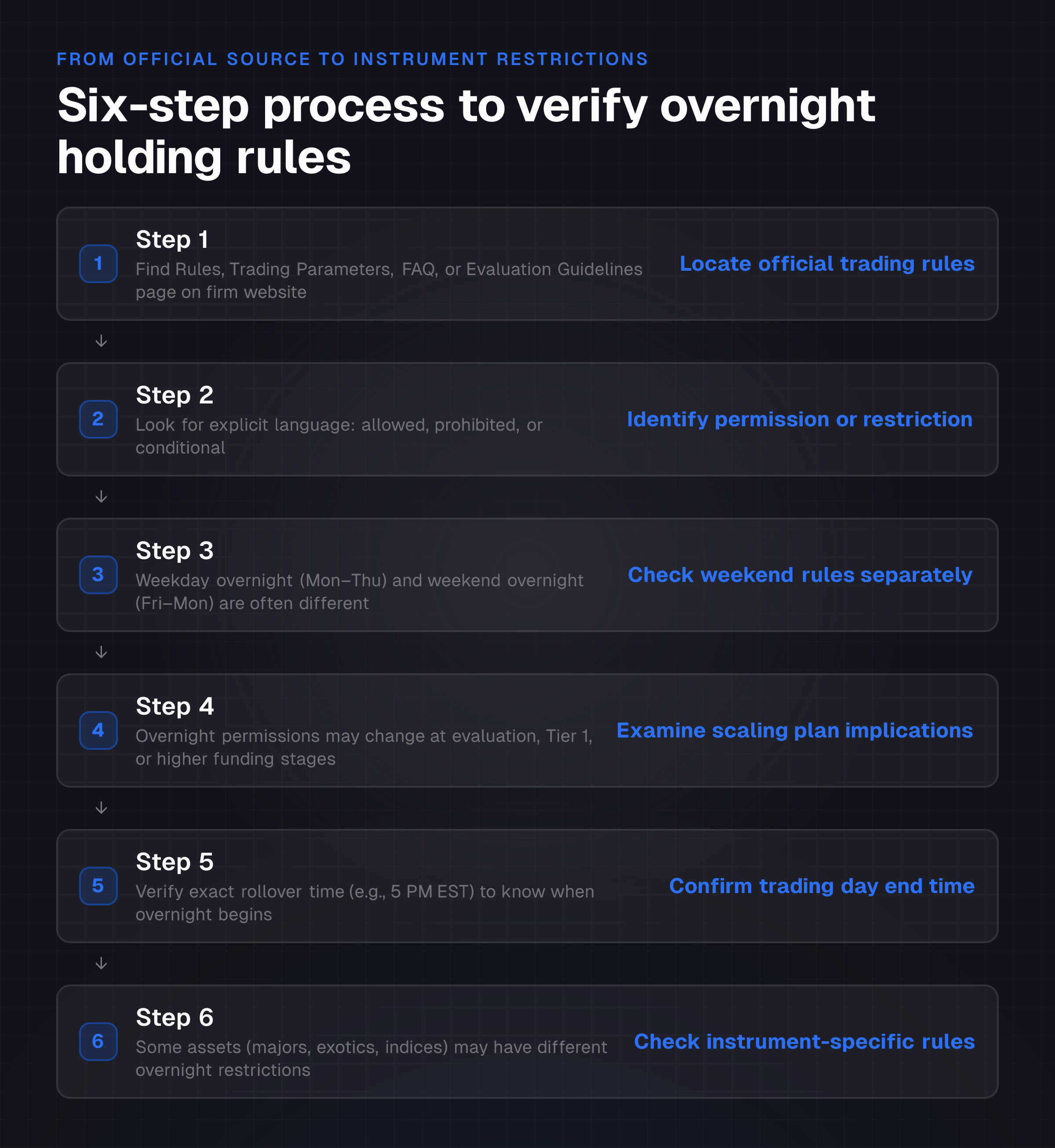
Step 1: Locate the firm's official trading rules
Navigate to the firm's website and find its Rules, Trading Parameters, FAQ, or Evaluation Guidelines section. This is the definitive source, not social media, forums, or community comments. Look specifically for headings like:
- Holding Positions Overnight
- Weekend Holding
- Trading Hours
- Position Management
- Overnight Restrictions
If the rules page doesn't have a search function, use your browser's find feature (Ctrl+F or Cmd+F) to search for "overnight," "weekend," or "hold."
Step 2: Identify explicit language on permission or restriction
Firms typically state one of three things:
- "Overnight holding is allowed" or "Positions may be held overnight", Permission is clear.
- "Overnight holding is prohibited" or "All positions must close by end of day", Prohibition is clear.
- Conditional statements, "Overnight holding is allowed in the funded stage" or "Only certain instruments can be held overnight."
If you find conditional language, note the exact condition. A firm allowing overnight holding "only after reaching funded stage" means you can't hold overnight during evaluation, even if you later qualify.
Step 3: Check weekend rules separately
Many firms differentiate between weekday overnight (Monday, Thursday) and weekend overnight (Friday, Monday). A firm might state:
- "Weekday overnight holding is permitted; weekend holding is prohibited."
- "No positions may be held from Friday 5 PM to Monday 9:30 AM."
- "Weekend holding is allowed with a 5% position size limit."
Don't assume weekday rules apply to weekends. Read the weekend language explicitly.
Step 4: Examine scaling plan implications
If the firm uses a scaling plan (phased funding based on performance), check whether overnight rules change at different stages:
- Evaluation stage: Often more restrictive; overnight holding prohibited or limited to specific pairs.
- First funded tier: Overnight holding may be permitted for major pairs only.
- Higher tiers: Restrictions may lift entirely, or conditions may change.
Review the firm's scaling documentation to see if overnight permissions shift as you advance.
Step 5: Confirm the trading day end/rollover time
"End of day" isn't universal. A firm might define trading day end as:
- 5:00 PM EST (common for forex and equities)
- 4:00 PM EST (some futures firms)
- Midnight UTC
- Daily settlement time (for futures indices, which may be hours after the market close)
A position open at 4:59 PM EST and closed at 5:01 PM EST might be classified as overnight if the firm's day ends at 5:00 PM EST, even though you held it for only 2 minutes. Clarify this definition in the rules or contact support if it's ambiguous.
Step 6: Check for instrument-specific rules
Some firms allow overnight holding for major currency pairs but prohibit it for exotics. Others restrict overnight holding on indices but permit it on forex. Scan the rules for language like:
- "Overnight holding allowed for majors only"
- "No overnight holding on [specific instrument]"
- "Weekend holding restricted to [asset class]"
If rules don't specify instruments, overnight permissions typically apply across all tradable assets.
Example or scenario: applying the verification process
Scenario: You're evaluating a firm's overnight rules before opening an account.
You visit the firm's website and navigate to Trading Rules. You find a section titled "Position Management" that states:
"Overnight holding is permitted in the funded stage. During the evaluation challenge, all positions must be closed by 5:00 PM EST. Weekend holding is prohibited at all stages."
You also find a scaling plan table showing three tiers. At Tier 1 (initial funding), it notes:
"Overnight holding: Major pairs only. Exotics and indices must close by end of day."
What you now know:
- You can't hold overnight during evaluation.
- Once funded (Tier 1), you can hold overnight on major pairs (EUR/USD, GBP/USD, etc.) but must close exotics and indices by 5:00 PM EST.
- You can't hold any position from Friday 5 PM to Monday 9:30 AM, regardless of stage.
- The firm's trading day ends at 5:00 PM EST, so any open position after 5:00 PM counts as overnight.
Decision: You can trade this firm if you're willing to close exotic positions daily and avoid Friday overnight positions. You can now open an account knowing the constraints and structure your trading plan accordingly.
Common mistakes or risks: what traders overlook
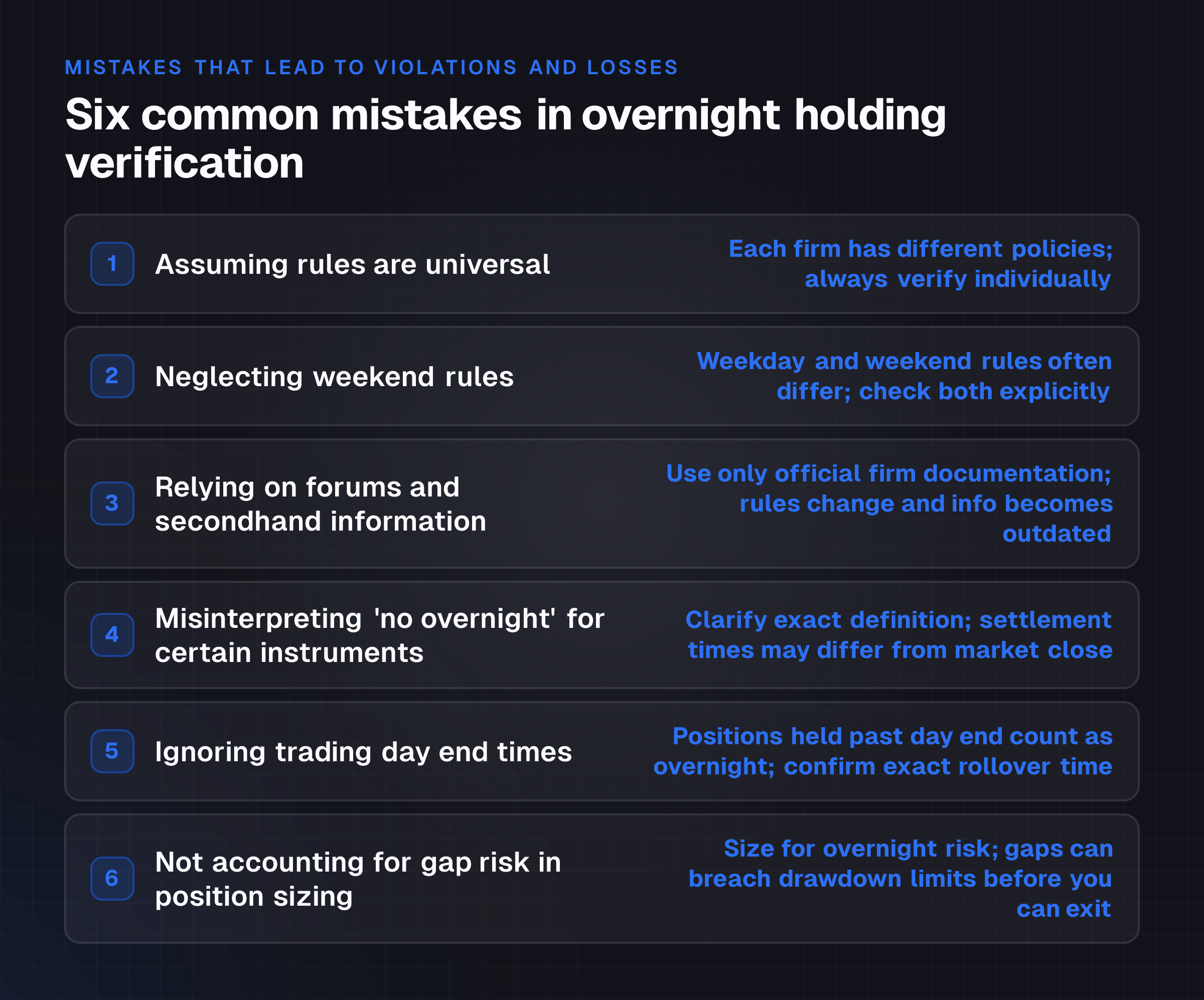
Mistake 1: Assuming rules are universal
Don't assume that if one firm allows overnight holding, all do. Policies vary significantly, even firms marketed as "similar" may have opposite rules. Always verify each firm individually.
Mistake 2: Neglecting weekend rules
Traders often focus on weekday overnight rules and overlook weekend restrictions. A firm allowing Monday, Thursday overnight holding might strictly prohibit Friday-to-Monday positions. Missing this has led to rule violations and account terminations.
Mistake 3: Relying on forums and secondhand information
Community discussions are helpful for general orientation, but they aren't official sources. Rules change, information becomes outdated, and users may misremember details. Always cross-reference forum advice with the firm's official documentation.
Mistake 4: Misinterpreting "no overnight holding" for certain instruments
Some firms state "no overnight holding on indices" but may allow positions until daily settlement time, which occurs hours after the primary market close but before the next day's open. Clarify the exact definition of "overnight" for each instrument.
Mistake 5: Ignoring trading day end times
A position held 10 minutes past the firm's stated day end counts as overnight. If you're used to trading until 5:00 PM EST and the firm's day ends at 4:00 PM EST, you'll inadvertently hold overnight positions. Confirm the rollover time and set alerts or hard stops before it.
Mistake 6: Not accounting for gap risk in position sizing
Even if overnight holding is allowed, overnight positions carry gap and news risk. A trade gapped against you can breach your drawdown limit before you can exit. Size appropriately for overnight risk, or avoid overnight holding altogether if your account is tight on drawdown room.
How to choose or what to do next: making the decision
Assess your trading style
- Intraday scalpers: Overnight restrictions may not affect you if you close all positions daily anyway.
- Swing traders and trend followers: You likely need overnight holding to capture multi-day moves. Seek firms that permit it at your intended account stage.
- News traders: Check the firm's news trading policy; many firms restrict trading during major economic releases, which may interact with overnight rules.
- EA traders: If you use automated strategies, verify whether the firm allows Expert Advisors and whether EAs can hold overnight.
Match the firm's rules to your needs
Identify which firms in your candidate list permit overnight holding at your intended stage (evaluation, funded tier). Note which instruments and pairs allow overnight holding. Do your strategies trade majors only, or do you need exotics or indices?
Verify weekend rules. If your strategy sometimes carries Friday positions, confirm weekend rules don't conflict. Test your strategy on a demo or micro account using the firm's actual day-end time and overnight constraints. This exposes conflicts before you commit capital.
Understand the broader account ecosystem
Overnight holding rules don't exist in isolation. They interact with:
- Drawdown limits: Tight drawdowns amplify the risk of overnight positions gapped against you.
- Position sizing rules: Some firms cap position size, which may force you to reduce overnight holdings.
- Scaling rules: Overnight permissions often unlock at higher funding tiers; ensure the scaling path suits your goals.
- Payout policies: Some firms may adjust payout percentages based on overnight holding activity or risk metrics.
For a full picture of account mechanics, see Live to Funded Account: What Actually Transfers? and Prop Firm vs Live Trading: Taxes & Account Ownership Rules.
Document your findings
Create a simple table comparing your candidate firms:
| Firm | Evaluation Overnight | Funded Overnight | Weekend Rule | Day End Time | Notes |
|---|---|---|---|---|---|
| Firm A | No | Yes (majors) | Prohibited | 5 PM EST | Exotics close daily |
| Firm B | Yes | Yes | Yes (limited size) | 4 PM EST | Highest flexibility |
| Firm C | No | No | No | 5 PM EST | Intraday only |
Use this table to eliminate firms that don't match your needs and prioritize those that do.
Frequently asked questions
What if a firm's rules don't explicitly state overnight holding policy?
Some firms don't use the term "overnight holding" directly. Look for language on "maximum position duration," "mandatory close times," or "end-of-day requirements." If rules are vague, contact support with a specific question: "Can I hold a position from 4 PM today to 9:30 AM tomorrow?" Request a written response to document the answer.
Does overnight holding mean I hold over the weekend too?
Not necessarily. Many firms separate weekday overnight (e.g., Monday close to Tuesday open) from weekend overnight (Friday close to Monday open). Always check rules for both. A firm may explicitly permit weekday overnight but forbid weekend holding, these are treated as different rules.
Can overnight rules change after I open an account?
Yes, firms can update their rules. The date of the last rule revision isn't always visible, so check periodically or enable alerts on the firm's Rules page. If you receive notification of a rule change that affects your strategy, review it carefully and adjust your plan accordingly.
What counts as "holding overnight" if the market doesn't trade 24/5?
For forex pairs that trade 24/5, holding from Friday 5 PM EST to Saturday (or Sunday through Monday open) still counts as overnight. For equities and most indices that close on Friday and reopen Monday, holding from Friday close to Monday open is "weekend holding" and usually restricted more heavily than weekday overnight. The firm's definition of "overnight" should specify whether it applies only to calendar day boundaries or also to market-closed windows.
If I'm in evaluation, can I still trade overnight if I keep my account small?
No. Overnight holding restrictions during evaluation typically apply regardless of position size. If the rules state "no overnight holding in evaluation," size doesn't exempt you. However, always confirm this with the firm, as some firms may allow overnight for positions below a certain notional value even in evaluation.
How do I know if a position I intended to close was classified as overnight?
Check your trade history and the firm's trading day end time. If you closed a position after the stated day end time (e.g., after 5 PM EST when the firm's day ends at 5 PM), it may be logged as overnight. Some firms provide a "position report" or "overnight holdings" summary. If uncertain, contact support with your trade tickets and ask for clarification on overnight classification.