Live to Funded Account: What Actually Transfers?
By Tomas Rieder

Moving from a personal live trading account to a funded account with a proprietary trading firm requires more than profitable history, it demands that you align your trading discipline, strategy, and risk management with stricter firm-set rules. Your personal account balance, broker relationship, and trading platform do not transfer. What does transfer: your strategy, risk discipline, emotional control, and market analysis skill. You must pass a separate evaluation challenge, paying a non-refundable fee, before receiving firm capital.
This guide walks you through what transfers, what doesn't, and the specific thresholds and rules at each step to move from your own capital to a firm's funded account.
Quick answer: what transfers from a live account to a funded account
Your trading strategy transfers. So does risk management discipline, emotional control, and trade execution skill. Your win rate, average trade size, and largest losing trade patterns inform your baseline but don't qualify you automatically.
Your account balance doesn't transfer. Neither does trading history, broker commissions, or platform settings. The funded account uses the firm's simulated capital and operates under stricter rules than most personal brokers allow, particularly on daily drawdown limits (commonly 4-5%) and maximum drawdown caps (commonly 8-10%).
A strategy profitable in your live account might fail a prop firm evaluation if it generates larger drawdowns, even if historically recoverable.
What you need first: baseline assessment before applying
Before you pay an evaluation fee, establish three concrete things.
Document your live trading performance
Pull your trading history from the past 3-6 months. Record:
- Win rate (percentage of winning trades)
- Average winning trade size
- Average losing trade size
- Largest single loss
- How often you experience daily losses
- How often you experience monthly losses
This self-assessment isn't a credential prop firms will accept. It tells you whether your strategy consistently produces profit under your current broker's conditions.
A profitable live account is a starting signal, not a guarantee of success in an evaluation. Maintain a detailed trade journal. Document entry reason, exit reason, position size, and outcome for every trade. This record helps you spot psychological patterns, revenge trading, oversize positions after losses, or inconsistent execution, before they fail an evaluation.
Understand typical prop firm evaluation structure
Prop firm evaluations are standardized assessments, not customized to your personal account. Most follow a two-phase model:
- Phase 1 (Challenge): Trade a simulated account under specific profit targets, drawdown limits, and daily trading rules. A non-refundable fee applies.
- Phase 2 (Verification): If you pass Phase 1, you trade a second simulated account to confirm consistent performance. Rules typically remain the same.
Each phase has explicit thresholds:
- Profit target: The minimum percentage gain you must achieve (commonly 8-10%)
- Daily drawdown limit: Maximum loss permitted from the starting balance or previous day's close within a single trading day (commonly 4-5%)
- Maximum drawdown limit: Maximum permissible loss from the highest equity point the account has reached (commonly 8-10%)
- Other rules: Minimum trading days, consistency thresholds, and restrictions on trading news events
Example: Funded Guru offers a two-phase structure with an 8% profit target, an 8% daily drawdown limit, and a 10% maximum drawdown limit across their challenge packages.
Compare your performance metrics to typical thresholds
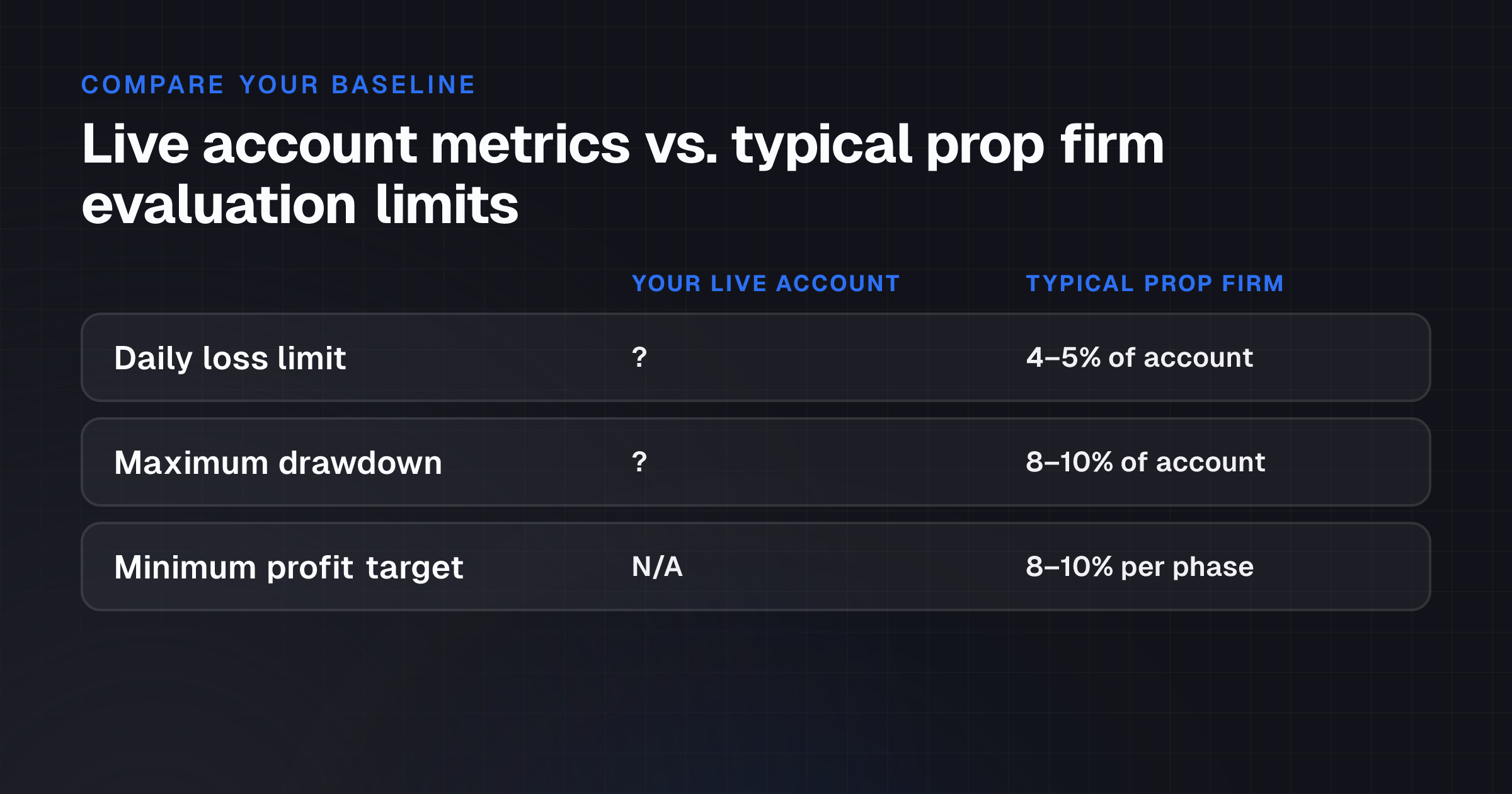
Pull your personal metrics. Compare them against industry-standard prop firm limits:
| Metric | Your Live Account | Typical Prop Firm |
|---|---|---|
| Daily loss limit | ? | 4-5% of account |
| Maximum drawdown | ? | 8-10% of account |
| Minimum profit target | N/A | 8-10% per phase |
If your personal daily losses regularly exceed 4-5%, or your drawdowns exceed 8-10%, your current risk management is misaligned with prop firm rules. This doesn't mean your strategy is unprofitable. It means your position sizing or stop-loss placement is too loose for the evaluation environment.
Step-by-step: moving from live account to funded account
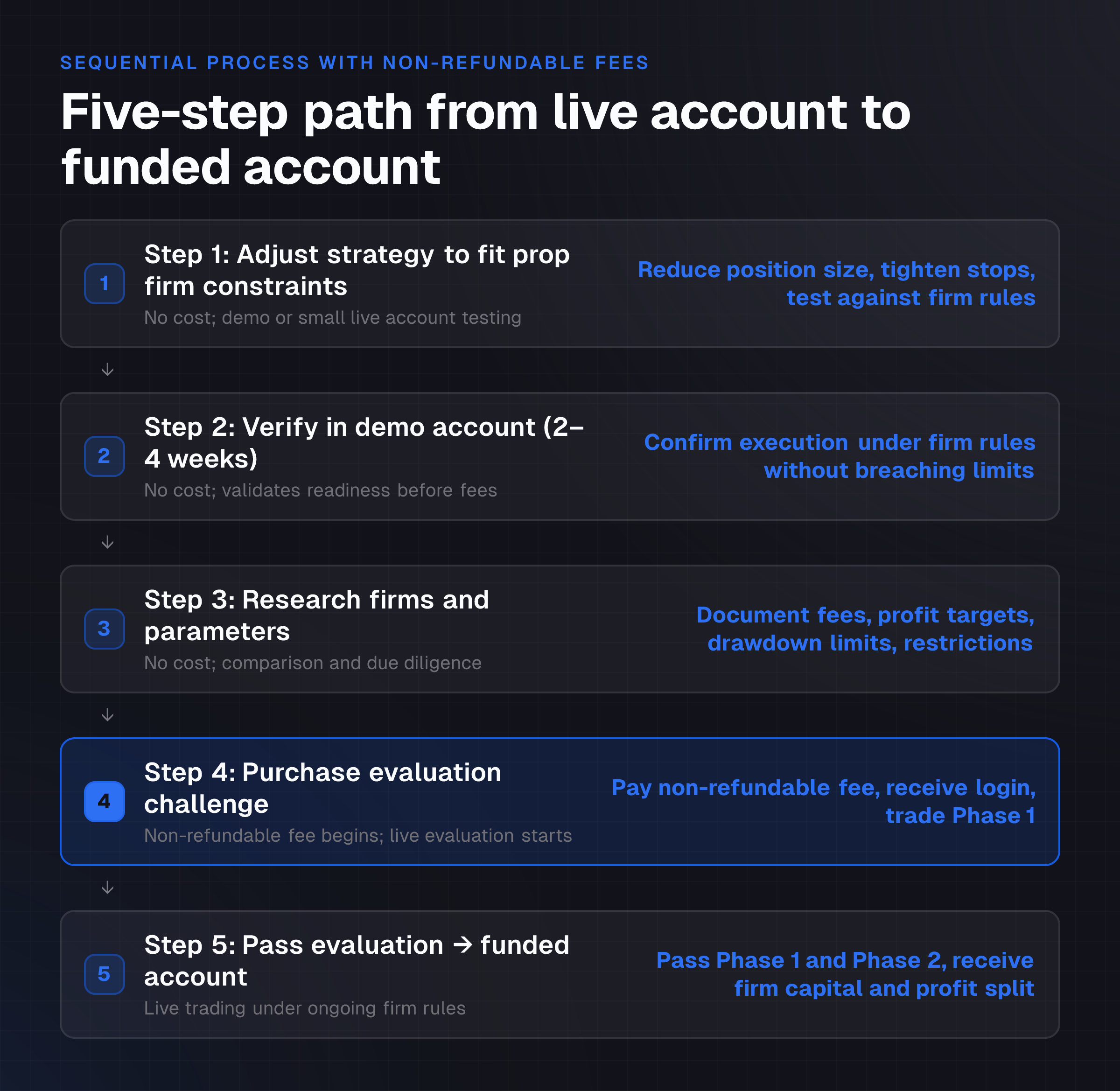
Step 1: Adjust your strategy to fit prop firm constraints
Your strategy itself transfers, but your execution parameters must tighten. Prop firms constrain daily and maximum drawdown harder than most personal brokers.
Reduce position size. If your live account trades 2% risk per trade, test 1% in a demo or small live account first. Tighten stop-losses. Larger stops increase drawdown faster. Backtest your strategy with stricter stops to confirm profitability.
Identify which rules will impact you most. If the firm restricts news trading, remove news-driven entries from your plan. If they ban overnight holding, adjust your strategy for day-only execution.
Write down the three most restrictive prop firm rules. Test each one against your historical trades. Would you have passed the evaluation under those rules?
Step 2: Verify your strategy works under firm rules in a demo account
Open a demo or paper trading account with a firm that supports TradeLocker or another supported platform. Set your demo account balance equal to the lowest-cost evaluation package you're considering.
Trade your adjusted strategy for 2-4 weeks. Track every trade. The goal isn't to reach the profit target yet; the goal is to confirm you can execute your strategy without triggering daily or maximum drawdown limits.
Step 3: Research firm evaluation parameters and fees
Visit the prop firm directory and identify 3-5 firms that match your capital need and strategy type.
Record for each firm:
- Evaluation fee (non-refundable)
- Challenge structure (one phase or two)
- Profit target percentage
- Daily drawdown limit
- Maximum drawdown limit
- Profit split or payout method after you pass
- Minimum trading days required
- Restrictions (news trading, overnight holding, platform constraints)
Don't assume all firms have identical rules. Prop Firm vs Live Trading: Taxes & Account Ownership Rules covers what happens after you pass; understand both the evaluation and the long-term mechanics before paying.
Step 4: Purchase and begin the evaluation challenge
Select one firm and one challenge package. Pay the non-refundable evaluation fee. You'll receive login credentials and a simulated account with the firm's capital.
Trade your adjusted strategy against the firm's rules for the duration of the challenge (typically 1-2 months). Don't deviate from your plan. Don't increase position size if you're winning. Don't over-trade to chase losses mid-week.
Track drawdown carefully. Many firms calculate daily and maximum drawdown differently, some measure from initial balance, others from highest equity, others from closed trades only. Confirm the firm's methodology before you trade.
Step 5: Pass the evaluation and move to the funded account
Upon reaching the profit target without violating daily or maximum drawdown limits, you pass Phase 1. You'll be offered Phase 2 (verification). Repeat your strategy under the same or similar rules.
Upon passing Phase 2, you receive a funded account with the firm's capital.
You then trade live under the firm's ongoing rules, subject to profit splits, ongoing drawdown limits, and payout conditions specific to that firm. Understand the profit split vs 100% of your own money trade-off before you accept a funded account.
Worked example: assessing readiness and adjusting strategy
Assume you've traded a live account for 4 months with these results:
- Average trade size: 1.5% risk per trade
- Win rate: 52%
- Largest losing trade: 3% loss
- Largest drawdown (peak to trough): 12%
- Average monthly profit: 6% of account
- Monthly drawdown range: 8% to 14%
You want to apply for a prop firm challenge with an 8% profit target, 8% daily drawdown limit, and 10% maximum drawdown limit.
Assessment:
Your monthly profits (6% average) meet the target. But your maximum drawdown (12% in one month) exceeds the 10% firm limit. Your largest single loss (3%) is within 1-2 trades of the 8% daily drawdown limit, leaving little margin for error in a single day.
Adjustment:
Reduce position size from 1.5% to 1% risk per trade. Backtest to confirm you remain profitable at this size. Tighten your stop-loss by 0.5%. If you currently lose 3% on a losing trade, target 2.5%. Simulate one month of trading at the new parameters in a demo account. Track the new drawdown profile.
After adjustment, your hypothetical drawdown range becomes 5% to 8% monthly, and your monthly profit drops to 4-5%. You now fit within the firm's constraints.
Your evaluation fee is non-refundable, so this demo validation step is critical.
Common mistakes: why traders fail evaluations
Over-reliance on past live account performance
A 6-month profitable history doesn't guarantee evaluation success. Your live account's rules, margin, leverage, commissions, drawdown tolerance, aren't the firm's rules. Traders often enter evaluations assuming their strategy will perform identically. It won't. The tighter constraints force adjustment, and many traders don't plan for this.
Ignoring drawdown calculation differences
Different firms calculate daily and maximum drawdown in different ways. Some measure from the account's opening balance. Others measure from the highest equity point reached. Some exclude intra-day swings and count only closed trades.
If you don't confirm the firm's methodology, you may violate the limit without realizing it until the evaluation ends.
Position sizing too aggressive
The single most common cause of failure is oversize positions. A trader might profitably run 2% risk per trade in a personal account but fail a prop firm challenge because 2% against an 8% daily limit leaves only four losing trades before disqualification. Tighter constraints demand smaller positions.
Chasing losses mid-week
Once you enter an evaluation, psychological pressure intensifies. If you hit a 5% daily loss early in the week, the temptation to over-trade or increase position size to recover is acute. This behavior, identified by trading analytics as a common failure point, typically triggers the maximum drawdown limit by week's end.
Neglecting consistency rules
Many firms require minimum trading days or consistent performance across phases. A trader who achieves the profit target in 2 weeks but trades only 3 days might still fail because the firm requires 15+ trading days.
Read the rules completely. Consistency rules are separate from profit and drawdown rules.
Misunderstanding overnight holding or news restrictions
If a firm bans overnight holding and your strategy relies on multi-day swing trades, you'll fail immediately. If a firm restricts news trading and your largest edge occurs during economic releases, you can't use it. Test your strategy against these specific constraints in a demo account before paying.
Frequently asked questions
Does my personal trading account history give me any advantage in an evaluation?
Your personal history shows the firm you've traded live capital, and your track record informs your own confidence. The firm, however, doesn't use your personal history to customize your evaluation.
All traders in the same challenge package face identical profit targets, drawdown limits, and rules, regardless of prior experience. What matters is whether you pass the evaluation under the firm's specific constraints, not your personal performance before it.
What happens if I fail the evaluation?
The evaluation fee is non-refundable. You don't receive a funded account, and you don't advance to Phase 2.
You may attempt another evaluation with the same firm or a different firm by paying a new non-refundable fee. Some traders fail, adjust their strategy, and pass on a second or third attempt. Others find their strategy incompatible with prop firm constraints and move to a different trading approach.
Can I use the same trading platform in an evaluation as I use in my personal account?
It depends on the firm. Most prop firms use standardized platforms like TradeLocker or TradingView for evaluations. Your personal broker's platform typically isn't available. You must adapt to the firm's platform during the challenge.
If you trade Expert Advisors or copy trading automation, confirm the firm's policy; many firms that allow expert advisors restrict or prohibit these tools.
How long does an evaluation typically take?
Most evaluations consist of two phases, each lasting 1-2 months. The timeline depends on how quickly you hit the profit target without violating drawdown limits.
Some traders pass in 4 weeks. Others take 6-8 weeks. There's no fixed end date; you progress upon meeting the criteria.
What is the typical profit split after I pass the evaluation?
After you pass and receive a funded account, the firm takes a percentage of your profits (commonly 30-50%, depending on the firm and your tier). You receive the remainder.
Some firms offer increased splits or full profit access at higher capital allocations. Review verified prop firm payouts and the specific firm's terms before accepting a funded account. Profit splits vary significantly across firms.
Do I need to pass with a specific trading strategy, or can I use any profitable approach?
Any profitable approach works, as long as it fits within the firm's rules. Scalping, swing trading, range trading, and trend-following strategies all succeed in evaluations, provided they respect drawdown and daily loss limits.
The constraint isn't strategy type; it's risk management discipline. If your strategy generates large, irregular drawdowns, it'll fail regardless of average profitability.