Overnight Holding: What Breaches an Account

Holding a trading position overnight in a proprietary trading firm carries specific risks, particularly account breaches triggered by overnight price gaps. Whether your account gets suspended depends on three overlapping factors: your firm's explicit overnight policy, the drawdown limits in your trading agreement, and how market volatility between close and open affects your position. This guide walks you through the decision process step by step, showing you where breaches occur and how to assess the risk before you hold.
Quick answer: overnight holding and account breach risk
Overnight holding is permitted at some prop firms but not others. When it is allowed, account breaches happen most often because overnight price gaps, especially around news events or market closures, trigger your firm's daily or trailing drawdown limits.
A position that gaps against you by 6% overnight will breach a 5% daily drawdown limit immediately upon market open, even if your stop-loss order can't execute at the desired price. The breach occurs not because overnight holding itself is forbidden, but because the loss exceeds the threshold your account agreement sets.
What you need first: firm policy and account agreement
Before you decide to hold overnight, verify three core documents:
Firm overnight holding policy: Check whether your prop firm explicitly allows overnight holding. This is stated in the firm's FAQ, trading rules, or terms and conditions. Some firms prohibit overnight positions entirely; others allow them with conditions.
Your account agreement: Locate the sections covering drawdown limits. You need to know the maximum daily drawdown, the largest peak-to-trough loss permitted from the starting equity of the day or the highest point reached during the day. Also identify maximum trailing drawdown (the largest loss allowed from the highest equity your account has ever reached since inception or a reset point) and absolute drawdown (the maximum permissible loss from your initial capital).
Economic calendar and upcoming events: Identify significant announcements, non-farm payrolls, central bank rate decisions, earnings releases, geopolitical news, occurring outside regular trading hours. Research by the Financial Conduct Authority (FCA) and other regulators highlights that volatility concentrates at market open as news accumulated during closure gets priced in, often creating gaps that bypass stop-loss orders entirely.
Once you have these documents, you can model the risk of holding.
Step-by-step: assessing overnight holding risk
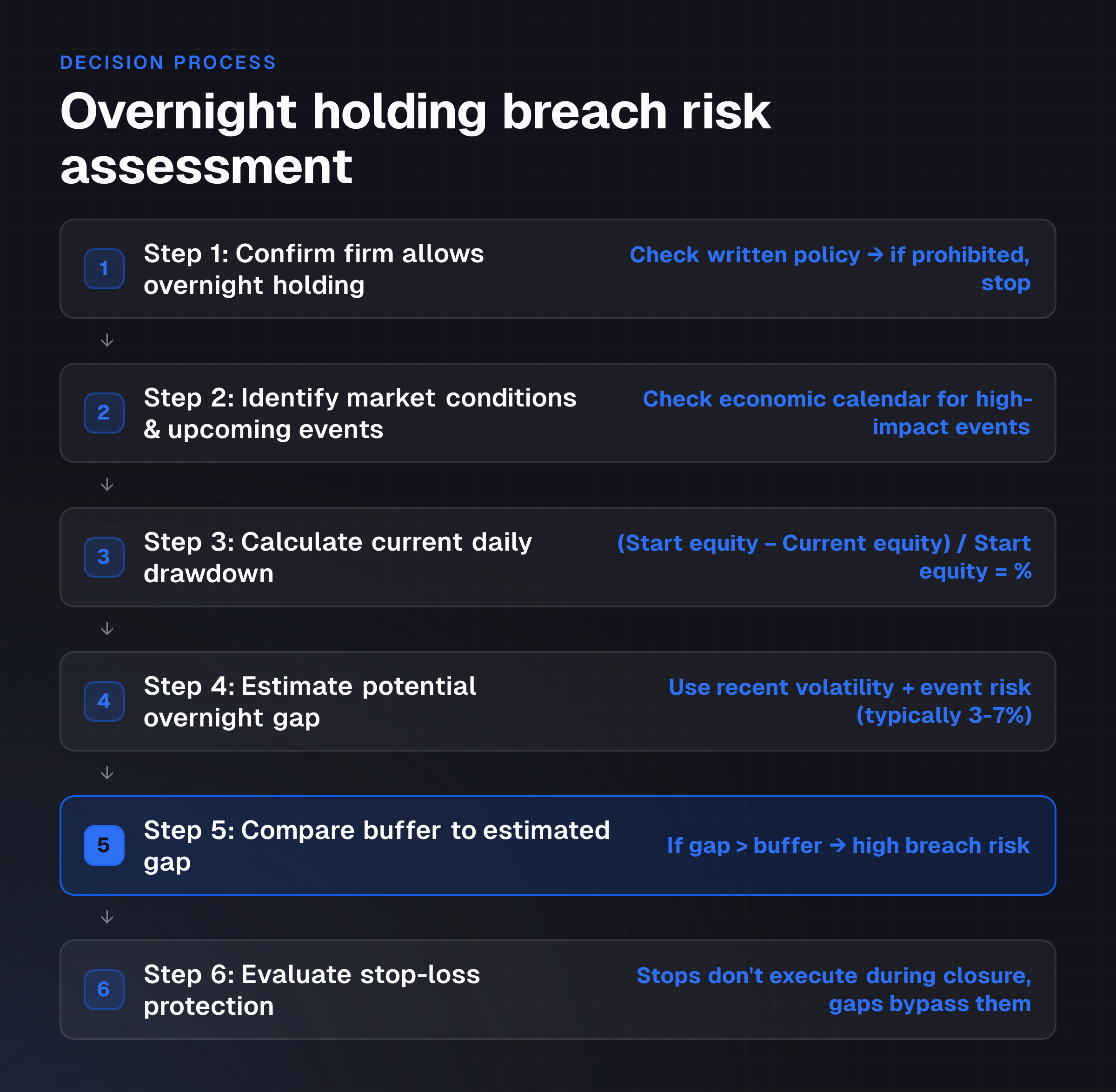
Step 1: Confirm your firm allows overnight holding
Not all prop firms permit positions to remain open after market close.
Publicly available firm rules clearly outline differing policies regarding overnight and weekend holding. Your firm's rules must explicitly state that overnight holding is permitted. If the rules are silent or prohibit overnight positions, stop here, holding violates your agreement and will trigger an immediate breach.
Step 2: Identify the market conditions and upcoming events
Overnight gaps occur when significant price movements happen between market close and open.
Your risk multiplies if you hold through major economic data releases (non-farm payrolls, interest rate decisions), corporate earnings announcements, geopolitical events or central bank statements, or weekend closures where positions held Friday through Monday face an extended closure window.
Consult an economic calendar for the next 24-48 hours. If a high-impact event occurs while markets are closed, your overnight risk is elevated.
Step 3: Calculate your current drawdown against your daily limit
This step is critical because it determines how much downside your account can absorb.
The formula: (Starting Daily Equity − Current Equity) / Starting Daily Equity = Current Daily Drawdown %
Example calculation: If your account started the day at $10,000 and is now at $9,600, your current daily drawdown is 4%.
Your prop firm's agreement specifies a maximum daily drawdown (often 5-10%). Subtract your current drawdown from this limit to find your remaining buffer. If your maximum daily drawdown is 5% and you're already down 2%, you have only a 3% buffer before a breach.
Step 4: Estimate potential overnight price movement
Estimate the worst-case overnight gap against your position. Academic research (such as "Intraday and Overnight Volatility" by Andersen and Bollerslev, 2000) demonstrates that volatility concentrates at market open due to overnight news accumulation.
Use recent volatility data for your instrument. If your position typically experiences 1-3% intraday moves, an overnight gap could easily be 3-5% or more, especially around news events or weekends. A position in a volatile pair could gap 5-7% against you over a weekend.
Step 5: Compare buffer to estimated gap
This is where the breach decision becomes clear.
If estimated overnight gap exceeds remaining daily drawdown buffer, holding overnight risks a breach.
Example: Your account has a 5% daily drawdown limit. You're currently down 2%, leaving a 3% buffer. You're holding a position in a volatile instrument ahead of a central bank announcement, and you estimate a 4% overnight gap is possible. Since 4% exceeds your 3% buffer, holding overnight carries a high breach risk. If the gap moves against you, your account will be suspended when markets open.
Step 6: Evaluate your stop-loss order
Stop-loss orders don't protect you from overnight gaps. If the market opens 5% against your position, your stop-loss order will execute, if at all, at the market-open price, not your intended price.
The loss will be larger than you expected. Accept that a stop-loss placed at, say, 2% below entry won't limit your loss to 2% if a 5% overnight gap occurs. Plan for slippage.
Step 7: Adjust position size or close the position
You have two actions:
Reduce position size: Smaller positions mean smaller overnight losses. If your current position is sized for intraday holding, reduce it by 50% or more for overnight exposure.
Close the position: If the estimated gap risk exceeds your buffer, close the trade before market close and eliminate the overnight risk entirely.
Worked example: weekend holding and a 6% gap
A trader holds a USD/JPY position sized at 10 micro lots ($100,000 notional) in a prop firm account with starting daily equity of $10,000, current daily equity of $9,700 (already down 3%), maximum daily drawdown limit of 5%, and remaining buffer of 2%.
On Friday afternoon, a geopolitical event is announced for the weekend. The trader estimates USD/JPY could gap 6% against their position on Monday open. They check the firm's policy: overnight holding is allowed.
Decision process: Remaining buffer is 2%, estimated gap is 6%, gap exceeds buffer. Outcome, holding overnight carries a 6% potential loss against a 2% remaining buffer. If the gap materializes, the account will breach by 4% on Monday open.
Action: Close the position Friday before close. The trader avoids the breach and re-enters the trade when conditions stabilize.
If the trader had reduced position size to 2 micro lots (50% of original), the potential 6% gap would generate only a 3% loss, still exceeding the 2% buffer but offering a smaller margin of risk. Many experienced traders choosing overnight holds reduce size by 50-75% to account for gap risk.
Common mistakes: where overnight holdings fail
Assuming all firms have the same overnight rules
Different prop firms have different policies. Some prohibit overnight holding entirely. Others allow it but impose strict daily or trailing drawdown limits.
Assuming your firm allows overnight holding without verifying the written policy is a critical error that leads to immediate breaches.
Ignoring firm-specific drawdown calculations
Firms define drawdown in different ways. Some calculate daily drawdown from the start of the day; others reset it after daily profit targets are hit. Without reading your exact agreement, you may misjudge your buffer.
Underestimating gap risk
A 2-3% intraday move doesn't mean overnight gaps are confined to that range.
Price gaps around news events, weekends, or market closures often exceed intraday volatility by 2-3×. Failing to account for this leads to positions that breach immediately on market open.
Over-leveraging overnight positions
Applying the same leverage or position sizing for intraday trades to overnight positions magnifies losses from gaps. A position sized for a 1% intraday stop-loss will produce a 6% overnight loss if a gap occurs, well beyond your drawdown buffer.
Relying on stop-loss orders for overnight protection
Stop-loss orders don't execute during market closure. They trigger on market open at whatever the market price is at that moment. If the market gaps past your stop, the loss is much larger, and your account may already be breached before the order executes.
Holding through high-volatility events without adjustment
Holding overnight through scheduled high-impact events, economic releases, earnings, central bank decisions, without reducing position size or reassessing your buffer is a primary cause of unexpected breaches.
Frequently asked questions
What is the difference between daily, trailing, and absolute drawdown?
Daily drawdown is the maximum loss from the start of the trading day (or from the day's highest point). It resets each day.
Trailing drawdown is the maximum loss from the highest equity your account has ever reached, it never resets during your trading period. Absolute drawdown is the maximum loss from your initial capital. A breach in any of these triggers account suspension. Overnight gaps can breach all three if large enough.
Can a stop-loss order protect me from an overnight gap?
No. Stop-loss orders don't execute during market closure. If markets are closed and price gaps past your stop level, the order will fill on market open at the gapped price, often significantly worse than your intended stop price. Many traders use overnight position size reduction instead of relying on stops.
If my firm allows overnight holding, am I guaranteed not to be breached?
No. Permission to hold overnight doesn't mean the firm guarantees protection from losses.
Your account can still be breached if overnight price movements exceed your drawdown limits. The firm simply allows the practice; the risk of breach remains entirely on you.
Should I hold positions over weekends?
Weekend holding extends market closure to 60+ hours, dramatically increasing the window for geopolitical or economic events to move price. Gap risk is significantly higher. Most traders who hold overnight avoid holding through weekends unless they've explicitly reduced position size and fully accept the extended closure risk.
How do I find my firm's exact drawdown limits?
Your drawdown limits are in your trading account agreement or terms and conditions. Check the firm's website, your account dashboard, or contact support. Public prop firm rules often outline these limits; you can also review the Prop Firm Overnight holding Rules: A Trader's Checklist for firm-specific policies.
What position size is safe for overnight holding?
There's no universal "safe" size. It depends on your buffer (remaining daily drawdown), the estimated overnight gap risk, and your instrument's volatility. Many experienced traders reduce overnight position size to 25-50% of their intraday size to account for higher gap risk. Model your specific scenario: if your buffer is 3% and potential gap is 5%, you need to reduce size or close the trade.