Prop Firm KYC for Indian Traders: Documents and Steps

You've passed your challenge and you're ready to get paid. But first: identity verification.
For Indian traders, KYC processes aren't optional extras, they're the gateway between hitting your profit target and actually seeing that money in your account. This guide breaks down each verification stage, from sign-up through withdrawal, so you know exactly what documents to prepare and what timeline to expect.
KYC and verification stop financial crime. Money laundering, terrorist financing, fraud: these are the threats that global AML frameworks address. The Reserve Bank of India enforces KYC norms for banks and financial institutions domestically, and when you trade with a prop firm, their payment processors answer to the same regulatory obligations no matter where the company is registered.
Quick answer: What KYC documents you'll need as an Indian trader
Verification usually kicks in when you request your first payout. You'll need a government-issued ID, Aadhaar, PAN, Passport, or Driver's License. Proof of address dated within 3-6 months: a utility bill, bank statement, or rental agreement. For larger withdrawals, firms may ask for documentation showing where your funds originated.
Processing takes 24 hours to several business days. If a firm promises "no KYC" or instant payouts without identity checks, that's a red flag for an unregulated or outright fraudulent operation.
What you need first: Documents and payment method setup
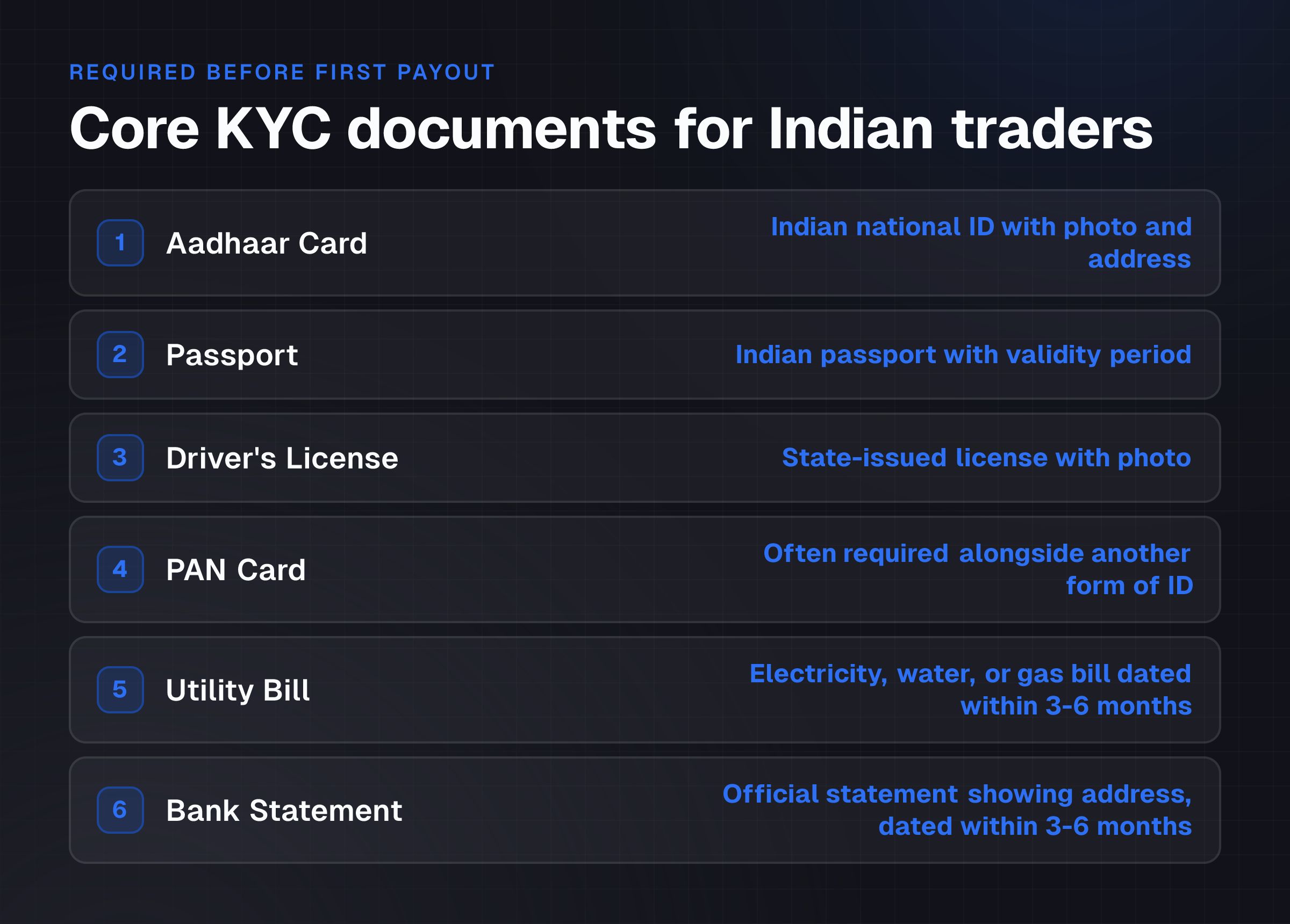
Get your core verification documents ready before you trade. Firms won't ask for them on day one, but having them on hand prevents payout delays later.
Proof of Identity (PoI)
One valid government-issued document from this list:
- Aadhaar Card, Indian national ID with photo and address
- Passport, Indian passport with validity period
- Driver's License, State-issued license with photo
- PAN Card, Permanent Account Number card (some firms require this alongside another form of ID)
The specific combination accepted varies by firm or payment processor. Your chosen ID must be current and clearly legible.
Proof of Address (PoA)
One document dated within the last 3-6 months that confirms your residential address:
- Utility bill, Electricity, water, or gas bill in your name
- Bank statement, Official statement showing your address
- Rental agreement, Registered and currently valid lease or tenancy agreement
Your address on all submitted documents must match exactly. Mismatches between your ID and proof of address are the most common reason for verification delays.
Payment method setup
Identify which payout method you plan to use. Common methods supported by firms that accept Indian traders include:
- Crypto, Direct withdrawal to a cryptocurrency wallet
- Bank Transfer, Direct transfer to your Indian bank account
- E-Wallets, PayPal, Skrill, Revolut, or similar services
- Local Payments, IMPS, UPI-connected services, or region-specific payment solutions (GCash, GrabPay, PromptPay, where available)
Your payout method must also be verified, which typically means the account holder name matches your verified ID. Have your account details ready before initiating withdrawal.
Step-by-step: KYC verification process
Follow these steps in order when you're ready to request a payout.
Step 1: Request withdrawal or payout
When you've completed your trading challenge and want to access your profits, initiate a withdrawal through your trading account dashboard or contact support. This action triggers the KYC verification process.
Most firms activate full KYC only when a payout is requested, not before.
Step 2: Submit Proof of Identity (PoI)
Upload a clear, legible scan or photo of your government-issued ID. Ensure all text is readable, no glare, blur, or shadow. The document must be current (not expired). Both front and back are required if the firm specifies.
You'll typically receive a response within 24-48 hours.
Step 3: Submit Proof of Address (PoA)
Upload documentation confirming your residential address. The document must be dated within the last 3-6 months (check your firm's specific requirement), clearly show your full name and current address, and match the name and address on your PoI exactly.
Address mismatches are common. "John Smith" on ID versus "J. Smith" on utility bill causes rejections. Ensure consistency.
Step 4: Wait for basic KYC approval
The firm's compliance team reviews your PoI and PoA. Standard KYC approval usually completes within 2-5 business days, depending on the firm's volume and your document quality.
Step 5: Assess for Enhanced Due Diligence (EDD)
If your withdrawal amount is large or your transaction pattern raises flags, the firm may request additional documentation. This is called Enhanced Due Diligence (EDD).
The threshold for EDD is at the firm's discretion and based on transaction size, frequency, and risk assessment. No universal fixed amount applies across all firms.
Step 6: Submit Source of Funds (SoF) documentation (if required)
If EDD is triggered, you may need to provide documentation showing where your funds came from. Accepted documents typically include:
- Bank statements, 3-6 months of statements showing the origin of deposits
- Salary slips or employment contracts, Proof of employment income
- Tax returns, Recent income tax filing (ITR for Indian traders)
- Documentation for large transactions, Inheritance certificates, property sale deeds, or loan agreements
Respond promptly to any EDD requests. Delays at this stage can hold up payouts indefinitely.
Step 7: Confirm payout method and final verification
Once KYC is approved, confirm or link your chosen payout method. The account holder name on your payout method must match your verified ID.
Common methods for Indian traders:
| Method | Timeline | Notes |
|---|---|---|
| Crypto | Varies | Depends on blockchain network; typically 15-60 minutes |
| Bank Transfer | 1-3 business days | Direct to Indian bank account via SWIFT or local rails |
| E-Wallet | 24-48 hours | PayPal, Skrill, Revolut processing times vary |
| Local Payments | 24 hours | IMPS or UPI-connected solutions where available |
Step 8: Receive approval and process withdrawal
Once all verification stages are complete and your payout method is confirmed, the firm processes your withdrawal. Processing and arrival times depend on your chosen method.
Expected payout timeline: 24 hours to 5 business days from final approval.
Worked example: A typical verification timeline for an Indian trader
Ravi completes a $100,000 trading challenge with a prop firm and requests a $25,000 payout via bank transfer.
Day 1 (Monday): Ravi initiates withdrawal request at 2 PM. Compliance team receives the request and sends an automated email asking for PoI and PoA.
Day 2 (Tuesday): By 10 AM, Ravi uploads clear scans of both sides of his Aadhaar Card (PoI) and a utility bill dated three weeks prior showing his current address (PoA). Compliance reviews the documents by 4 PM. Both are clear and match. Basic KYC is approved.
Day 3 (Wednesday): Ravi receives approval email. He confirms his bank account details. The firm runs a final check: his account holder name matches his Aadhaar. No EDD is triggered because $25,000 falls within standard processing and his account has no red flags.
Day 4 (Thursday): The firm initiates bank transfer. Ravi's bank receives the SWIFT transfer and processes it.
Day 5 (Friday): Funds appear in Ravi's account.
Total time from request to receipt: 4 calendar days.
If EDD had been triggered, say Ravi requested $150,000 instead, compliance might have asked for 3 months of bank statements and an ITR to verify the source of his trading capital. That additional documentation would add 2-3 business days to the process.
Common mistakes to avoid
Incomplete or inconsistent documentation is the primary cause of verification delays and rejections.
Mistake 1: Waiting to gather documents until payout time
You request withdrawal but don't have scans or photos of your documents ready. This forces you to find and prepare them during processing, adding 1-2 days to the timeline.
Gather and scan your documents before you start trading. Store them in a secure folder so they're ready when needed.
Mistake 2: Mismatched information across documents
Your Aadhaar shows "Rajesh Kumar" but your utility bill shows "R. Kumar." Compliance rejects the submission as inconsistent.
Ensure your full name and address are identical on all submitted documents. If your documents use different name formats, contact the issuing authority to obtain a corrected version or provide an explanation letter.
Mistake 3: Submitting expired or outdated documents
You upload an ID that expired two months ago or a utility bill dated eight months prior. The firm rejects it as outside the acceptable recency window (typically 3-6 months).
Check expiry dates and document dates before uploading. Renew expired IDs if needed. For proof of address, use the most recent utility bill or bank statement available.
Mistake 4: Poor document quality
Your photo of your Aadhaar is blurry, has glare, or only shows one side. Compliance cannot verify the document and requests a resubmission.
Take clear photos in good lighting. Ensure all text is legible and both sides of the ID are visible. Use a scanner if possible; phone photos work but must be high quality.
Mistake 5: Choosing a payout method you can't verify
You list a bank account as your payout method, but the account holder name doesn't match your verified ID. Compliance flags this and delays the payout.
Use a payout method registered in your verified name. If you have multiple accounts, confirm which one matches your ID before submission.
Mistake 6: Ignoring or delaying EDD requests
Compliance requests Source of Funds documentation, but you don't respond for a week. Your payout gets stuck in a holding pattern.
Respond to any KYC or EDD requests within 24-48 hours. Set a phone reminder if needed. Compliance teams often have strict timelines; delayed responses can result in account suspension.
Frequently asked questions
Why do prop firms require KYC at all?
KYC is a regulatory requirement enforced by global anti-money laundering (AML) and anti-terrorist financing (CTF) frameworks. Even offshore prop firms must comply because their payment processors, banks, crypto exchanges, e-wallet providers, are regulated and must verify the identity of anyone withdrawing funds.
The Reserve Bank of India enforces similar standards for domestic financial institutions, setting a precedent for financial due diligence. Firms that skip KYC are operating illegally and pose a high risk to your funds.
How long does KYC verification typically take?
Basic KYC (PoI and PoA) usually takes 24 hours to 5 business days. Enhanced Due Diligence (EDD), if triggered, can add another 2-5 business days.
The exact timeline depends on document quality, completeness, and the firm's compliance team workload. Submitting clear, consistent documents the first time minimizes delays.
What if my documents don't match exactly?
Mismatches, such as different name spellings or address formats, are the most common cause of rejection. Contact your document issuer (bank, municipality, etc.) to request corrected versions that match your ID exactly.
Alternatively, provide a brief explanation letter and supporting evidence (e.g., a name-change certificate). Most firms will accept a clarification if it resolves the inconsistency.
Can I use documents in my spouse's name or a joint account?
No. KYC documents must be in your name as the account holder. Payout methods (bank accounts, e-wallets) must also match your verified identity.
Using someone else's documents or account violates KYC regulations and can result in account suspension or closure.
What if I'm in India and the firm accepts Indian traders?
Prop firms that accept traders from India still require full KYC, they must comply with the same global AML frameworks as any other firm. Your documents must be consistent, current, and verifiable.
Having a firm that explicitly accepts Indian traders simplifies the process because their payment infrastructure is often optimized for local methods (bank transfers, IMPS, e-wallets) that you're familiar with.
What happens if I don't complete KYC?
If you don't respond to KYC requests or submit incomplete documentation, your account may be suspended or permanently closed. Your funds could be frozen or, in extreme cases, forfeited.
Always respond promptly to verification requests and submit clear, complete documents the first time.
KYC is mandatory and non-negotiable; it protects against financial crime and is enforced globally. Gather Proof of Identity, Proof of Address, and payment method details before you trade, don't wait until withdrawal time. Ensure all documents are current, consistent, and legible; mismatches cause delays. Respond quickly to any Enhanced Due Diligence requests; delays risk account suspension.
If a firm promises "no KYC," it's a red flag for an unregulated or fraudulent operation.
For a complete list of verified firms that accept Indian traders, see Prop firms that accept traders from India. For payout details and firm comparisons, check Verified prop firm payouts.