How to check a prop firm accepts traders from India
By Tomas Rieder

Confirming whether a proprietary trading firm accepts traders from India requires a methodical check across multiple firm touchpoints. Geographic acceptance isn't always stated directly, it's often buried in terms pages, revealed during account setup, or confirmed only through customer support. This guide walks you through the verification process step-by-step so you can confirm eligibility before paying a challenge fee or investing time in an application.
Key takeaways: confirming India eligibility
- Check the firm's restricted countries list first; absence of India is a promising sign but not definitive proof.
- Test the account registration dropdown to see if India appears as a residence option, this is a strong indicator of acceptance.
- Contact support directly with an explicit question and retain the response in writing.
- Verify that the firm's payment processors can handle deposits and withdrawals to and from Indian banks.
- Cross-reference official information with trader experiences on forums, treating community reports as anecdotal evidence only.
What it means: geographic restrictions and compliance requirements
Proprietary trading firms impose geographic restrictions for legal, regulatory, and operational reasons. A geographic restriction is a firm-level rule that prevents individuals based in certain countries or regions from participating in their funding programs.
These restrictions often stem from three sources. First, regulatory compliance. Different countries have different rules for financial services, derivatives trading, and fund management, a firm operating in one jurisdiction may not be licensed to accept traders from another. Second, sanctioned countries. Financial institutions avoid territories subject to trade or financial restrictions imposed by international bodies or national governments, regardless of the firm's own location. Third, payment processing limitations. Payment gateways and banking partners may refuse to process transactions to or from specific regions due to their own compliance policies, blocking both challenge fee deposits and profit withdrawals.
India isn't universally restricted. Many firms do accept Indian traders. The fact that India isn't restricted by one firm doesn't mean it's accepted by another, though. Each firm sets its own policy.
Why it matters: avoiding wasted applications and fees
Submitting a challenge application to a firm that doesn't accept Indian traders wastes both your money and time. Most firms charge a non-refundable fee to open a challenge account, typically $99 to $599 depending on the account size and challenge difficulty.
Beyond the financial cost, mismatched eligibility can result in account rejection after payment. Your application may pass initial screening, only to be rejected during KYC verification when the firm discovers your residence. You might face delayed payouts or denied withdrawals, even if you pass the initial setup, payment processing failures later in the trading cycle can freeze your profits. Attempting to circumvent geographic restrictions, such as providing a false address, creates legal and compliance risks for both you and the firm.
Verifying acceptance upfront eliminates these outcomes. Understanding how to evaluate a firm's payout rules and withdrawal policies gives you a fuller picture of what happens after you qualify.
How it works: the five-step verification process
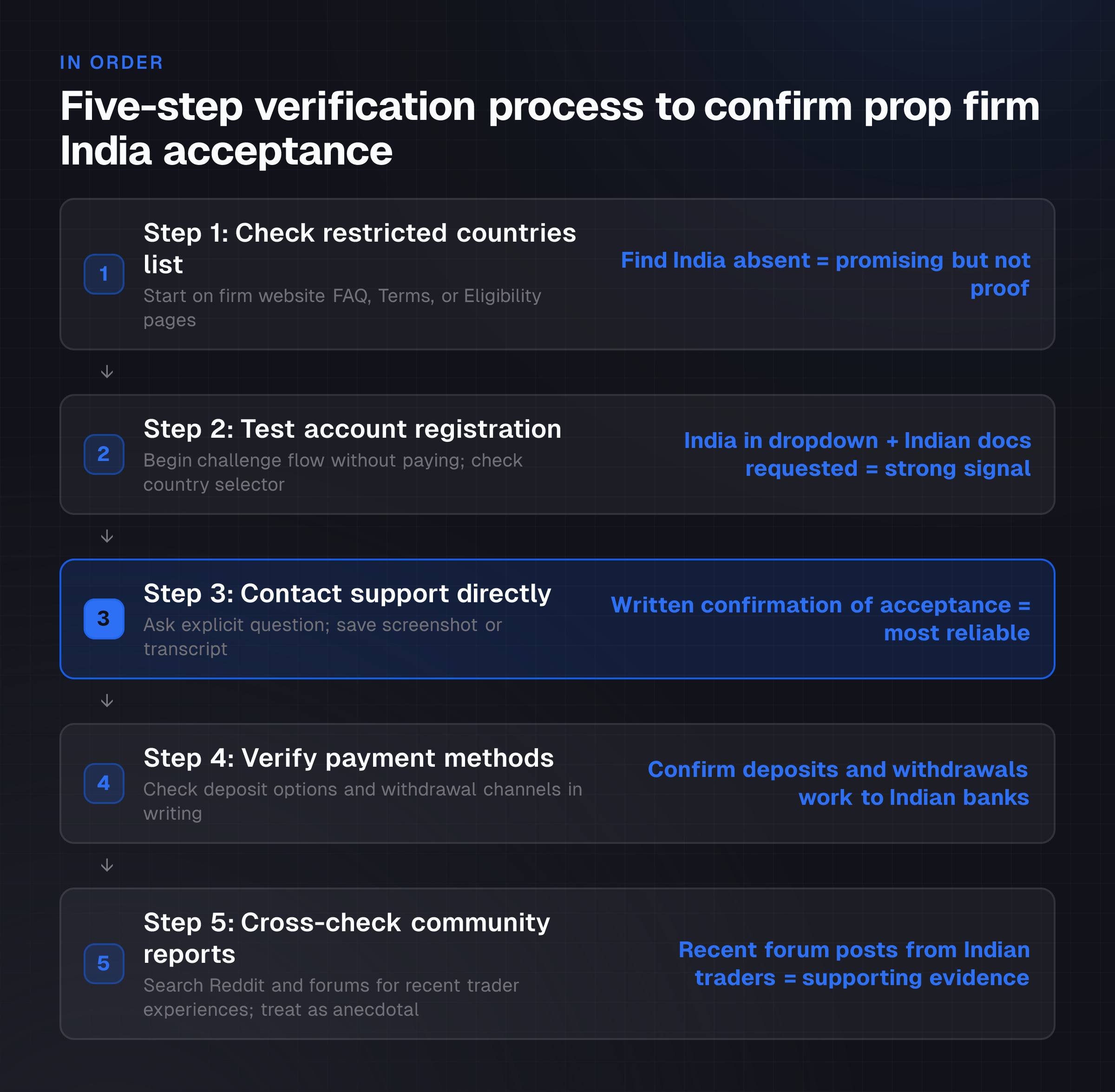
Step 1: Check the firm's official website for restricted countries
Start on the firm's public site. Navigate to sections typically labeled FAQ or Help Center, Terms and Conditions, Eligibility Requirements, or Restricted Countries.
Search explicitly for the word "India" in these pages. Most firms list countries they don't accept rather than those they do accept.
What to look for: a stated list of restricted countries. If India is absent, that's a positive indicator. Umbrella statements like "traders from EU, US, or sanctioned territories are not eligible" are common. If India isn't mentioned, assume it may be accepted, but don't treat this as confirmation.
The absence of India from a restricted list isn't proof of acceptance. Some firms only list a few prominent restricted countries and may have implicit restrictions. Proceed to step 2.
Step 2: Test the account registration process
Create a test account or begin the challenge purchase flow without committing payment. During account creation, you'll typically encounter a dropdown menu asking for your country of residence.
What to check: is "India" available as a selectable option in the dropdown? Are the requested identification documents standard for Indian residents, Aadhaar card, passport, utility bills with Indian addresses?
If India appears as a country option and the firm requests documents issued by Indian authorities, the firm has already configured its system to accept Indian traders. This is strong evidence of acceptance.
If India isn't in the dropdown, don't proceed with payment. Move to step 3 instead.
Step 3: Contact customer support directly
Use the firm's official support channels, live chat, email, or a support ticket system, and ask an unambiguous question:
"Do you accept traders who are residing in India for your funding programs?"
Record the response. Take a screenshot or save the chat transcript. This creates a written record of the firm's position and protects you if the firm later denies acceptance or reverses its policy.
What to expect: a clear "yes" or "no." If unclear, ask a follow-up: "If I'm an Indian resident, am I eligible to open an account and trade?"
Customer support representatives have access to current compliance rules. Their answer is more reliable than forum hearsay or outdated blog posts.
Step 4: Examine payment gateway options
Confirming that a firm accepts Indian traders is only half the battle. The firm must also be able to process your deposits and payouts.
Check: what deposit methods does the firm accept? Look for e-wallets, bank transfers, or payment processors known to support Indian banks. What withdrawal methods are available? Confirm the firm can send profits back to India via a compatible channel. Does the firm process transactions in USD or other major currencies accessible from India?
A firm may accept Indian traders but rely on payment partners that refuse Indian transactions. This creates a practical barrier even if you pass all eligibility checks. If payment methods are unclear, ask support: "What withdrawal methods are available to Indian traders?"
Step 5: Review community reports and trader experiences
Search for discussions on Reddit, independent trading forums, and review sites using the search terms: "[firm name] India," "[firm name] accept India," or "[firm name] Indian trader."
What to look for: direct reports from Indian traders about account setup, verification, and payouts. Recent posts, within the last six to twelve months, are more reliable than older threads, as firm policies change. Look at both positive and negative experiences to get a balanced view.
Community reports are anecdotal. A single positive report doesn't confirm firm acceptance, and a negative report may reflect an individual's experience rather than a firm-wide policy. Treat these findings as supporting evidence, not primary proof. Cross-reference with step 3, direct support contact, before committing.
Example or scenario: verification in practice
Assume you're interested in opening a challenge account with a firm called Example Prop Trading.
Your steps: first, visit the website. You navigate to Example Prop Trading's FAQ page. You search for "restricted countries" and find a list: United States, Canada, United Kingdom. India isn't mentioned.
Second, test registration. You begin the challenge purchase flow. In the country dropdown, you see "India" listed. You note that the required documents include passport and utility bill, both standard in India.
Third, contact support. You email support: "I am a trader based in India. Am I eligible to open a funded account with Example Prop Trading?" Within 24 hours, support responds: "Yes, we accept traders from India. Please proceed with account verification."
Fourth, check payments. You review the deposit and withdrawal methods. The firm accepts bank transfers and a specific e-wallet that operates in India. You confirm payouts are sent in USD, which your Indian bank can receive.
Fifth, cross-check forums. You search Reddit for "Example Prop Trading India." You find three posts from Indian traders describing successful account openings and payouts. One post mentions a two-week verification delay, but accounts were approved.
Conclusion: you proceed with confidence. All five verification steps confirm acceptance. You pay the challenge fee and open an account.
Common mistakes or risks: pitfalls to avoid
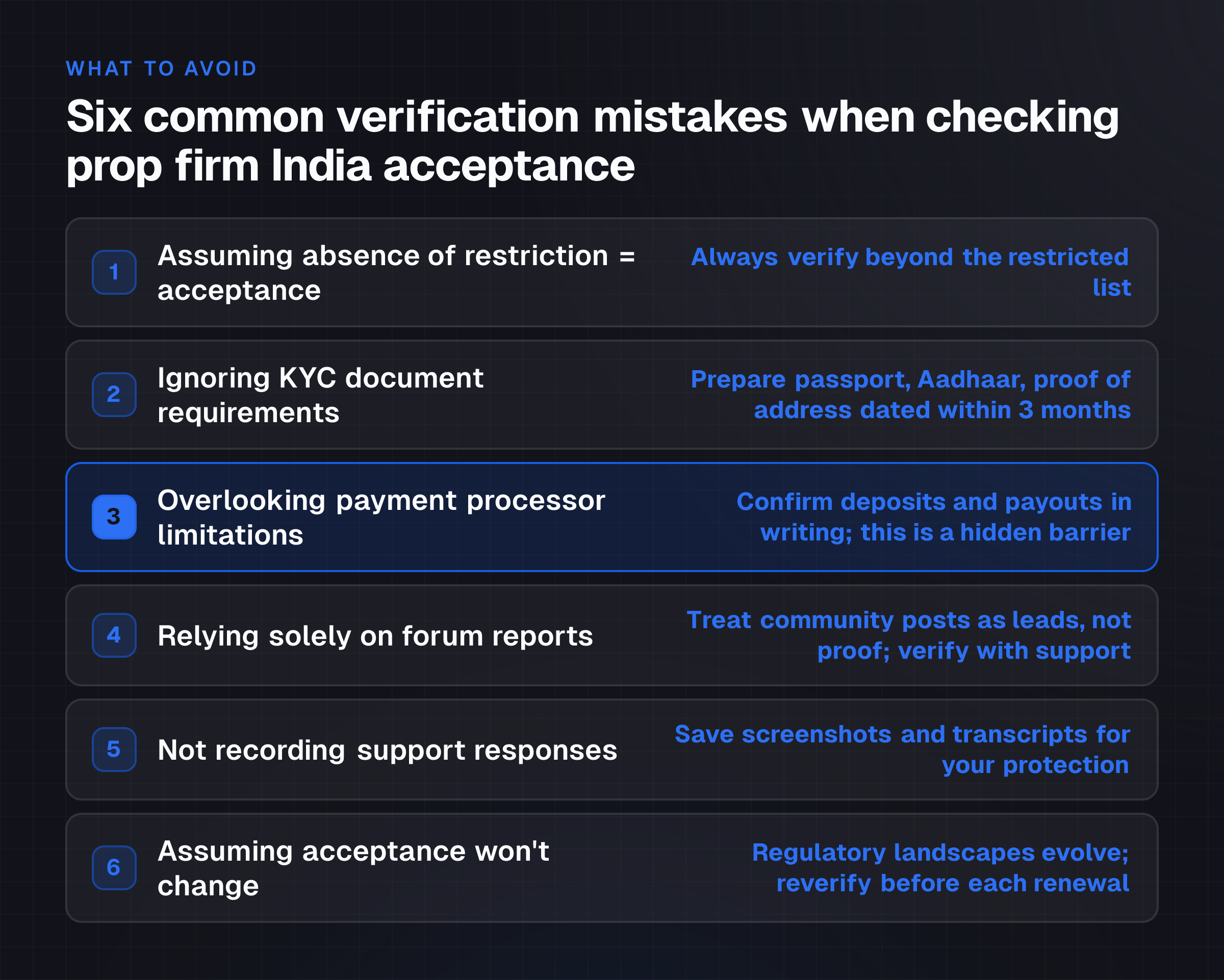
Mistake 1: Assuming absence of restriction means acceptance
Finding that India isn't on a firm's restricted list feels like confirmation, but it isn't. Some firms only publish a few restricted countries and maintain private policies for others. Always move past step 1 to step 2 or 3 before committing.
Mistake 2: Ignoring KYC document requirements
A firm may accept Indian traders, but it'll enforce strict identity verification rules. Failing to have the correct documents, or providing documents that don't match your application details, can cause account rejection even after you've paid.
Ensure you have a valid passport or national ID (Aadhaar card), plus proof of current address issued in India, utility bill, bank statement, or government-issued document dated within the last three months.
Mistake 3: Overlooking payment processor limitations
Payment gateway restrictions are a common hidden barrier. A firm may accept Indian traders but its banking partner may not process Indian transactions. You could pass all eligibility checks only to discover at withdrawal that the firm can't send your profits to India.
Always confirm payment methods in writing from support before paying the challenge fee.
Mistake 4: Relying solely on forum reports without official verification
Community forums are useful for gathering anecdotal evidence, but they aren't authoritative. A trader's positive experience three years ago may not reflect current policy. Regulatory changes, payment processor updates, or firm policy shifts can make old forum posts misleading.
Treat community reports as leads to investigate further, not as final proof.
Mistake 5: Not recording support responses
If you receive written confirmation of acceptance via email or live chat, save it. Screenshots or transcripts protect you if the firm later denies having accepted Indian traders or if your account is rejected during verification. This record is also useful if you need to dispute a charge or appeal a rejection.
Mistake 6: Assuming geographic acceptance won't change
Regulatory landscapes evolve. A firm that accepts Indian traders today may impose restrictions tomorrow due to changes in Indian law, international sanctions, or the firm's own licensing status. Before each renewal or challenge, reverify acceptance to confirm the policy hasn't shifted.
How to choose or what to do next: action steps for traders
If all five verification steps confirm acceptance
Ensure you have the required KYC documents ready, passport, proof of address. Review the firm's payout rules and withdrawal policies so you understand profit-sharing terms and withdrawal timelines. Open the account, pay the challenge fee, and begin trading. Keep records of all communications with support for future reference.
If verification steps return mixed or unclear results
Contact support again and ask for explicit written confirmation of India eligibility. Ask support to detail the exact documents required for KYC and the expected verification timeline. Ask support to confirm the payment methods available for deposits and withdrawals specifically to India. If support can't provide clear answers, move on to another firm. Ambiguity at this stage often signals operational or compliance issues later.
If you're rejected or India is restricted
Note the firm's name and reason for rejection. Consult the main catalog of prop firms that accept traders from India to identify alternative firms that explicitly confirm Indian eligibility. When exploring alternatives, start the verification process from step 1 again, don't assume similarity across firms.
General best practices
Document everything. Save screenshots, email confirmations, and chat transcripts. Verify early, confirm acceptance before paying any fee or spending time on applications. Ask specific questions. Vague inquiries get vague answers. Use the exact phrasing: "Do you accept traders based in India?" Check payment methods directly. Don't assume a common payment processor operates in India; verify with support.
Frequently asked questions
Is India typically restricted by most prop firms?
India isn't universally restricted. Many established prop firms accept Indian traders because India is a large and growing trading community with accessible payment infrastructure. Not all firms do, though. Restrictions depend on each firm's compliance, banking relationships, and regulatory licensing. Always verify individually rather than assuming acceptance.
Can I use a VPN or false address to bypass geographic restrictions?
No. Misrepresenting your residence during account setup violates compliance rules and creates legal risk for both you and the firm. Many firms verify address using utility bills or government ID, which are difficult to falsify. If discovered, you can lose both your challenge fee and any profits earned. Use only your genuine residence.
How long does India KYC verification typically take?
Verification timelines vary by firm but commonly range from 24 hours to two weeks. Some firms process Indian documents faster than others depending on their compliance infrastructure. During your support contact, ask for an estimated verification timeline so you can plan accordingly.
What if a firm accepts me but its payment processor rejects Indian withdrawals?
This is rare but possible. If you encounter a payment block at withdrawal, contact support immediately. The firm may offer an alternative payment method or require a wire transfer to a specific bank account. Document the issue and the firm's resolution. If the firm can't resolve it, file a dispute with your payment method provider and consult the verification checklist on how to tell if a prop firm actually pays.
Can I switch countries if I move away from India?
Yes, but you must notify the firm and update your account information immediately. Moving to a new country may trigger re-verification, and some countries may be restricted while others aren't. Your current account may be frozen during the update. Always inform support of a relocation before it occurs rather than after.
Are there any India-specific compliance requirements I should know about?
The main requirement is valid Indian government-issued ID and proof of current address from Indian authorities. Some firms may ask additional questions about income sources or investment experience due to Indian regulatory practices, but these vary. Support will detail any India-specific steps during verification.