Copy Trading: the Rules That Get Accounts Breached

Copy trading on a proprietary trading firm account carries significant compliance risk. When you automate the replication of another trader's positions, you bypass direct control over individual trades, and prop firms enforce strict rules that copy trading can inadvertently violate. The most common breaches involve prohibited automated strategies, identical trading across multiple accounts, latency exploitation, and position sizing mismatches that blow through drawdown limits before you notice.
This guide walks you through the vetting steps required before connecting copy trading software to a prop firm account, so you can identify rule conflicts before they cost you your funded status.
Quick answer: why copy trading risks prop firm account termination
Copy trading systems replicate trades automatically. That means they can breach prop firm rules without your intervention.
The three highest-risk violations: running the same strategy across multiple accounts simultaneously (most firms prohibit this for fairness reasons), using execution methods that exploit minor latency differences between brokers, and triggering daily or maximum drawdown limits through position sizing that wasn't designed for your account size. Prop firms don't segment copy trading violations from other automated trading breaches in their published enforcement data, so the true failure rate is opaque, but rule documentation from major firms consistently flags automated strategies as a common source of account termination.
What you need first: platform and rule compatibility checklist
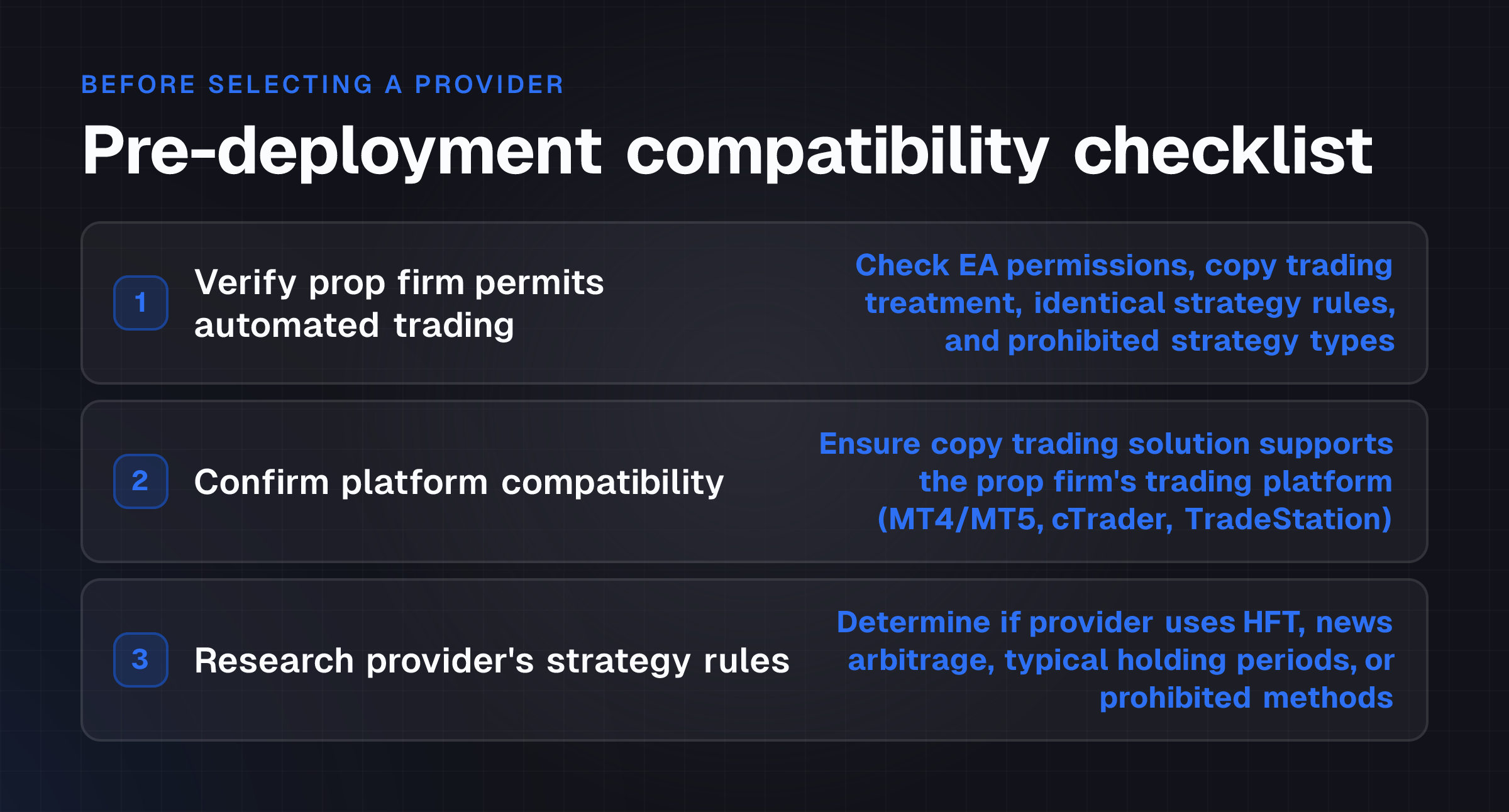
Before you select a copy trading provider or software, establish three prerequisites.
Verify the prop firm permits automated trading
Read the firm's published rules on Expert Advisors (EAs) and third-party software. Not all firms allow them.
Check whether:
- EAs are explicitly allowed on the trading platform you plan to use (MT4, MT5, cTrader, or TradeStation).
- Copy trading software that functions as an EA is covered under that permission or prohibited separately.
- The firm restricts simultaneous accounts trading identical strategies, this applies directly to copy trading, since all copied trades will be identical.
- The firm has prohibitions on high-frequency trading (HFT), tick scalping, arbitrage, or news trading during specific windows.
How to check a firm really allows Expert Advisors covers this verification in detail. Don't assume permission; many firms prohibit EAs entirely or allow them only on specific account types.
Confirm platform compatibility
Verify that your chosen copy trading solution supports the prop firm's trading platform.
Copy trading typically runs on:
- MetaTrader 4 or 5 (via EA or plugin)
- cTrader (via cAlgo or plugin)
- TradeStation
- Proprietary firm platforms (rare; most copy trading integrations don't exist here)
If the prop firm uses a platform the copy trading service doesn't support, you can't proceed without choosing a different provider or a different firm.
Research the copy trading provider's strategy rules
Before examining the provider's trades, determine whether their core strategy type is prohibited by the prop firm.
Request or review:
- Whether the provider uses high-frequency or news-based arbitrage strategies.
- Typical holding periods and order frequency.
- Average position size relative to account equity.
- Whether they trade during economic news releases or employ grid trading.
If the provider's strategy inherently relies on methods the prop firm forbids, copy trading won't work for that account.
Step-by-step: validating copy trading before deployment
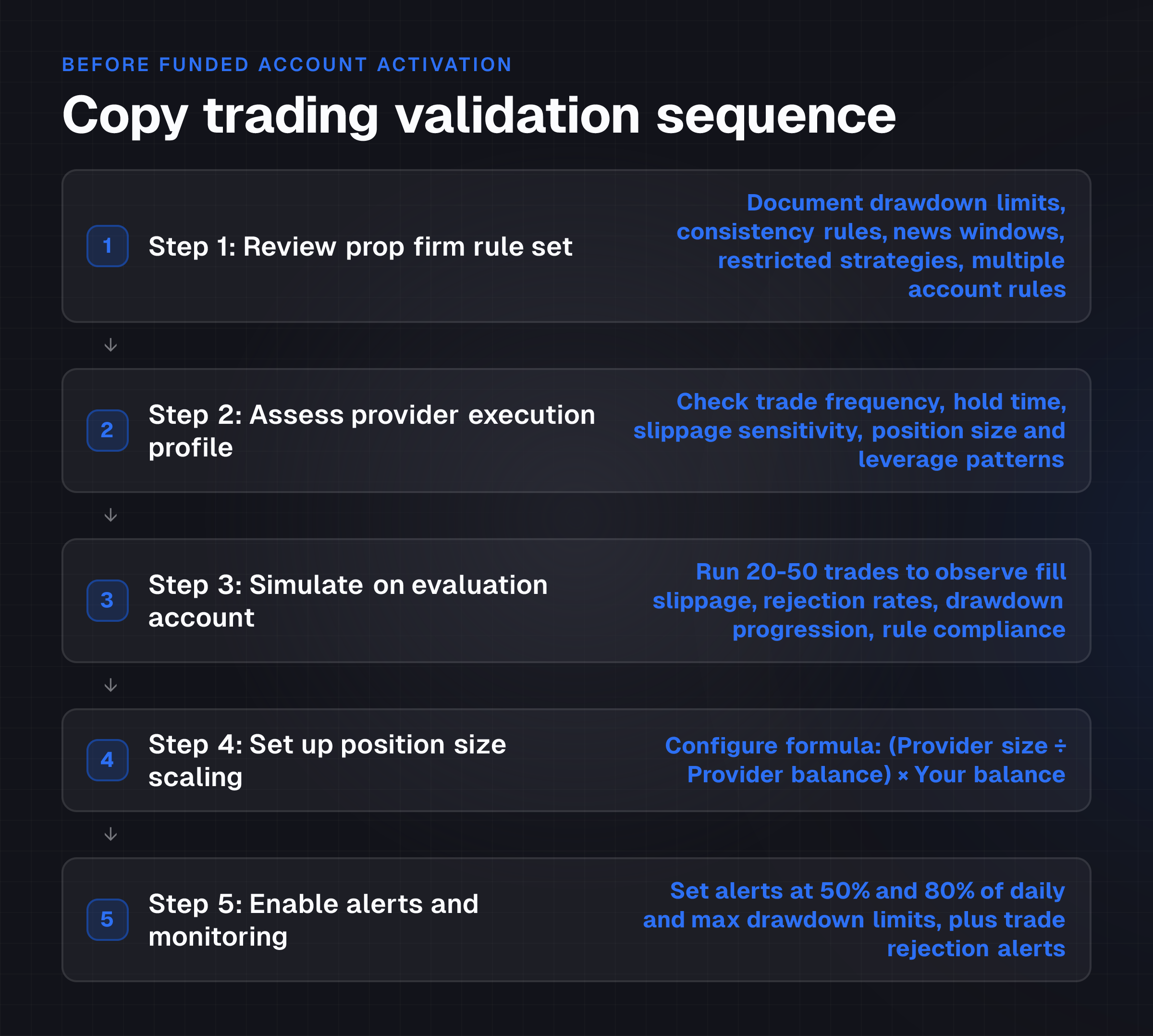
Once you've confirmed baseline compatibility, perform these steps in order before activating copy trading on a funded account.
Step 1: Review the prop firm's specific rule set in full
Obtain and read the complete rule document.
Identify thresholds for:
- Daily drawdown limit: the maximum loss allowed in a single trading day. Typical range: 5% to 10% of account balance.
- Maximum drawdown limit: the total loss from account peak allowed over the challenge or funded period. Typical range: 10% to 20%.
- Consistency rules: minimum number of profitable days or weeks required; many firms require at least 40% win rate or similar.
- News trading windows: specific hours when trading is forbidden or restricted.
- Restricted strategies: explicit prohibition on scalping, arbitrage, latency exploitation, or certain order types.
- Multiple account rules: whether identical strategies across two or more accounts (with the same firm or others) are prohibited.
Document each threshold and rule. This becomes your compliance checklist.
Step 2: Assess the copy trading provider's execution profile
Examine the provider's live trade history or backtest results for:
- Trade frequency: How many trades per day or week? Copy trading with extremely high frequency increases the risk of accidentally triggering HFT or scalping prohibitions.
- Average hold time: Do they close positions within seconds (scalping risk) or hold for hours or days?
- Slippage and latency sensitivity: Does the strategy depend on tight execution, or does it tolerate slippage? If tight execution is critical, copying across different brokers or prop firm setups may degrade performance and trigger rule violations if the system adapts by increasing risk.
- Position size and leverage: What's the provider's typical position size as a percentage of their account? If they trade 2% per trade and you scale that to your prop firm account, will you exceed the firm's leverage limits or breach drawdown on a normal drawdown sequence?
Step 3: Simulate copy trading on your prop firm account
Before activating copy trading on a funded account, test it on an evaluation account or demo account using the same prop firm's rules and platform.
Run the copy trading system for at least 20-50 trades to observe:
- Actual fill slippage: How much worse are executions on the prop firm platform than on the provider's broker?
- Order rejection rates: Does the prop firm reject any order types the copy trading software uses (e.g., certain limit order configurations, trailing stops)?
- Drawdown progression: How quickly does the account drawdown? At what point does it approach the firm's daily or maximum drawdown limits?
- Rule compliance: Does any trade trigger a warning or suspension from the prop firm's compliance monitor?
If the evaluation account shows breaches or approaches limits uncomfortably quickly, don't activate on funded.
Step 4: Set up scaling and position size adjustment
Copy trading software must adjust position sizes from the provider's account to your prop firm account. The adjustment formula is:
Your position size = (Provider position size ÷ Provider account balance) × Your account balance
For example: if the provider risks 2% of a $100,000 account (2 lots on a standard account), and your prop firm account is $50,000, you should risk 2% of $50,000, not 2 lots directly.
Verify that your copy trading software applies this scaling automatically. If it doesn't, you must configure it manually before activation. Failure to scale down position sizes is the most common driver of rapid drawdown on smaller prop firm accounts.
Step 5: Enable alerts and daily monitoring
Set up real-time alerts for:
- Daily loss alerts: Alert when daily loss reaches 50% of the firm's daily drawdown limit, and 80% of the limit.
- Maximum drawdown alerts: Alert when account equity falls to 50% and 80% of the maximum drawdown threshold.
- Trade rejection alerts: Alert if the broker rejects an order (usually indicated by a pending order that never fills or a broker error code).
Don't assume the copy trading system will protect you. Prop firm rules are non-negotiable; breaching them results in account termination regardless of strategy profitability.
Worked example: identifying a rule breach before it happens
Scenario:
You're considering copying a provider who trades the EUR/USD 4-hour breakout strategy. Your prop firm (a hypothetical firm with standard rules) allows EAs, but prohibits:
- More than one identical strategy across multiple accounts.
- Daily drawdown exceeding 5% of account balance.
- News trading 1 hour before and after major economic releases.
- Strategies exhibiting latency arbitrage patterns.
Provider's profile:
- Average 8-12 trades per day.
- Typical hold time: 2-6 hours.
- Average risk per trade: 1.5% of their account.
- Recent drawdown: hit 8% in one day during a volatile week.
Your prop firm account: $50,000, with a 5% daily drawdown limit ($2,500).
Analysis:
-
Position sizing: The provider risks 1.5% per trade on their account. On your $50,000, that's $750 per trade. With their 8-12 trades per day, you could risk $6,000, $9,000 daily, which exceeds your $2,500 daily limit on a losing day. Risk identified.
-
Daily drawdown history: The provider's recent 8% drawdown over one day translates to $4,000 on your account, already above your 5% limit. If the provider repeats this, your account is terminated. Risk identified.
-
News trading: The provider's 4-hour breakout strategy might trade near economic releases (a common volatility driver for breakouts). If the firm's rules prohibit news trading during certain windows and the provider's strategy triggers trades during those windows, you breach compliance. Risk identified, but requires trade-by-trade monitoring.
Conclusion: This setup is too risky without position size adjustment.
You must either:
- Reduce the scaled position size from 1.5% per trade to 0.5% per trade to stay safely within daily limits.
- Choose a different provider with lower daily variance.
- Use a larger prop firm account to accommodate the strategy's drawdown profile.
Common mistakes: how copy trading plans fail
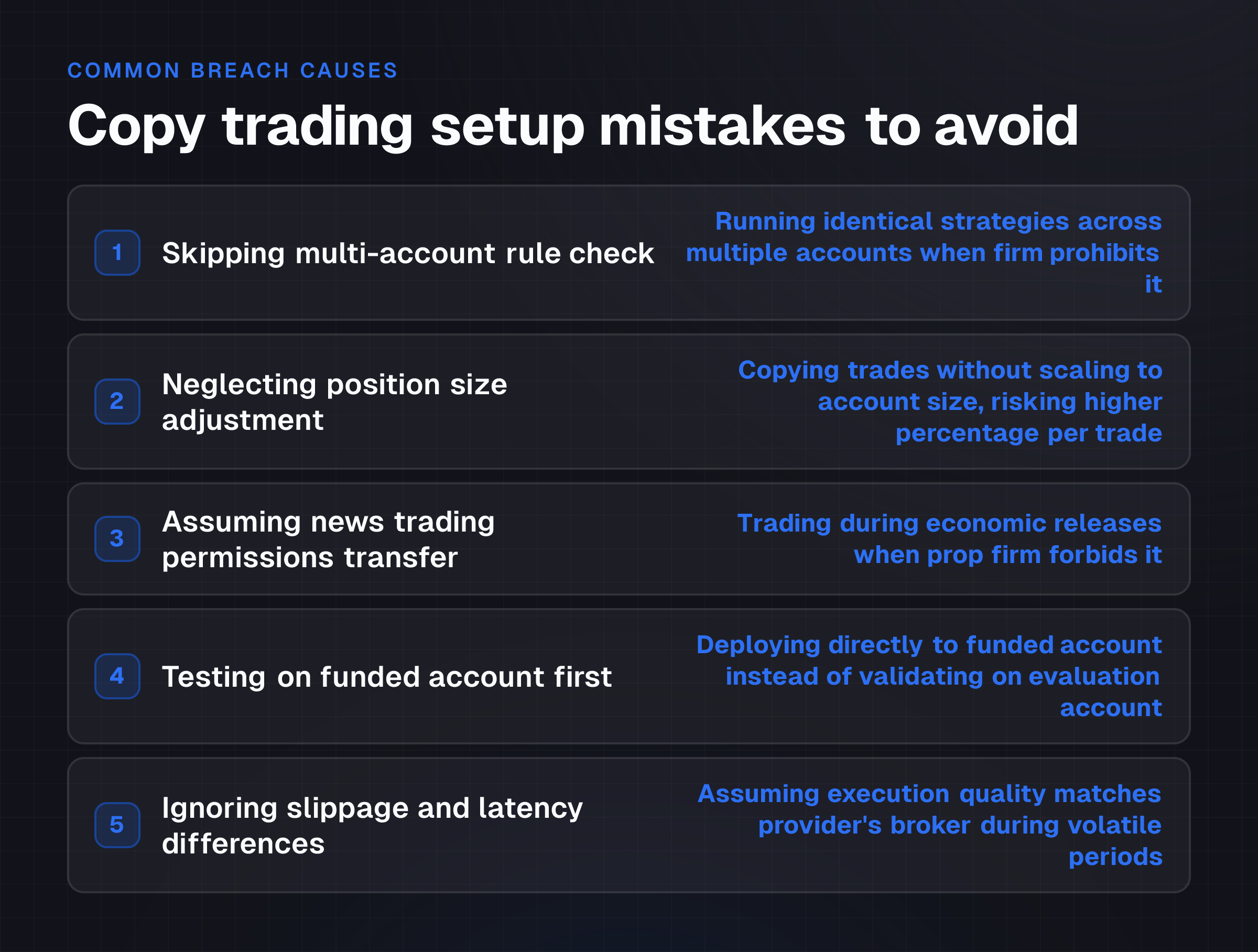
Mistake 1: Skipping the multi-account rule check
Many prop firms prohibit traders from running the exact same strategy across two funded accounts simultaneously, or from running a funded account and an evaluation account together with identical trades. Copy trading makes this very likely if you're not careful.
If you have multiple accounts, verify whether the firm allows identical strategies across them. If not, choose one account for copy trading only.
Mistake 2: Neglecting to adjust for position size
Copying trades without scaling them to your account size is the fastest way to breach drawdown limits. Your account is smaller than the provider's (usually); direct copying means you risk a higher percentage of your capital per trade.
Always verify that position sizing is scaled before deployment.
Mistake 3: Assuming news trading permissions transfer
Your personal broker might allow trading during news releases; the prop firm might not.
Copy trading doesn't know the difference. If the provider trades during economic data releases and the prop firm forbids it, you'll breach rules. Check the firm's news trading window explicitly and either disable copy trading during those times or choose a provider who avoids news periods.
Mistake 4: Testing on a live funded account instead of evaluation
Deploying copy trading directly to a funded account without testing on an evaluation account first removes your safety margin.
Evaluation accounts are cheaper and risk-free. Use them to validate execution, drawdown progression, and compliance. Only move to funded after confirming the setup works.
Mistake 5: Ignoring slippage and latency differences
The provider executes on their broker; you execute on the prop firm's connection. Slippage and latency will differ, sometimes significantly during volatile periods.
If the strategy relies on tight fills and you see much worse execution on the prop firm platform, the strategy may fail or trigger larger drawdowns than the provider's history suggests. Monitor the first 50 trades carefully.
Mistake 6: Setting and forgetting
Copy trading isn't passive. Prop firm rules apply regardless of automation.
Monitor your account daily for:
- Drawdown progression relative to firm limits.
- Trade rejections or order errors.
- Any deviation from the provider's typical risk profile (which might indicate a platform issue or connection lag).
If you don't check daily, you'll only notice a breach after the account is terminated.
Frequently asked questions
Can I copy trade if the prop firm allows EAs but not third-party software?
This depends on how the copy trading software integrates. If it functions as a native Expert Advisor (e.g., running directly on MT4/MT5), it may fall under the EA allowance. If it operates as a plugin or connection layer that modifies or routes orders, it might violate a "no third-party software" rule.
Contact the prop firm's support desk with the specific copy trading tool name and ask for explicit written permission. Don't assume compatibility.
What happens if my copied trades breach the daily drawdown limit mid-day?
Most prop firms monitor drawdown in real time. If a trade causes your account to exceed the daily limit, the firm typically freezes the account and prevents further trading until the next trading day or trading session.
You may then face termination of the funded account, depending on the firm's policy. This is why daily monitoring and alerts are critical, you need to pause copy trading before hitting the limit.
If the copy trading provider is profitable overall, will I still breach rules?
Yes.
Profitability doesn't exempt you from rule compliance. A provider might be +5% over 100 trades but have a drawdown sequence that violates your prop firm's limits. Rules exist independently of outcome. You must verify that the provider's historical drawdown, daily loss sequences, and trade frequency fit within the firm's constraints, not just their net profitability.
Can I adjust the copy trading provider's position sizes manually for each trade?
Some copy trading platforms allow manual adjustment, but most don't, they scale automatically or require you to set a global scaling factor before activation. Manual trade-by-trade adjustment defeats the purpose of automation.
If you need that level of control, copy trading may not be the right tool; consider semi-automated trading instead, where you review each signal before executing.
Do prop firms detect if I'm copy trading versus trading manually?
Prop firms detect identical trades and patterns. If your trades exactly mirror another trader's (entry price, exit price, position size, timing), the firm may flag this as identical strategies across accounts or suspected copy trading. Some firms explicitly investigate this.
However, if copy trading is allowed under the firm's rules, disclosure is typically not required, the account remains compliant as long as rule thresholds are met.
What if the copy trading software goes down during a trade?
If the software disconnects mid-position, your trade will remain open on the prop firm platform until you close it manually or it hits a stop loss. Copy trading downtime doesn't pause the trade itself.
This is a risk of automation. Use a backup internet connection or trading setup, and set hard stop losses on all positions so that a platform outage doesn't leave you exposed indefinitely.
Key takeawaysCopy trading on a prop firm account is legal and often permitted, but it exposes you to compliance risks that don't exist with manual trading.
Verify EA and third-party software permissions in writing before selecting a copy trading provider.
Scale position sizes to your account size; failing to do so is the primary driver of drawdown limit breaches.
Test copy trading on an evaluation account first. Never deploy directly to a funded account.
Monitor your account daily; automation doesn't absolve you of responsibility for rule compliance.
If the provider's historical drawdown or trade frequency exceeds your firm's thresholds, adjust your setup or choose a different provider rather than hoping for better future performance.
For more on prop firm compliance and account setup, see How to check a firm really allows copy trading, How to check a firm really allows Expert Advisors, and Prop Firm Overnight holding Rules: A Trader's Checklist.