How to check a firm really allows copy trading

Proprietary trading firms often claim to allow copy trading, but marketing language doesn't always align with official rules. The only way to verify permission is to check three sources in order: the firm's public marketing and FAQ, its formal Terms and Conditions and Trading Rules, and direct confirmation from customer support. The distinction matters because many firms permit Expert Advisors (EAs) for automation but explicitly prohibit copying trades from external platforms or other accounts, a gap that can result in account termination if you proceed without confirmation.
This guide walks you through the verification process, explains what copy trading means in a prop firm context, and shows you how to identify the rule clauses that most often trap traders who assume permission exists.
Key takeaways: verifying copy trading permission
- Marketing claims about "all trading styles allowed" or "EAs permitted" do not confirm copy trading is allowed; these refer to original algorithmic strategies only.
- Always read the full Terms and Conditions and Trading Rules, searching specifically for clauses on "unique trading strategy," "identical trades," or "third-party signals", these often prohibit copying.
- Contact customer support with a direct, specific question in writing; save the response. Verbal or chat-only answers can contradict official documentation.
- A firm may allow copy trading on challenge accounts but ban it on live funded accounts, or vice versa. Always verify for the account type you plan to use.
- Non-compliance can result in immediate account termination, profit forfeiture, and permanent disqualification from the firm.
What it means: copy trading in proprietary firms
Copy trading, also called social trading or mirror trading, is an automated strategy that replicates trades executed by another trader. In the prop firm context, this typically means one of three things.
You copy trades from a personal account (your own brokerage or another prop firm account) to your funded account. You use a third-party service such as MetaTrader signal services, ZuluTrade, or Myfxbook AutoTrade to automatically mirror trades into your prop firm account. Or you subscribe to a signal service or account management system that executes the same trades across multiple accounts, including yours.
This differs from using an Expert Advisor to automate your own original strategy. An EA you write or purchase to trade your own logic is automation. Copy trading is outsourcing execution to another trader's decisions.
Most prop firms distinguish between these two. They may explicitly allow EAs while prohibiting copy trading, because copy trading raises concerns about whether the trader demonstrates individual skill, a requirement many firms enforce to maintain their brand and reduce operational risk.
Why it matters: account termination and profit forfeiture risk
Prop firms face significant incentives to enforce a "unique trader" rule. When hundreds of traders using the same copy trading service generate identical trades, the firm's risk exposure becomes concentrated and difficult to manage. Regulators also view this arrangement with scrutiny because it can blur lines of accountability and risk.
If a firm discovers you're copy trading when their rules forbid it, the consequences are severe.
Immediate account termination. Your funded account can be closed without advance notice.
Profit forfeiture. Any profits generated on the account may be withheld or clawed back.
Disqualification from future funding. Many firms maintain a blacklist and will reject future applications from the same trader.
This is why verification before you start trading, not after, is critical. The cost of misunderstanding a rule isn't a warning; it's account closure.
Some firms use automated trade monitoring to detect patterns. If your account's trades are identical to hundreds of others using the same copier, the firm's compliance systems may flag you automatically, triggering a review that uncovers the violation.
How it works: the four-step verification process
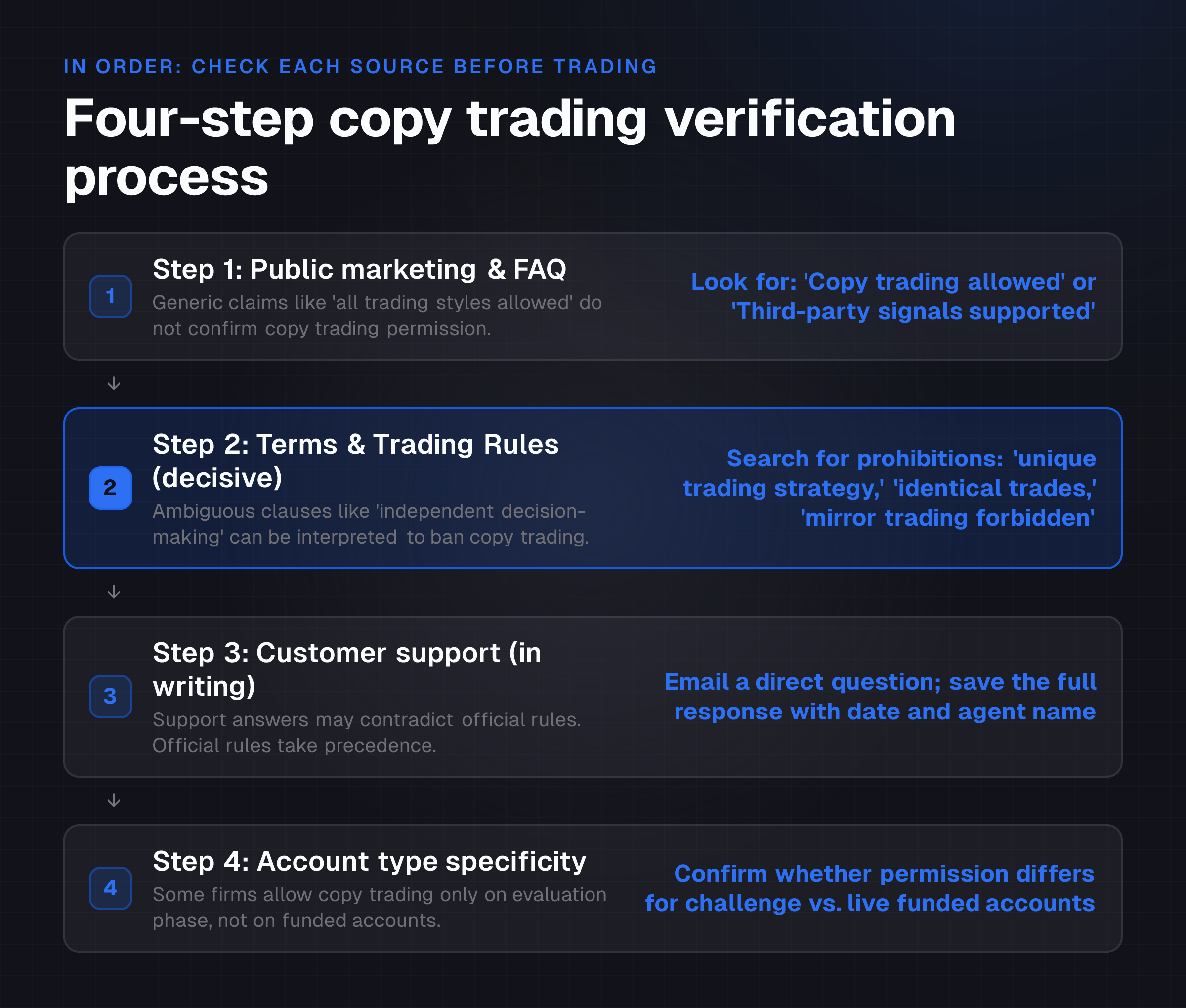
Verification requires you to check multiple sources in a specific order. Each step either confirms permission or raises red flags that prompt the next question.
Step 1: Check public marketing and FAQ
Start with the firm's website, FAQ section, and promotional materials. Look for explicit statements using these terms: "Copy trading allowed," "Social trading permitted," "Trade copier compatible," "Third-party signal services supported."
What counts as evidence: A direct statement that copy trading is allowed, ideally with any conditions (e.g., "only on challenge accounts" or "only if you are the master account holder").
What doesn't count: Generic claims like "all trading styles allowed" or "Expert Advisors permitted" are not proof of copy trading permission. These often refer to original algorithmic strategies only. Screenshot or note the exact wording so you can compare it against the official rules later.
Red flag: Absence of any mention of copy trading, especially when the FAQ addresses other tools or restrictions. Silence isn't permission.
Step 2: Read the formal Terms and Conditions and Trading Rules
This is the decisive step. Locate and carefully read every document related to trading rules. Most firms publish these in a footer link labeled "Terms," "Legal," "Rules," or "Compliance." Look for explicit prohibitions: "Copy trading is prohibited," "Mirror trading from external platforms is not allowed," "Account management or signal-following services are forbidden," "Identical trades across multiple accounts will result in account termination."
Look for explicit permissions: A clear statement allowing copy trading, with any conditions spelled out (e.g., "copy trading is permitted provided you are the account holder of the master account").
Watch for ambiguous or indirect clauses, these are where most conflicts occur. "Traders must demonstrate a unique trading strategy" or "each account must reflect independent decision-making." "Trades must not be identical to those on other accounts managed by this firm." "High-frequency trading, latency arbitrage, and other strategies that create unfair advantage are prohibited." "All trading must be original to the account holder."
Ambiguous clauses can be interpreted to prohibit copy trading, even if the words "copy" or "mirror" don't appear. If your trades are copies from an external source, a firm can argue this violates the "unique strategy" or "independent decision-making" requirement.
What to do: Print or save a PDF of the full document. Highlight or quote verbatim any section that mentions copy trading, signals, automation, unique strategy, or identical trades. Note the document name, version number, and publication date if visible.
Step 3: Contact customer support in writing
Marketing and rules documents can contradict each other. Support staff may also give inconsistent answers. Always ask in writing (email or support ticket, not live chat) and save the full response.
Specific questions to ask:
- "Is copy trading permitted on [account type: challenge / funded / live]?"
- "Are there any restrictions on using third-party copy trading services, such as [name a specific service if applicable]?"
- "If I copy trades from another account I personally own, is this allowed?"
- "What are the implications if my account's trades are identical to trades on another account, whether my own or someone else's?"
What to record: Save the full email thread or support ticket transcript, including the date, the support agent's name (if provided), and the exact wording of their answer. Don't rely on verbal assurances.
Trade-off and risk: Support staff may sometimes give an answer that contradicts the official rules, either because they're not fully trained on the policy or because they interpret ambiguous clauses differently. If a support agent says copy trading is allowed but the Trading Rules say traders must demonstrate a unique strategy, the official rules take precedence. Always flag this contradiction to support in a follow-up email: "Your previous response stated copy trading is permitted, but Section 4.2 of the Trading Rules states all trades must be original to the account holder. Can you clarify?"
Step 4: Check account type specificity
Some firms permit copy trading on challenge accounts (where you're proving your skill with firm capital in a simulated or low-risk phase) but ban it on live funded accounts (where you're trading with the firm's real capital). The reverse can also occur.
Ask specifically: "Is the permission or restriction different for challenge accounts versus live funded accounts?"
Why this matters: You may qualify for copy trading on the evaluation phase but lose permission once you move to a funded account, a detail that can surprise traders mid-journey. See "Live to Funded Account: What Actually Transfers?" for how rules can shift between account stages.
Example or scenario: three traders, three outcomes
Trader A: Reads the FAQ, sees no mention of copy trading, but doesn't check the rules. Assumes silence means permission.
Trader A signs up and uses a MetaTrader 4 signal service to copy trades from a more experienced trader. After 30 days of profitable trading, the firm's compliance team detects the pattern (identical trades across multiple accounts), reviews the account, and discovers the copier connection. The account is terminated, profits are forfeited, and Trader A is told the action violated the "unique trading strategy" clause in Section 3 of the Trading Rules.
Trader A never read Section 3.
Outcome: Account closed, profits lost, disqualified from future funding.
Trader B: Reads the FAQ (which says nothing about copy trading) and the Trading Rules (which have a "unique strategy" clause). Emails support asking: "Can I use copy trading?" Support responds: "Yes, copy trading is allowed."
Trader B starts copying. Two months later, the same compliance review process flags the account. When Trader B contests, the firm pulls up the Trading Rules Section 3 and states that the support email was issued in error or that support staff misunderstood the question. The firm enforces the "unique strategy" clause.
Outcome: Account closed, but Trader B has written evidence of a support response that contradicts the firm's enforcement. This may allow Trader B to negotiate, escalate, or seek refund of the challenge fee, but the funded account is still terminated.
Trader C: Checks the FAQ (no mention of copy trading), reads the full Trading Rules, and finds: "Copy trading and mirror trading from third-party platforms are explicitly prohibited. Violations will result in account termination and forfeiture of profits." Emails support with the same question. Support responds: "Copy trading is not permitted on any account type." Trader C doesn't use copy trading.
Outcome: Trader C avoids the violation. No account closure, no forfeiture. Trader C either uses an original strategy or chooses a different firm that permits copy trading.
This scenario shows that verification requires all three steps, and that written confirmation from support, saved as evidence, is your only protection if a contradiction arises.
Common mistakes or risks: what traders overlook
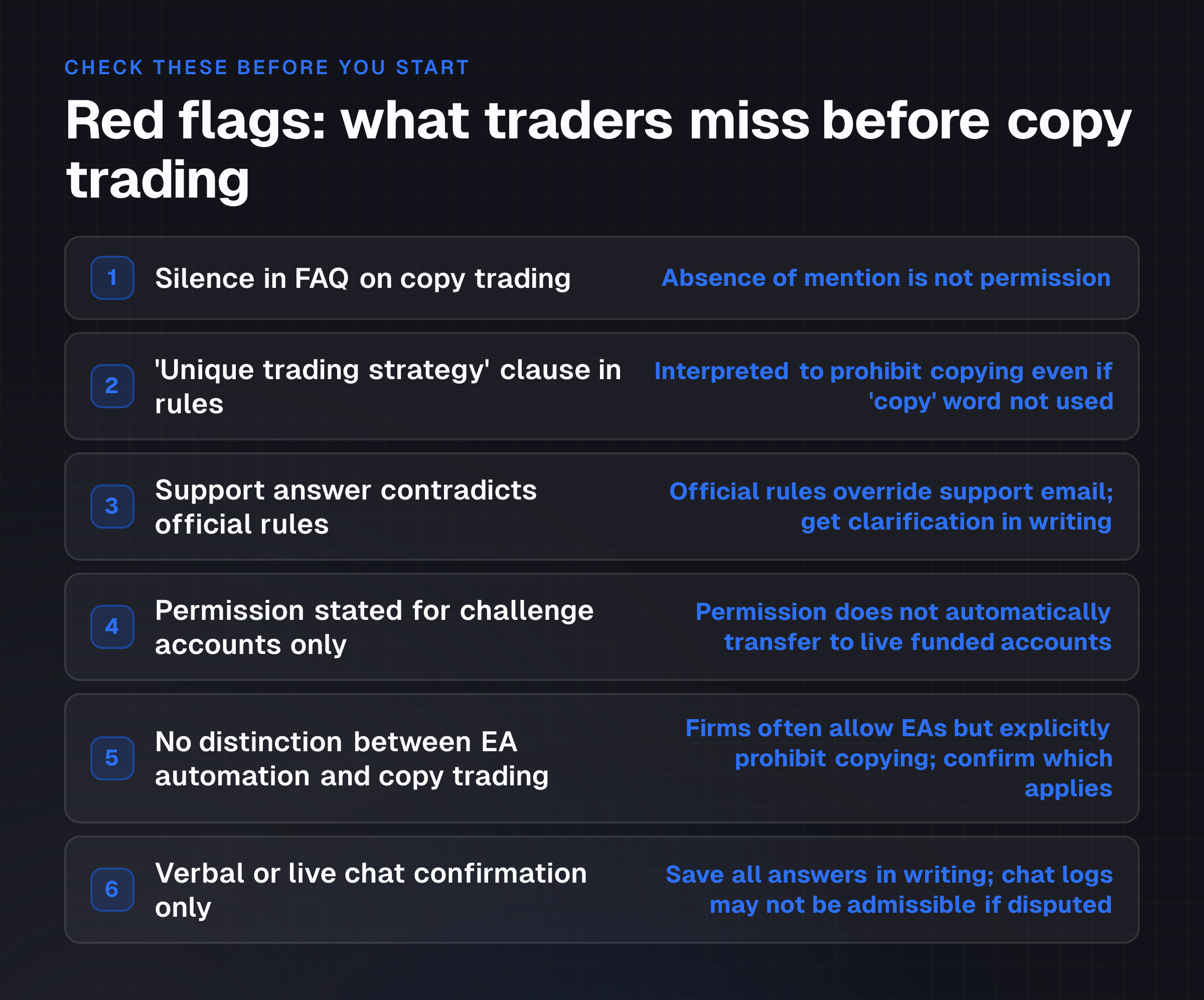
Mistake 1: Conflating "Expert Advisors allowed" with "copy trading allowed"
Many prop firms explicitly state that EAs are permitted. An Expert Advisor is a script that automates your own trading logic (e.g., "if the RSI crosses above 70, sell"). Copy trading is using an external system to execute someone else's logic.
A firm can allow the first and ban the second. Always check for copy trading language specifically; don't assume EA permission covers it.
Mistake 2: Relying on marketing language instead of legal documents
Marketing can be imprecise or aspirational. A firm might say "we support all modern trading tools" without intending to include copy trading. Legal documents are binding; marketing isn't. If there's a conflict, the rules win.
Mistake 3: Ignoring the "unique strategy" clause
Many firms include language requiring traders to demonstrate individual skill or a unique approach. This clause is broad enough to cover copy trading. If your account's trades are identical to hundreds of other accounts using the same copier, a firm can argue you've failed to demonstrate a unique strategy, even if the word "copy" is never mentioned.
Mistake 4: Assuming verbal or chat support is binding
A live chat agent saying "yes, copy trading is OK" isn't a contract. The agent may be untrained, may have been overheard by compliance later, or may issue a response that contradicts written rules. Always request written confirmation via email and reference the official section of the rules that allows it.
Mistake 5: Not checking for account-type restrictions
A firm may allow copy trading on challenge accounts but prohibit it on live funded accounts. If you move to funding and your trades are still copied, you violate the new rules for that account stage. Always verify the permission applies to the specific account type you plan to use.
Mistake 6: Copying identical trades across multiple prop firms or personal accounts
If you use the same copy trading service to trade multiple accounts (your own brokerage, Account A at Firm X, Account B at Firm Y), each firm sees identical trades on its account and may detect the copy trading pattern. Even if Firm Y allows copy trading, Firm X's compliance team might see your account's trades as "non-unique" and take action.
Each firm monitors its own accounts independently.
Detection method: Prop firms use automated trade-matching software that flags accounts with identical or near-identical trade sequences. If your entry and exit prices, times, and lot sizes match other accounts (especially accounts you don't control), a red flag is raised for manual review.
How to choose or what to do next: your verification checklist
Use this checklist before you fund any account and commit to copy trading:
-
Locate the firm's marketing materials on copy trading. Screenshot any claims. Note if there are none.
-
Find and download the Trading Rules, Terms and Conditions, and User Agreement. Search for keywords: "copy," "mirror," "social trading," "unique strategy," "third-party signals," "automated trading," "identical trades."
-
Quote and save any relevant clauses verbatim. Note the section number, document name, and date.
-
Email customer support with the four specific questions listed in Step 3 above. Use a clear subject line: "Question: Copy Trading Permissions on [Account Type]." Save the entire response thread.
-
If support says "yes" but the rules say "no" (or are ambiguous), send a follow-up email flagging the contradiction. Example: "Your previous response stated copy trading is permitted, but I want to confirm this aligns with Section 3.2 of the Trading Rules, which states trades must be original to the account holder. Can you clarify in writing how these two statements fit together?"
-
If the firm doesn't explicitly allow copy trading, don't use it. Silence, ambiguity, or a rule requiring a "unique strategy" are not permission. Assume prohibition unless explicitly stated otherwise.
-
Document everything. Print or save PDFs of the rules, screenshots of the FAQ, and the support email thread. If your account is later terminated, this documentation is your only defense.
-
Choose a firm that explicitly allows copy trading if that's your intended strategy. The prop firm catalog includes firms with different policies; some permit copy trading and some don't. Selecting a firm that matches your strategy avoids the entire risk category. See the verified prop firm list for firms that allow copy trading.
If you discover a firm doesn't permit copy trading but you want to trade algorithmically, consider whether an original Expert Advisor strategy would work instead, or explore whether a different firm's rules better fit your approach.
Frequently asked questions
What counts as copy trading in the eyes of a prop firm?
Any trade sequence that's identical or nearly identical to trades executed by another trader or system, whether that trader is you on another account or someone else. This includes using a third-party signal service, MetaTrader signal followers, ZuluTrade, Myfxbook AutoTrade, or manual mirroring of another account's trades. If a compliance system can match your entry and exit prices to another account's, it flags as copying.
Can I use copy trading on a challenge account but not a funded account?
Yes, this is common. Many firms permit copy trading on demo or challenge phases to evaluate the strategy, then prohibit it once you move to a live funded account because the firm's risk management rules tighten. Always verify the permission applies to the account stage you plan to use. Some firms do the reverse: they prohibit it during evaluation to ensure you prove your own skill.
What if the firm's support email says copy trading is allowed but the Trading Rules don't mention it?
The Trading Rules are the binding legal document; the support email is secondary. If there's a conflict, a firm will enforce the rules, not the email. However, a support email that contradicts the rules gives you evidence to dispute an account closure. Always escalate the contradiction in writing to support: "Please clarify in writing how your previous response aligns with Section X of the Trading Rules."
If I copy trades on a prop firm account and also on my personal brokerage account, can the firm detect it?
No, the prop firm can only detect patterns on accounts it monitors (its own accounts). However, if you copy the same strategy on multiple prop firm accounts, each firm's compliance system will see identical trades on its account and may flag you. Your personal brokerage account is separate and not visible to the prop firm.
What happens if the firm terminates my account for prohibited copy trading?
The account closes immediately, all open positions are liquidated, and any profits are forfeited or clawed back. You'll be disqualified from future funding at that firm. Your challenge fee is typically non-refundable. A termination for rule violation is also recorded on your trader profile in the firm's system.
How do I verify whether a firm actually allows copy trading if they use vague language in the rules?
When rules are vague, email support with a specific written question and ask for a written response that explicitly permits or forbids copy trading. Example: "I plan to use [specific service name] to copy trades. Is this permitted under your rules? Please respond in writing with a yes or no." Save the response. If the firm refuses to give a direct answer, treat it as prohibition and use a different strategy or firm.