Tradeify vs FTMO: Futures Funding or Forex/CFD Prop Trading?
Tradeify specializes in futures trading with account sizes up to $300,000, while FTMO focuses on forex and CFDs with allocations scaling to $2,000,000. The two firms serve different markets: Tradeify routes trades through Tradovate, NinjaTrader, and Sierra Chart; FTMO uses MetaTrader 4, MetaTrader 5, and cTrader. If you trade index futures, micro contracts, or volatility products, Tradeify's platform flexibility and daily payout options may suit you. If you trade forex, crypto spot, or equities CFDs with 100:1 leverage, FTMO's broader asset selection and higher leverage cap make it the better fit. This review examines pricing, rules, drawdown limits, payouts, and platform compatibility to help you decide.
Quick verdict: Which firm fits your trading style
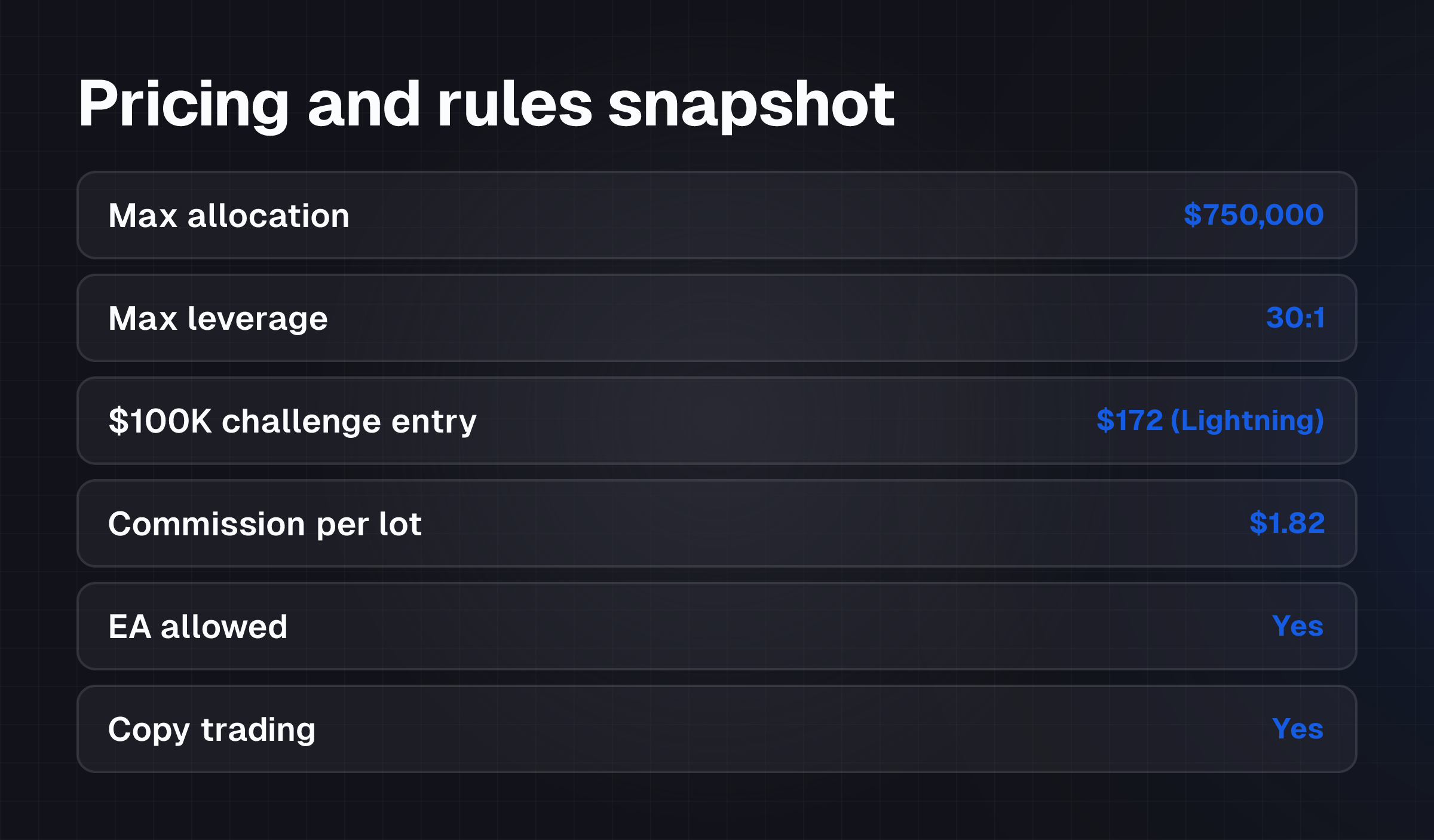
Choose Tradeify if you trade E-mini Russell, Micro Nasdaq, S&P 500 futures, or forex pairs on futures exchanges; require multiple platform integrations (NinjaTrader, Tradovate, or Sierra Chart); want daily payout cycles; and accept 30:1 maximum leverage.
Best for:
- Futures day traders scaling from challenge to funded accounts
- Traders using NinjaTrader, Tradovate, or Sierra Chart
- Accounts requiring EA and copy trading functionality
- Traders seeking frequent withdrawal cycles and low-cost domestic bank transfers
Avoid if:
- You need leverage above 30:1
- You trade primarily spot forex or crypto spot markets
- You are located in one of 57 restricted territories (including Afghanistan, Australia, Brazil, China, France, United States, and others listed in Tradeify's help center)
- You want to start with a free trial before paying for a challenge
Choose FTMO if you trade forex, crypto, indices, commodities, stocks, or options; prefer MetaTrader 4, MetaTrader 5, or cTrader; need leverage up to 100:1; and want a refundable challenge fee or free trial period.
Best for:
- Forex traders seeking high leverage and varied asset classes
- Traders who use MetaTrader or cTrader exclusively
- Those looking for a refundable challenge fee option
- Traders requiring a free trial to test strategy before payment
Avoid if:
- You require direct futures market access
- You are restricted from participating due to your country of residence (including the United States, Australia, and others)
- You need a firm that offers copy trading
Main pros:
- Tradeify: Specialized futures infrastructure, daily payouts, copy trading allowed, platform flexibility (9 integrations).
- FTMO: Higher maximum leverage (100:1), larger maximum allocation (scales to $2,000,000), free trial available, refundable challenge fees on select account sizes.
Main cons:
- Tradeify: Lower maximum leverage (30:1), smaller maximum allocation ($300,000), no free trial period.
- FTMO: No futures access, no copy trading, higher base pricing for some account sizes.
Pricing/rules snapshot:
| Feature | Tradeify | FTMO |
|---|---|---|
| Max allocation | $300,000 | Scales to $2,000,000 |
| Max leverage | 30:1 | 100:1 |
| Lightning $100K challenge | $172 | 1-Step $100K: $499 |
| Commission per lot | $1.82 | $2.50 per side ($5 round trip) |
| EA allowed | Yes | Yes |
| Copy trading | Yes | No |
| Free trial | No | Yes |
Last verified: 24 November 2026
Source confidence: Pricing verified from official websites and current promotional codes. Platform support and payout methods drawn from published documentation. Leverage and allocation limits confirmed via firm websites.
Pricing and account sizes
Tradeify offers two main challenge programs: Growth and Lightning. The Lightning program typically provides lower entry costs for the same account sizes.
Tradeify pricing (current as of 24 November 2026)
| Program | Account Size | Price | Notes |
|---|---|---|---|
| Growth | $50,000 | $107 | 1-Step and 2-Step options |
| Lightning | $50,000 | $107 | Fast-track evaluation |
| Lightning | $100,000 | $172 | Current promotional pricing |
| Lightning | $150,000 | $240 | Current promotional pricing |
Additionally, the firm has an "Unlimited Evaluation Accounts" promotion that enables traders to manage multiple simulated-funded accounts and retain a significant portion of their simulated profits.
FTMO pricing (current as of 24 November 2026)
FTMO offers 1-Step, 2-Step, and Instant Funding options. The 2-Step challenge includes a refundable fee on select account sizes.
| Challenge Type | Account Size | Price | Refundable |
|---|---|---|---|
| 1-Step | $10,000 | $79 | No |
| 2-Step | $10,000 | $89 | Yes |
| 1-Step | $25,000 | $199 | No |
| 2-Step | $25,000 | $250 | Yes |
| 1-Step | $50,000 | $319 | No |
| 2-Step | $50,000 | $345 | Yes |
| 1-Step | $100,000 | $499 | Yes |
| 2-Step | $100,000 | $540 | Yes |
| 1-Step | $200,000 | $999 | No |
| 2-Step | $200,000 | $1,080 | Yes |
| Instant Funded | $5,000 | $169 | No |
| Instant Funded | $10,000 | $339 | No |
| Instant Funded | $25,000 | $749 | No |
| Instant Funded | $50,000 | $1,499 | No |
| Instant Funded | $100,000 | $2,999 | No |
FTMO also offers a free trial with no time limit and accounts up to $200,000, allowing traders to test the platform and rules before committing payment.
Account size comparison
Tradeify caps allocations at $300,000, while FTMO scales to $2,000,000. This makes FTMO the choice for traders seeking larger capital allocations. For mid-range accounts ($50K to $150K), both firms offer comparable pricing on their most competitive tier.
Evaluation and trading rules
This section compares the evaluation phases, trading conditions, and permitted strategies for each firm's challenge programs.
Tradeify evaluation structure
Tradeify offers Growth and Lightning programs, each with 1-Step and 2-Step options. The specific profit targets, daily loss limits, and overall drawdown percentages for these programs are not detailed in this review's data.
Both programs allow Expert Advisors (EAs) and copy trading. Traders can use automated strategies and signal-following approaches during the evaluation phase, which distinguishes Tradeify from many competitors.
FTMO evaluation structure
FTMO provides three evaluation pathways: 1-Step Challenge, 2-Step Challenge, and Instant Funding (which skips evaluation entirely). The 1-Step Challenge requires traders to pass a single evaluation phase with a 50% consistency rule. Instant Funding accounts operate on a 30% consistency requirement.
Like Tradeify, FTMO allows Expert Advisors. However, FTMO does not permit copy trading. Traders using the FTMO News Indicator must have automated trading enabled and may require DLL imports, depending on platform configuration.
Key differences
The main structural difference is that Tradeify permits copy trading during evaluation, while FTMO does not. This makes Tradeify more flexible for signal-following traders and those who wish to replicate a strategy from another account. Both firms allow EA-based automation, so algorithmic traders can use either platform.
Drawdown and risk rules
Drawdown and risk management rules govern how much losing capital traders can sustain during the evaluation phase.
Tradeify risk management
The specific daily drawdown percentage, overall maximum drawdown, and risk thresholds for Tradeify's Growth and Lightning programs are not covered in this review's sourced data. Traders should consult Tradeify's help center for current drawdown limits and risk policies before entering a challenge.
FTMO risk management
FTMO's 1-Step Challenge enforces a 50% consistency rule; specific daily and overall drawdown percentages are not fully detailed across all account sizes in this review's data. FTMO's Instant Funding accounts operate under a 30% consistency requirement. Traders are advised to review FTMO's official challenge rules for precise drawdown thresholds.
Risk framework considerations
Both firms employ consistency rules or drawdown caps to protect trader capital, but the exact percentages and calculation methods differ. This review does not cover complete drawdown matrices for either firm; traders should verify the specific limits that apply to their chosen challenge size and program type before entering.
Payouts and profit split
Payout methods, frequency, and profit distribution terms determine how and when traders receive their earnings.
Tradeify payout options
Tradeify offers multiple payout methods:
- Bank Transfer
- Crypto (USDT, USDC)
- E-wallet
- PayPal
- Deel
- Wise
- Rise Pay
The firm publishes daily payout options and supports 5-day withdrawal cycles. This makes Tradeify attractive for traders who prefer frequent access to profits. Commission per lot is $1.82.
FTMO payout options
FTMO provides the following withdrawal methods:
- Bank Transfer
- Crypto (Bitcoin, Ethereum, Litecoin, Terra, USDC, USDT)
- E-wallet
- Wise
- Revolut Bank Wire
- Visa Direct
- Mastercard Send
FTMO's payout frequency is not detailed in this review's data. Commission is $2.50 per side ($5 round trip) per lot.
Profit split comparison
Both firms retain a share of trader profits as the firm's take, but specific percentage breakdowns are not covered in this review's sourced data.
Platforms and instruments
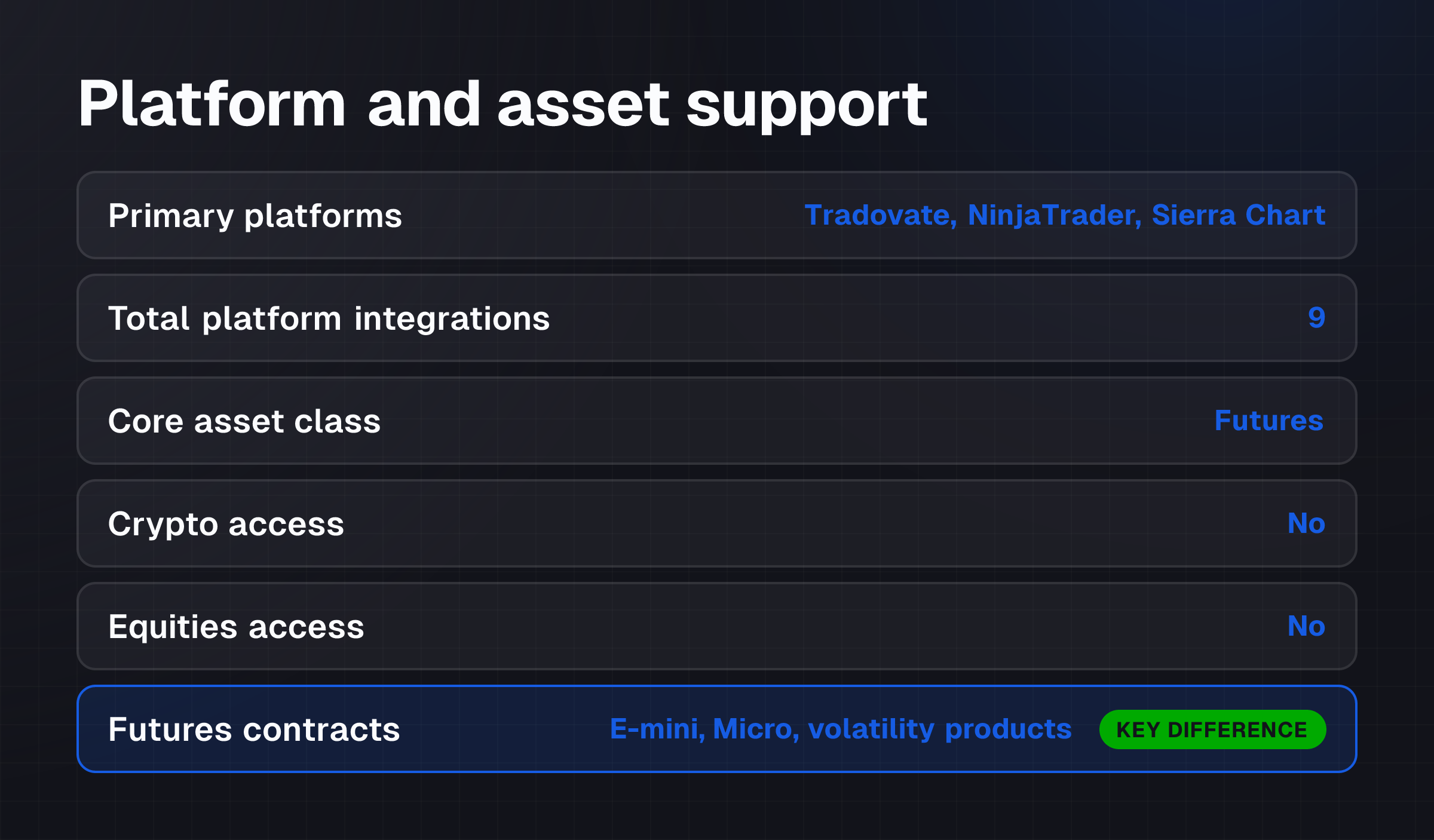
Trading platform compatibility and available asset classes determine which instruments and execution environments each firm supports.
Tradeify platforms and assets
Tradeify supports nine trading platforms:
- Tradovate
- NinjaTrader
- TradingView
- Quantower
- Sierra Chart
- Rithmic
- MetaTrader 4
- MetaTrader 5
- cTrader
This broad integration allows traders to use their preferred interface without platform switching. Tradeify specializes in futures and offers access to:
- E-mini Russell, Micro Nasdaq, S&P 500 futures
- Indices (Russell, Nasdaq 100, Dow)
- Metals, Energy, Commodities
- Forex pairs on futures exchanges
- Bonds, Interest Rate Contracts, Grains, Livestock
- Volatility products (VSTOXX, STOXX Europe 600)
Tradovate, NinjaTrader, and Sierra Chart are the most commonly used Tradeify routing platforms for futures traders.
FTMO platforms and assets
FTMO's primary trading environments are:
- MetaTrader 4
- MetaTrader 5
- cTrader
- TradingView (for Instant Accounts)
FTMO supports a broader asset range than Tradeify:
- Forex (GBPUSD, EURUSD, USDCAD, DXY)
- Crypto (Bitcoin, Ethereum, Litecoin, XRP, Dogecoin, Cardano)
- Indices (S&P 500, Nasdaq 100, US30)
- Commodities (metals, energy)
- Equities CFDs (Apple, Microsoft, Tesla, Google, Amazon, and 50+ stocks)
- Options (select contracts)
The main advantage for FTMO is access to spot crypto and equities CFDs, which Tradeify does not offer.
Platform fit by strategy
- Choose Tradeify if: You use NinjaTrader, Sierra Chart, or Tradovate and trade futures exclusively.
- Choose FTMO if: You rely on MetaTrader 4 or 5 and trade forex, crypto spot, or stock CFDs.
The platform choice often determines the firm: if your strategy is built on MT4/MT5, FTMO is the only practical option. Conversely, if you scalp E-mini contracts on NinjaTrader, Tradeify is the natural fit.
How it compares: Tradeify vs FTMO
| Feature | Tradeify | FTMO |
|---|---|---|
| Founded | 2015 | 2014 |
| Specialization | Futures | Forex, CFDs, Crypto |
| Max allocation | $300,000 | Scales to $2,000,000 |
| Max leverage | 30:1 | 100:1 |
| Platforms | 9 integrations (Tradovate, NinjaTrader, Sierra Chart, MT4, MT5, cTrader, TradingView, Quantower, Rithmic) | 4 (MetaTrader 4, MetaTrader 5, cTrader, TradingView) |
| Commission per lot | $1.82 | $2.50 per side ($5 round trip) |
| EA allowed | Yes | Yes |
| Copy trading | Yes | No |
| Free trial | No | Yes |
| Challenge types | Growth, Lightning (1-Step, 2-Step) | 1-Step, 2-Step, Instant Funding |
| Payout methods | 7 options (Bank, Crypto, E-wallet, PayPal, Deel, Wise, Rise Pay) | 7 options (Bank, Crypto, E-wallet, Wise, Revolut, Visa Direct, Mastercard Send) |
| Refundable fees | Not covered in this review's data | Yes, on select 2-Step accounts |
| Instant funding | Not offered | Yes ($169, $2,999) |
Biggest operational differences
Leverage is the first divergence. FTMO's 100:1 cap is 3.3 times higher than Tradeify's 30:1, enabling higher position sizing on forex and CFDs but greater drawdown risk.
Asset access separates the two firms entirely. FTMO covers forex, crypto spot, and equities CFDs; Tradeify covers futures exclusively. These are distinct markets with separate execution and margin models.
Cost structure matters for volume traders. FTMO charges $2.50 per side ($5 round trip) per lot and Tradeify $1.82 per lot. High-frequency traders on either platform should factor this into profitability calculations.
Copy trading is allowed on Tradeify but not on FTMO. For signal followers or managed account traders, this is a decisive feature.
Trial period lowers entry risk. FTMO offers a free trial; Tradeify does not.
Platform-driven choice
The choice between these firms often comes down to platform and asset class:
- If you trade micro contracts on NinjaTrader, Tradeify is your only option.
- If you scalp EURUSD on MetaTrader 5, FTMO is the practical choice.
- If you use an EA on Sierra Chart to trade Russell 2000 E-minis, Tradeify is the fit.
- If you want to copy a profitable forex signal, Tradeify's copy trading feature is essential; FTMO cannot support it.
Frequently asked questions
What is the main difference between Tradeify and FTMO?
Tradeify specializes in futures trading routed through Tradovate, NinjaTrader, and Sierra Chart, with a 30:1 leverage cap and daily payouts. FTMO focuses on forex, CFDs, and crypto on MetaTrader and cTrader, with up to 100:1 leverage and higher maximum allocations. The choice depends on your instrument (futures vs. forex/crypto) and preferred platform.
Can I use an EA on both platforms during evaluation?
Yes. Both Tradeify and FTMO allow Expert Advisors during the challenge phase. However, only Tradeify permits copy trading; FTMO does not. If your strategy relies on replicating another trader's signal, Tradeify is required.
Which firm is cheaper per lot?
FTMO charges $2.50 per side ($5 round trip) per lot, while Tradeify charges $1.82 per lot. Tradeify's challenge entry fees run $107 to $240.
Does FTMO offer a free trial?
Yes. FTMO provides a free trial with no time limit and accounts up to $200,000, allowing you to test the platform and rules before paying for a challenge. Tradeify does not offer a free trial; all challenges require an upfront fee.
Which firm allows higher leverage?
FTMO's maximum leverage is 100:1; Tradeify's is 30:1. FTMO is the choice for forex and CFD traders seeking higher leverage and position size. Tradeify's lower leverage reflects its futures specialization, where CME Group rules and margin requirements often limit leverage caps.
Can I trade crypto on both platforms?
Tradeify does not offer crypto spot trading; it focuses on futures and forex pairs on futures exchanges. FTMO supports crypto spot CFDs (Bitcoin, Ethereum, Litecoin, XRP, and others) with up to 100:1 leverage. If crypto spot access is essential, FTMO is the only choice between these two.
The full picture is in our Firm-vs-firm at volume guide.