Prop Firm Overnight Holding Rules: What to Check
By Tomas Rieder

Some prop firms allow overnight holding, but permission can depend on the account type, evaluation stage, instrument and trading platform. Overnight holding does not automatically mean weekend or news-event holding is permitted.
Holding trades overnight through a prop firm exposes you to gap risk, drawdown penalties, and overnight fees, but only if you understand your firm's rules first. Before you commit capital to overnight positions, you need to verify three things: whether your firm permits overnight holding at all, how overnight price gaps affect your drawdown limits, and what costs or margin changes kick in after hours. This guide walks you through the checks that prevent early account termination.
Key takeaways: what to confirm before holding overnight
Verify your firm's overnight holding policy explicitly, permission varies by asset class, position size, and news event windows. Understand how overnight price gaps interact with your daily and trailing drawdown calculations; a gap down can breach limits on market open. Check swap and rollover fees, margin requirements for overnight positions, and whether weekend holding is allowed.
Monitor economic calendars and volatility forecasts before holding into high-impact events; news released outside market hours drives most overnight gaps. Underestimating drawdown impact and ignoring firm-specific restrictions are the most common reasons overnight positions breach accounts.
What it means: overnight holding in prop firm trading
Overnight holding means keeping an open position after the regular market close and into the next trading session.
In prop firm terms, this matters because most firms impose strict daily and trailing drawdown limits, and those limits interact with overnight risk in ways that can terminate your account faster than you expect.
When you hold overnight, your position is exposed to market movements during off-hours: news releases, geopolitical events, earnings announcements, or central bank decisions. If a market gaps against you at the open, your account equity can drop instantly. That single gap can trigger a daily drawdown violation or push your trailing drawdown past the firm's limit, ending your trading immediately.
Key definitions that shape overnight risk:
Gap risk: The price of an instrument jumps significantly from one session's close to the next session's open, skipping intermediate prices. Most overnight gaps occur because of news released outside market hours.
Maximum daily drawdown: The largest permissible single-day loss. The calculation method matters: does it reset from the previous day's close or the current day's open? A gap down overnight can breach this limit before you trade a single contract on market open.
Maximum trailing drawdown: The largest permissible loss measured from your highest peak equity ever. An overnight dip reduces your capital and pulls you closer to this limit.
Swap and rollover fees: Charges or credits applied for holding positions overnight, particularly in forex and futures. These fees erode profits over time, especially on longer-duration trades.
Margin requirements: Collateral needed to hold a position. Requirements can increase significantly for overnight or weekend positions on volatile assets.
Why it matters: overnight positions breach accounts more than day trades do
Overnight holding is the fastest way to breach a prop firm account, not because it's inherently riskier, but because drawdown rules are rigid and gaps are unpredictable.
A single overnight move can erase days or weeks of profit and trigger a drawdown violation instantly.
The interaction between overnight risk and drawdown mechanics is what most traders underestimate. If your firm calculates daily drawdown from the current day's open, and a market gaps down 2% overnight, you start the next trading session already 2% behind. That gap counts toward your daily drawdown limit. You may have zero margin for error the moment the market opens.
Trailing drawdown is equally punishing. One bad overnight gap reduces your peak equity permanently. If your firm allows a 10% trailing drawdown and you hold through an overnight gap that costs 5%, you're halfway to account termination before you place the next trade.
News events amplify overnight risk. Economic data releases, central bank announcements, and earnings reports released outside market hours cause price gaps that bypass protective stops. Liquidity also shrinks overnight, especially in less common instruments, widening bid-ask spreads and making it harder to exit at desired prices if you need to close a losing position fast.
Understanding overnight holding rules before you build positions on them prevents account termination and wasted capital. Overnight Holding: What Breaches an Account covers the mechanics of how overnight gaps interact with specific drawdown types.
How it works: the verification process before holding overnight
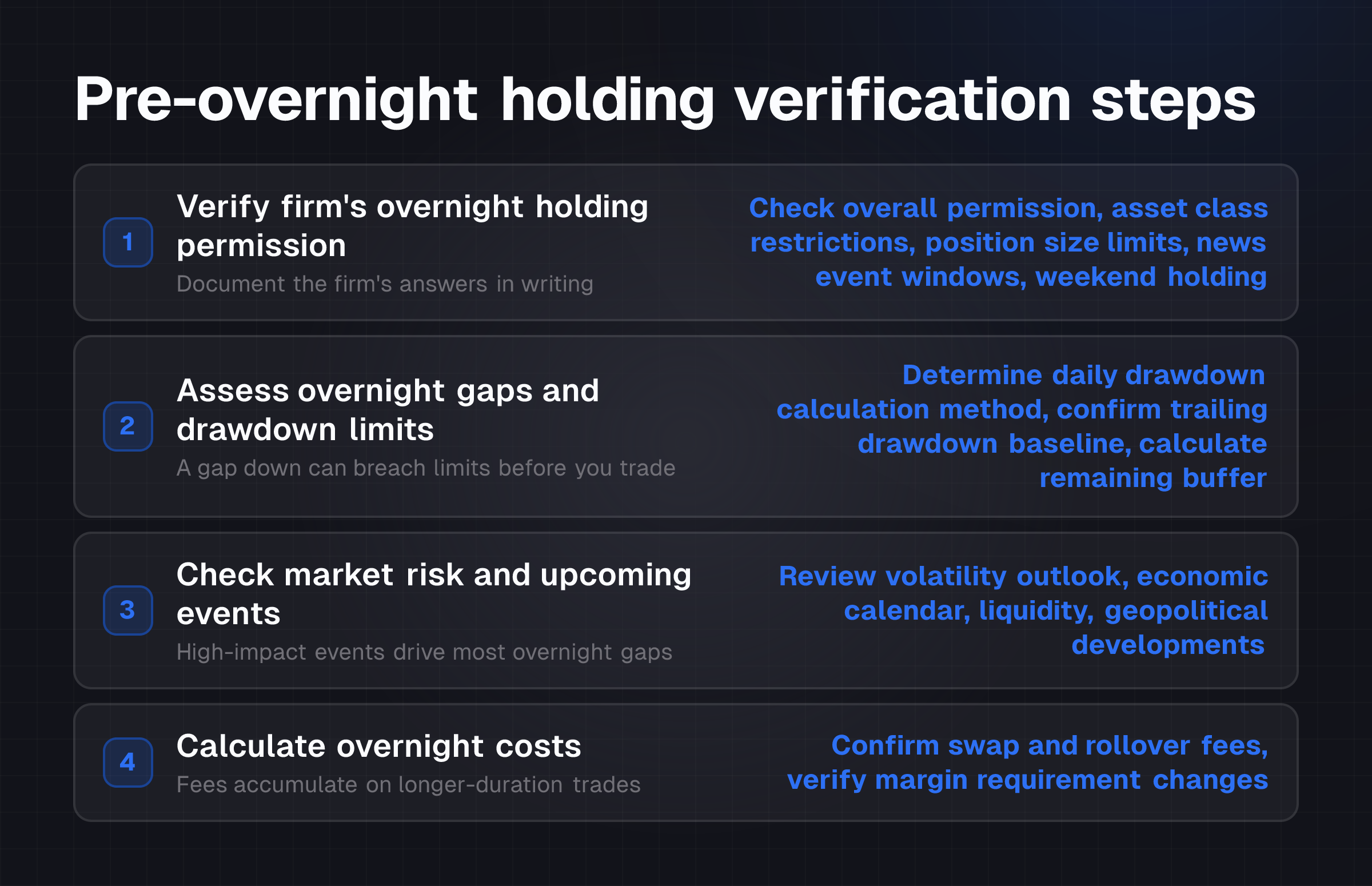
Step 1: Verify your firm's overnight holding permission
Start by confirming whether your firm permits overnight holding at all.
Not all prop firms allow it, and those that do often impose conditions.
Ask your firm directly or review their rules documentation for:
Overall permission: Do they allow overnight holding, or is it prohibited entirely?
Asset class restrictions: Are certain instruments banned from overnight holding? For example, some firms restrict overnight holding on volatile single stocks or specific futures contracts.
Position size limits: Are there caps on the maximum size you can hold overnight? A firm might allow overnight holding but only on positions under 5 or 10 micro contracts.
News event windows: Is overnight holding suspended around major economic announcements, central bank meetings, or earnings? Some firms restrict OH only during high-impact news windows.
Weekend holding: Can you hold positions over a weekend? Weekend gaps are often larger than weekday overnight gaps because markets are closed for 60+ hours.
Document the firm's answers in writing. Policy violations, even unintentional ones, are grounds for account closure.
Step 2: Assess how overnight gaps affect your drawdown limits
This is the step most traders skip, and it's where accounts breach.
For daily drawdown, determine:
Does the firm calculate daily drawdown from the previous day's close or the current day's open? If it resets from the previous day's close and you hold overnight, does a gap down count against your daily limit?
Example: Your daily drawdown limit is 5%. You end Tuesday with $10,000 equity. Wednesday at open, a gap causes your equity to drop to $9,600 (a 4% loss). You've already used 80% of your daily allowance before trading a single contract.
For trailing drawdown, understand:
Your trailing drawdown is measured from your highest peak equity ever achieved. An overnight gap that reduces your equity pulls down the baseline for this calculation. If you had $12,000 peak equity and a gap causes you to drop to $11,000, your allowable range shrinks immediately, regardless of whether you made a trade.
Ask your firm or review their rules for these specific calculation methods. Don't assume all firms calculate drawdown the same way.
Step 3: Check market risk and upcoming events
Before you hold any overnight position, assess whether market conditions justify the overnight gap risk.
Volatility outlook:
Check volatility indices for your asset class (VIX for equities, for example). Higher volatility increases both gap size and likelihood. Historical price action also signals volatility: if the asset has moved 3% or more on recent overnight gaps, overnight holding carries elevated risk for your account.
Economic calendar:
Review upcoming economic data releases and central bank meeting schedules. Events scheduled for outside market hours (pre-market or after-hours announcements) are primary drivers of overnight gaps. Common high-impact events: US employment data (non-farm payrolls), central bank interest rate decisions, GDP announcements, earnings reports.
Liquidity assessment:
Less liquid instruments tend to gap larger overnight and have wider bid-ask spreads. If you need to exit a losing overnight position in a hurry, poor liquidity makes it harder to get a fill near current prices.
Geopolitical and macro monitoring:
Broader market sentiment and unfolding geopolitical developments can create sudden overnight shifts. This is harder to quantify but necessary context.
Step 4: Calculate overnight costs
Swap and rollover fees:
Holding positions overnight triggers charges or credits based on interest rate differentials (particularly in forex and futures). These fees accumulate on long-duration trades and can materially erode profits.
Example: If your firm charges $2 per contract per night held and you hold 5 contracts over 10 nights, that's $100 in fees before you count any market movement.
Request your firm's fee schedule for overnight positions in your target instruments.
Margin requirement changes:
Margin requirements often increase for overnight or weekend positions, especially on volatile assets. Ensure you have sufficient capital to cover increased margin to avoid a margin call. A margin call closes your position involuntarily, locking in losses and potentially breaching your drawdown limits in the process.
Example or scenario: overnight holding decision framework
Scenario: You're long ES (E-mini S&P 500) into a Wednesday close.
Checks you perform before holding overnight:
Firm permission: Your prop firm allows overnight ES holding up to 10 contracts. You're holding 5, so you're within limits.
Drawdown interaction: Your firm calculates daily drawdown from the previous day's open. Your current daily loss is 2% (used 40% of your 5% daily limit). You have $10,000 equity.
Event risk: You check the economic calendar. Non-farm payrolls (jobs data) will be released Friday morning before the US market open. This is a high-volatility event. Historically, ES has gapped 1-3% on NFP data.
Overnight costs: Your firm charges no swap on ES. Margin is unchanged for overnight holding.
Decision:
Friday's NFP release is outside regular market hours (before the Friday open). Holding ES overnight Thursday, Friday morning exposes you to a potential 1-3% gap at the Friday open.
A 3% gap down would reduce your equity from $10,000 to $9,700, a 3% loss. Combined with your existing 2% daily loss, you'd hit 5% and breach your daily drawdown limit.
Conclusion: You close your ES position Wednesday. Waiting until after the Friday open to re-enter is safer for your account.
Alternative scenario:
If NFP were released Wednesday after the close (instead of Friday morning), holding overnight Wednesday, Thursday would avoid the event. Thursday's open wouldn't be affected by a Wednesday announcement. In that case, holding overnight becomes lower-risk (though not zero-risk).
Common mistakes or risks: what gets traders terminated early
Underestimating drawdown impact
The most common mistake is failing to account for how overnight gaps instantly trigger drawdown limits.
Traders often think: "I have a 10% daily drawdown limit. I can hold overnight because a small gap won't hit that." But if you've already used 5-6% of your daily allowance and hold overnight during a volatile event, even a 2-3% gap breaches your limit.
Prevention: Calculate your remaining daily drawdown buffer before you hold overnight. If you've used more than 50% of it, closing your position is safer than gambling on overnight price stability.
Ignoring swap and rollover fees
Overnight fees seem small per night ($1-5 per contract, typically) but compound quickly on longer-duration trades.
A trader holding 10 contracts for 20 nights at $2 per contract per night incurs $400 in fees. If the position only makes 0.5%, that's $500 profit before fees, meaning the net profit is only $100 after fees. Many traders simply don't factor this into their P&L.
Prevention: Calculate total overnight fees into your expected profit before you hold. If fees exceed 50% of your expected profit, the risk-reward is poor.
Overlooking firm-specific restrictions
Prop firms have different rules.
Some prohibit overnight holding on news events. Others cap overnight position sizes. Some allow weekend holding; others don't.
Assuming all firms operate the same way leads to policy violations and account closure.
Prevention: Request your firm's overnight holding rules in writing. Confirm restrictions on asset classes, position sizes, news events, and weekends explicitly. Don't rely on guesses or conversations; get documentation.
Lack of risk management for overnight positions
Holding overnight without a pre-defined exit strategy is the fastest way to turn a manageable loss into an account breach.
If a gap moves against you and you have no predetermined exit level, panic or indecision can trap you in a losing position while your drawdown limit tightens.
Prevention: Before you hold overnight, define:
A maximum loss level (in dollars or %) you'll accept before closing. An exit plan if you wake up to a gap that breaches that level. A trailing stop or limit order at a level you're comfortable with.
Prop Firm Overnight holding Rules: A Trader's Checklist covers these rules in detail with a structured verification checklist.
How to choose or what to do next
Before you hold overnight for the first time
Get your firm's overnight holding policy in writing. Email support or check their rules documentation. Confirm permission, asset class restrictions, position size caps, news event windows, and weekend rules.
Map your drawdown limits to overnight gaps. Calculate what percentage of your daily and trailing drawdown buffers remain. If less than 25% remains, close the position instead of holding overnight.
Check the economic calendar for the next 48 hours. If high-impact events are scheduled outside market hours, skip overnight holding for that window.
Calculate total overnight fees. Add swap, rollover, and any other overnight charges into your expected profit. If overnight costs exceed 20-30% of your edge, the risk-reward is poor.
Set a pre-defined exit plan. Decide your maximum loss level, trailing stop, or limit order before you hold. Document it.
Building a sustainable overnight holding strategy
Once you've verified your firm's rules and understood the interaction with your drawdown limits, you can build an overnight strategy that's sustainable:
Limit overnight positions to low-volatility windows: Hold overnight only when the economic calendar is clear and volatility is subdued.
Size overnight positions smaller than day trades: If you day-trade 10 contracts, consider holding overnight only on 5 or fewer. This reduces gap impact on your account.
Use overnight holding for trend captures, not scalping: Overnight holding makes sense when you're targeting a longer-term move (hours or days). Scalping overnight is self-defeating because overnight fees erode thin margins.
Monitor your trailing drawdown closest margin: As you get closer to your trailing drawdown limit, stop holding overnight. The risk of an accidental breach isn't worth the potential reward.
What to verify before signing up for a prop firm
If you're evaluating prop firms and overnight holding is part of your trading plan, How to tell if a prop firm actually pays: the 2026 verification checklist includes steps to confirm that a firm's published rules are actually enforced and that payouts align with their stated policy.
Similarly, if your strategy involves automation or alternative trading methods, How to Check if a Prop Firm Allows Your EA walks through verification for rule compliance before you deploy capital.
Frequently asked questions
Does overnight holding always count against my daily drawdown limit?
It depends on how your firm calculates daily drawdown.
If they reset from the previous day's close, overnight gaps count against your daily limit. If they reset from the current day's open, the overnight gap itself doesn't count, but any loss you incur after the market opens that day does. Always confirm your firm's calculation method in writing before you hold overnight.
What happens if a gap triggers my drawdown limit while the market is closed?
Most firms monitor drawdown violations at market open.
Your position will be closed automatically, locking in the loss. This can happen before you have a chance to exit manually. That's why understanding your remaining drawdown buffer before you hold overnight is critical.
Do all prop firms charge swap fees for overnight positions?
No.
Some firms charge swap fees (particularly on forex and futures); others don't charge fees on equities or micro contracts. Request your firm's fee schedule explicitly. Don't assume fees are zero; confirm in writing.
Can I hold through a weekend?
Some firms allow weekend holding; others prohibit it.
Weekend gaps are often larger than weekday overnight gaps because markets are closed 60+ hours. Confirm your firm's weekend holding rules before you hold into Friday close with the intention of holding into Monday open.
How do I know if an economic event will cause a big overnight gap?
Check the economic calendar for the announcement time and historical volatility of that data release.
High-impact events (non-farm payrolls, central bank rate decisions, major GDP prints) typically move markets 1-3%. Cross-reference the event time against market hours: if it's released outside your market's trading window, overnight gap risk is elevated. Avoid holding overnight into these windows.
What is the safest size for my first overnight position?
Start small, 50% of your typical day-trade size or smaller.
This limits the gap impact on your account. If your first overnight position works, you can gradually increase size once you see how your firm's rules interact with real overnight moves. Always prioritize staying in the account over maximizing size.