Prop Firm Discount Codes: A Curated List of Verified Offers

Legitimate discount codes for prop firm evaluations exist, but they vary wildly in type and actual value. Percentage discounts, fixed-amount reductions, refundable fees, reset packages, each carries different cash-flow and risk implications. Finding verified codes means checking the firm itself, then cross-referencing terms and expiry dates. Our exclusive offers page lists every code we have confirmed with the firm. Understanding which discount type suits your evaluation size and risk tolerance is the difference between saving a small amount and meaningfully reducing your barrier to entry.
This article explains the discount types you'll encounter, how to verify them before you buy, and which offers typically deliver better value for different trading scenarios.
Quick answer: Where to find legitimate codes and which type saves the most
Legitimate discount codes come from two sources: official firm websites (most reliable) and affiliate partner channels (verify against official announcements). These are the exclusive codes active on WhatProp right now:
| Firm | Code | Discount | Offer | Get deal |
|---|---|---|---|---|
| GOAT Funded Futures | WHATPROP | 55% off | 55% off with WHATPROP | Get deal |
| Atlas Funded | WHATPROP | 50% off | 50% off with WHATPROP | Get deal |
| Funding Traders | WHATPROP | 50% off | 50% off with WHATPROP | Get deal |
| Sure Leverage | WHATPROP | 42% off | 42% off with WHATPROP | Get deal |
| Goat Funded Trader | WHATPROP | 40% off | 40% off with WHATPROP | Get deal |
| Alpha Capital Group | WHATPROP | 40% off | 40% off with WHATPROP | Get deal |
| FunderPro | WHATPROP | 30% off | 30% off all challenges and Instant Funded | Get deal |
| Blueberry Funded | WHATPROP | 30% off | 30% off with WHATPROP | Get deal |
| Blue Guardian | WHATPROP | 25% off | 25% off with WHATPROP | Get deal |
| For Traders | WHATPROP | 15% off | 15% off with WHATPROP | Get deal |
| FTM | WHATPROP | 10% off | Extra 10% off 100K+ evaluations | Get deal |
| Bullwaves Prime | WHATPROP | 10% off | 10% off with WHATPROP | Get deal |
| FXIFY | WHATPROP | 10% off | 10% off with WHATPROP | Get deal |
| Eightcap Challenges | WHATPROP | 10% off | 10% off Challenges with code WHATPROP | Get deal |
| FundingPips | BJH4QYR1 | 10% off | 10% off your first purchase | Get deal |
| Pipstone Capital | WHATPROP | 5% off | 5% off with WHATPROP | Get deal |
| The5ers | WHATPROP | 5% off | 5% off with WHATPROP | Get deal |
| Dominion Funding | WHATPROP | 5% off | 5% off with WHATPROP | Get deal |
| Earn2Trade | WHATPROP | Code WHATPROP | Get deal |
The discount types differ significantly:
- Percentage off (e.g., 10% off): Direct reduction from listed price. Better value on larger challenges.
- Fixed amount off (e.g., $50 off): Specific monetary reduction. Can offer higher percentage savings on smaller evaluations.
- Refundable fees: A portion or all of the evaluation fee refunded upon passing the challenge or reaching a payout threshold. Saves money only if you succeed, but ties no upfront cost reduction to performance uncertainty.
- Reset/retake offers: Free or discounted re-attempts if the initial evaluation fails. Reduces long-term cost and emotional risk for traders uncertain about passing on the first attempt.
For smaller evaluations under $500, a fixed amount off often saves a higher percentage. For larger challenges, percentage discounts typically yield more absolute savings.
Refundable fees appeal to confident traders; direct discounts suit those managing upfront cash carefully.
The objection: Why you might hesitate to use a code you found online
You've encountered discount codes for prop firms on aggregator sites, YouTube, or trading forums. Several blockers stop you from using them.
Expired or invalid codes. Aggregators don't always update verification dates. A code listed as active might have expired weeks ago, wasting your time at checkout or causing frustration when it fails to apply.
Unclear or hidden terms. A refundable fee sounds great until you realize you must reach a specific profit target to claim it, or that it only applies to a particular account tier. Missing these details leads to unexpected charges.
Misleading comparisons. Without understanding discount types, you might assume a 10% offer always beats a $50 fixed discount, even when the fixed amount saves more on your specific evaluation size.
Source confusion. Third-party aggregators sometimes list unverified or outdated promotions without cross-checking the firm's official website, leaving you unsure whether the offer is real or current.
Affiliate vs. public offers. Codes shared through content creators or trading communities may be exclusive but are harder to verify independently. Failing to cross-reference with official channels risks applying a code that doesn't work or carries undisclosed conditions.
What is actually true: How discount types work and what verification means
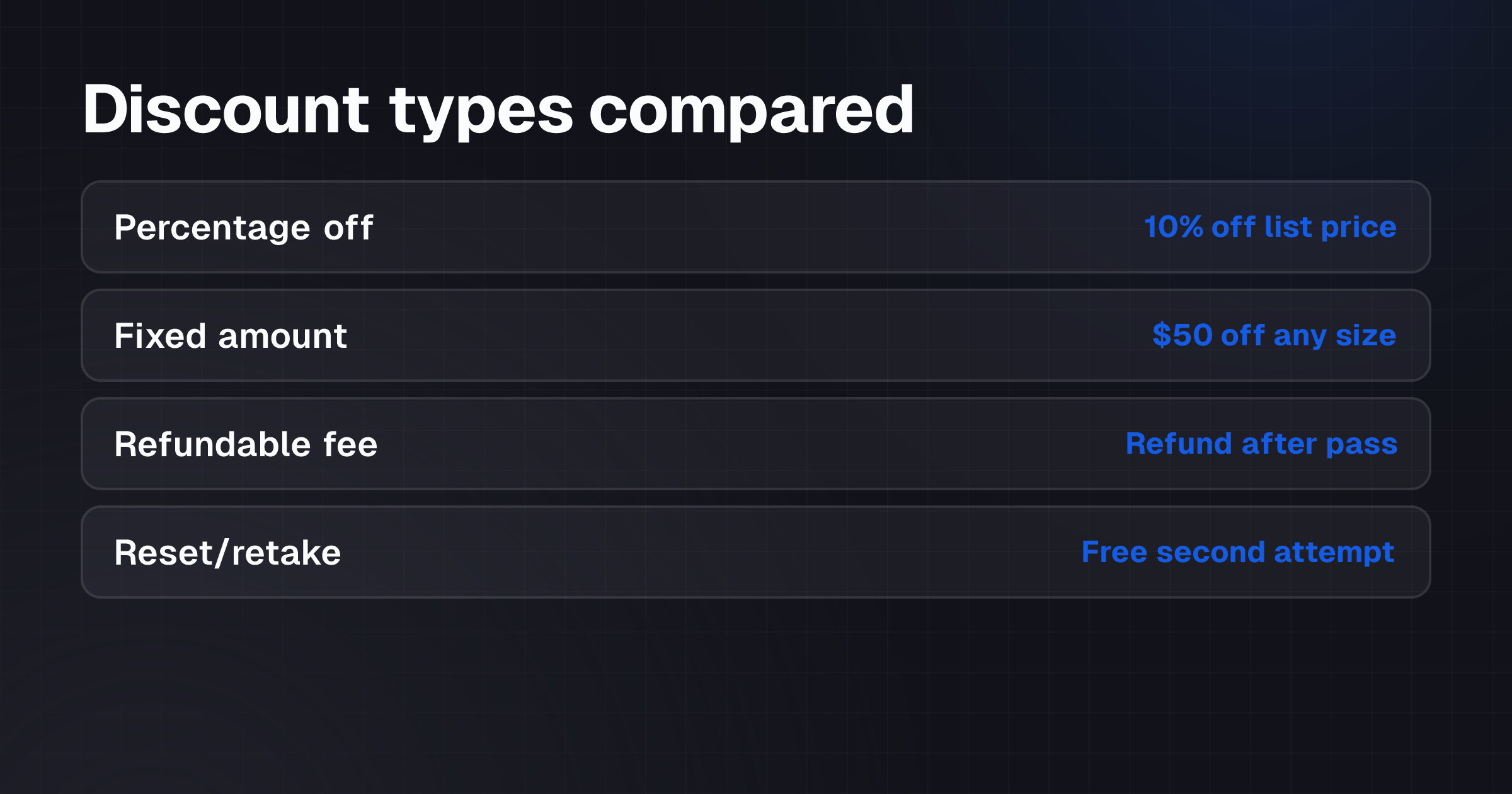
Types of discounts and their actual mechanics
Percentage off. A straightforward reduction from the stated evaluation fee. Ten percent discount on a $500 evaluation saves $50. On a $200 evaluation, it saves $20. As evaluation costs rise, percentage-off deals yield larger absolute savings.
Fixed amount off. A set dollar reduction regardless of evaluation size.
A $50 discount on a $500 evaluation is 10% off; the same $50 off a $200 evaluation is 25% off. For smaller challenges, this type often delivers a higher percentage reduction than published percentage-off offers.
Refundable fees. Some firms structure offers where a portion or the entirety of an evaluation fee is refunded upon successful completion of the challenge or reaching a payout threshold. This is not a direct upfront discount, you pay full price initially, but it functions as a cost reduction if you pass.
The cash-flow implication is significant: you must fund the full challenge cost upfront, then reclaim money after success. This approach appeals to traders confident in their ability to pass but carries the risk that failure means no refund. Understanding the exact pass criteria (reaching a profit target, maintaining a risk limit) is essential before committing.
Account credit or bonus. Less common as a direct purchase discount. Some firms offer credit towards a future purchase or a bonus upon funding an account after passing. This shifts value to a later stage and appeals to traders planning multiple attempts or longer engagement.
Resets and retakes. Offers that provide free or discounted re-attempts at an evaluation if the initial attempt fails.
Their value lies in reducing long-term total cost and psychological risk. If you pay $100 for one evaluation and fail, a discount-reset offer means the second attempt might cost $50 or be free, capping your total exposure. For traders uncertain about passing on the first try, this can provide significant long-term savings and reduce anxiety around the decision.
What verification actually entails
Verification means confirming that a code is active, legitimate, and correctly applied on the day you buy. The process:
-
Check the expiry date. Confirm the code is still valid on the date you plan to use it. Aggregator sites should list the date they last verified the offer; if that date is more than a few weeks old, cross-check with the firm's official website or contact support.
-
Read terms and conditions. Understand any exclusions (e.g., "not valid on Silver tier accounts"), minimum purchase requirements, or specific eligibility rules. Some codes apply only to first-time buyers; others exclude refunds or resets.
-
Test the code without committing. Attempt to apply the code at the checkout stage on the firm's website and observe whether it registers and shows the correct discount. Most platforms let you see the discount applied before finalizing payment.
-
Cross-reference the offer. Compare what you see on an aggregator site with the firm's official website, social media announcements, or public communications. If an aggregator lists a code that doesn't appear on the firm's own channels, contact support to confirm it's still active.
What we don't yet know
Public data on the frequency and typical duration of prop firm discount campaigns is not centrally compiled. Standard metrics for comparing the 'true value' of different discount types across various firm models, for example, how a 10% discount on a $100 evaluation compares in absolute value to a $10 refundable fee on a $50 evaluation, aren't consistently published.
This comparison draws on verified public rules, official pricing pages, and platform support communications.
What to do next: A step-by-step decision framework
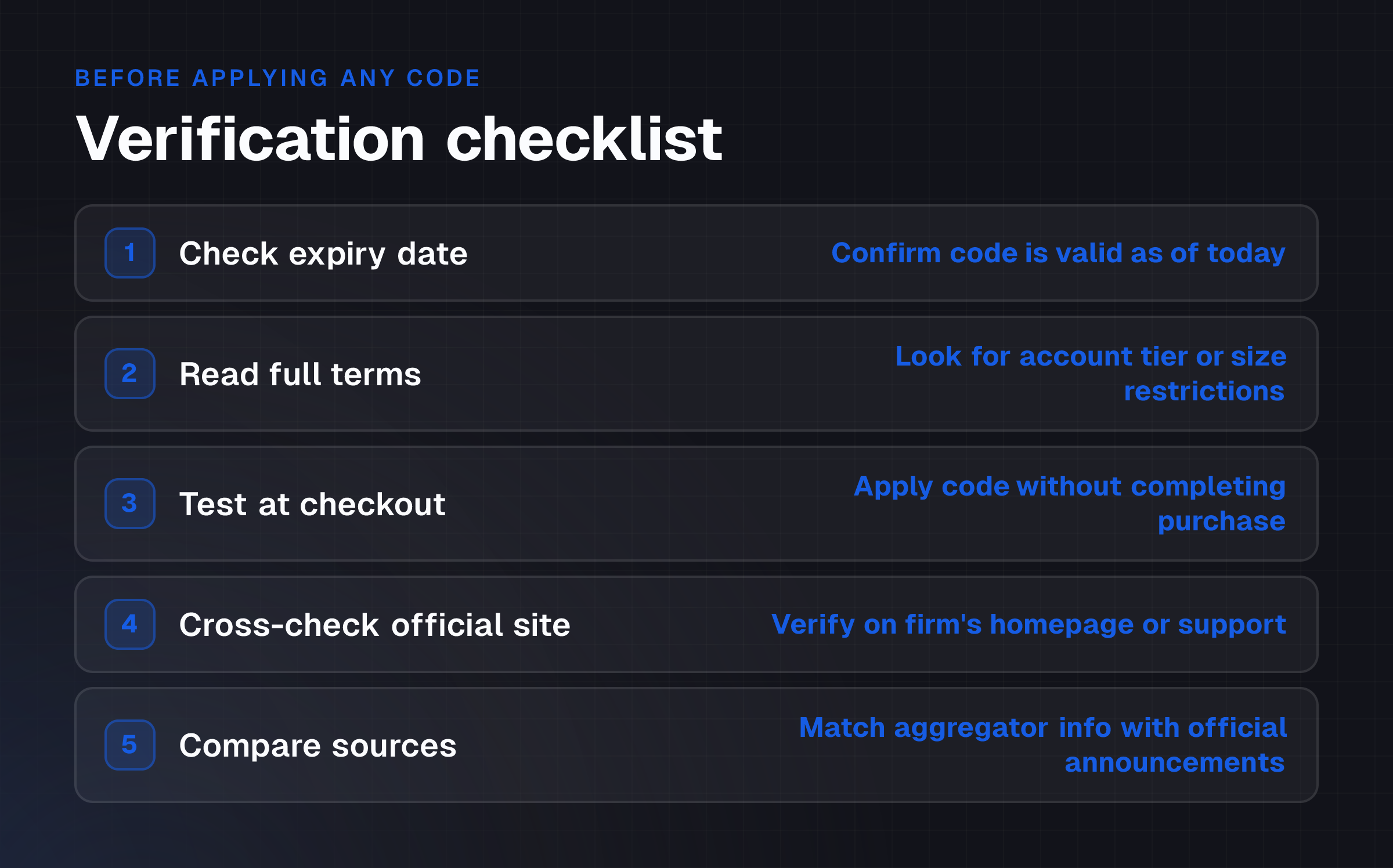
Step 1: Identify your evaluation needs
Determine what kind of challenge or account you're targeting. Are you looking for a small $200 evaluation as a first test, or a $5,000+ account after a previous pass?
Your challenge size will heavily influence which discount type offers the best value. For reference, prop firms under $500 minimum may have different promotional strategies than larger-account platforms.
Step 2: Locate potential discounts
Check these sources in order of reliability:
- Official firm websites. The primary source. Most firms list active promotions on their homepage, pricing page, or FAQ. If you don't see a current offer, it may not exist.
- WhatProp exclusive offers. Codes confirmed with each firm, with their tracked links.
- Affiliate partner channels. Some firms offer unique codes through content creators, trading communities, or educational platforms. Advise caution and always cross-reference with the official website or contact support to confirm the code is legitimate and not expired.
Step 3: Verify the offer
Before applying any code:
- Check the expiry date. Is it still valid today?
- Read the full terms. Are there restrictions on account size, account type, or user eligibility?
- Test the code at checkout (without completing purchase) to confirm it applies correctly.
- Cross-check the offer on the firm's official website or recent social announcements.
Step 4: Compare discount types for your specific situation
Use this framework:
- Upfront cash constraint? Prioritize direct discounts (percentage or fixed amount) to reduce your immediate cost. Refundable fees require full payment upfront and only save money after you pass.
- Uncertain about passing on the first attempt? Look for reset or retake offers. The long-term cost reduction and psychological buffer may outweigh a smaller upfront discount.
- Larger evaluation size (e.g., $1,000+)? Percentage-off codes typically save more in absolute terms than fixed amounts. Compare the two on your specific evaluation size.
- Smaller evaluation size (e.g., under $300)? A fixed-amount code may deliver a higher percentage reduction than a published percentage offer.
For deeper analysis of how different fee structures affect your total cost, see prop firm fees and payouts: the real math.
Step 5: Apply the code
Follow the firm's specific instructions during checkout. Most platforms prompt for a promo code field; paste the code exactly as written (case-sensitive in some systems).
Verify that the discount applies before finalizing payment.
Frequently asked questions
What happens if a discount code I found online doesn't work?
If a code fails to apply, it's likely expired or was never valid for your account tier. Contact the firm's support team with the code and ask for verification. If the code is confirmed defunct, ask whether a current promo is available. Aggregator sites sometimes list outdated offers without updating verification dates, so always cross-check with the official website first.
Is a refundable fee better than a direct discount?
Not always.
A refundable fee saves money only after you pass the evaluation; a direct discount reduces your upfront cost immediately. If cash flow is tight, a direct discount is better. If you're confident in passing and want to minimize your total cost over time, a refundable fee can match or exceed the value of an upfront discount, but only if you succeed. The risk and cash-flow timing differ significantly.
How do I know if a discount code is current?
Check the firm's official website first. If a code appears on an aggregator site, verify the date it was last checked. If that date is more than a few weeks old, contact firm support or check their social media for recent announcements. Test the code at checkout without completing the purchase to confirm it registers.
Can I combine multiple discount codes?
Most prop firms don't allow stacking multiple promo codes on a single purchase. Check the terms of the code you're using, or contact support. Some firms may offer a single best-available discount; using one code typically voids others.
Are affiliate discount codes different from public offers?
Affiliate codes are often exclusive to specific content creators or communities but may carry identical discounts or unique terms. Always cross-reference an affiliate code with the firm's official announcements to confirm it's legitimate and current. Some affiliate codes may have higher restrictions or shorter expiry periods than public promotions.
Which type of discount saves the most money?
It depends on your evaluation size and success confidence.
Percentage-off codes save more on larger evaluations; fixed amounts save more on smaller ones. Reset offers save the most total cost if you fail the first attempt and must retake, but only if you actually use the discounted retake. Direct discounts save money regardless of outcome; refundable fees save money only after passing. Compare specific numbers for your evaluation size rather than assuming one type is universally best.