Prop Trading Firms for Swing Traders: Evaluation methodology
Swing traders need prop firms that explicitly allow overnight positions, use predictable daily drawdown resets, and offer low account minimums to reduce entry costs. This article ranks six firms, FundedNext, Blueberry Funded, Atlas Funded, and Aqua Funded, against three core criteria: overnight rule clarity, daily drawdown reset methodology, and minimum balance size. The comparison draws on verified public rules, official pricing pages, and platform support documentation current as of 13 November 2026. Understanding how these factors interact helps you match a firm's structure to your multi-day holding strategy before committing capital.
Key takeaways: What to evaluate before choosing
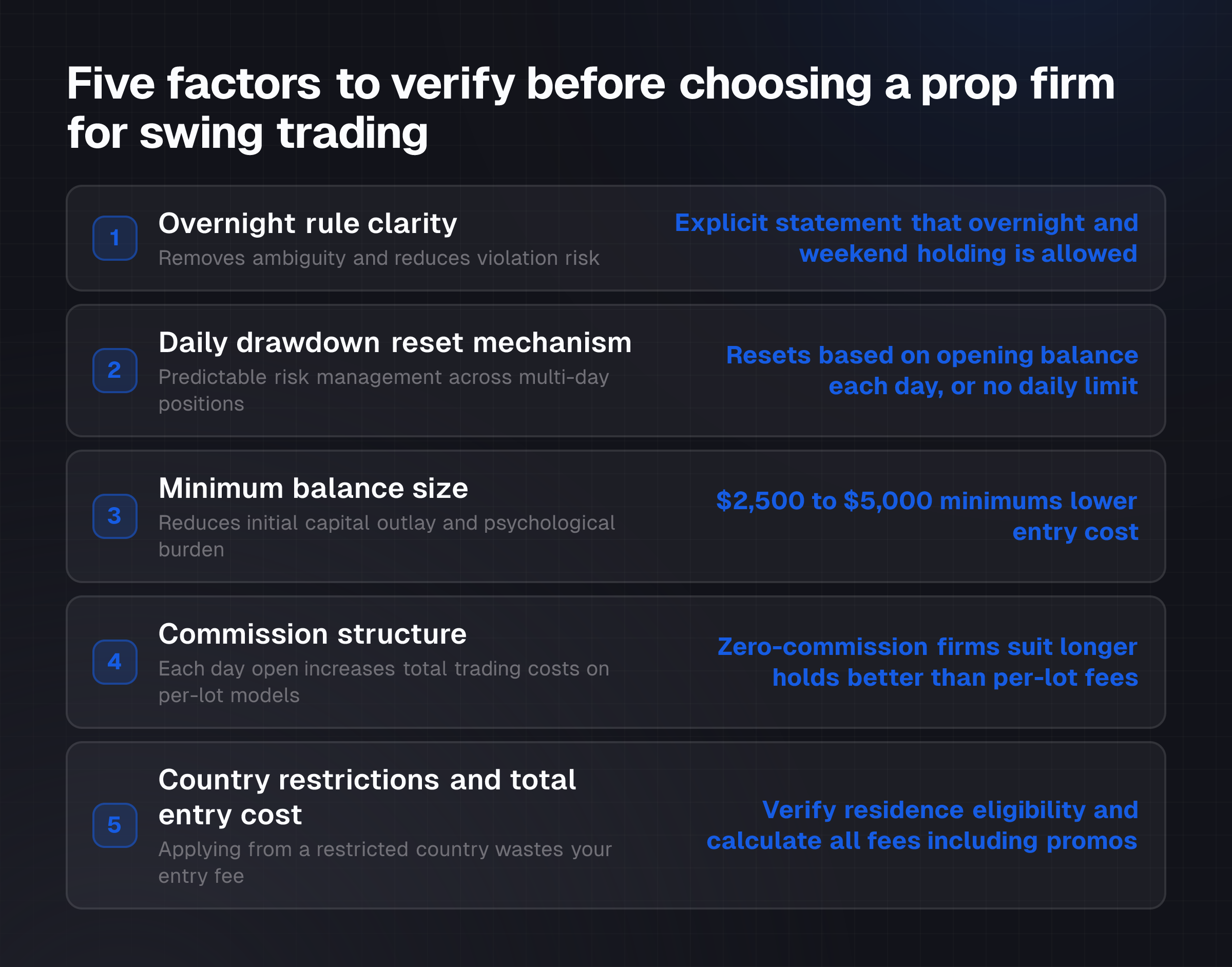
- Overnight rule clarity matters most: Firms that explicitly state "overnight and weekend holding allowed" remove ambiguity and reduce the risk of account violations.
- Daily drawdown resets affect position duration: Firms with daily limits that reset based on the starting balance of the trading day offer more predictable risk management across multi-day positions than those using rolling high-water marks.
- Minimum balance size sets entry cost: Accounts starting at $2,500, $5,000 significantly lower your initial capital outlay compared to larger minimums, though they also cap your allocation during the challenge phase.
- Commission structure compounds over longer holds: Zero-commission firms suit swing traders better than those charging per-lot fees, since each day a position remains open increases total trading costs.
- Fee structure and restricted countries apply universally: Always verify your country of residence and calculate total entry costs, including challenge fees and potential promo codes, before applying.
What it means: Core concepts for swing trading in prop firms
Swing trading is a strategy that seeks to profit from price changes over days to a few weeks, requiring positions to remain open across multiple trading sessions. This contrasts with day trading, where all positions close within a single day.
Overnight holding means keeping a trading position open past the close of the trading day and into the next session. For swing traders, this is essential, without explicit permission, holding overnight can violate a firm's rules and result in account termination.
Daily drawdown is the maximum amount your account balance can fall within a single trading day, typically expressed as a percentage of your starting balance for that day. Exceeding this limit often triggers a rule violation.
Daily drawdown reset defines how and when the limit resets. Some firms reset based on your opening balance at the start of the trading day; others adjust dynamically based on intraday peaks. For swing traders holding positions across multiple days, understanding this mechanism is critical to avoid unexpected breaches.
Minimum balance size is the smallest account size a prop firm offers. Firms offering $2,500 or $5,000 minimums provide a lower barrier to entry than those requiring $10,000 or more.
Why it matters: How overnight rules and drawdown resets affect profitability
Swing traders hold positions through market gaps and overnight sessions, where most of their profit or loss can occur. A firm that prohibits overnight holding forces you to flatten positions daily, blocking your core strategy.
Daily drawdown resets are equally important. Suppose you enter a swing trade on Monday that drops 3% by Tuesday morning before recovering. If a firm's daily drawdown resets only on a rolling high-water mark (the highest intraday peak), that Tuesday dip counts against your Monday limit, compressing your allowed risk for the remainder of the position. A firm that resets based on the opening balance each day gives you a fresh risk budget on Tuesday, letting you manage the position more logically across its full duration.
Commission costs also compound over multi-day holds. FundedNext charges $5 per lot and Blueberry Funded $7 per lot on FX pairs and gold, per trade rather than per day held. Atlas Funded publishes no CFD commission on its official pages.
Lower minimum account sizes mean you can test your strategy with less capital at risk, then scale up if you pass the challenge. Entry-level accounts also reduce the psychological burden of managing a large allocated balance while learning a firm's specific rules.
How it works: Evaluation methodology for each criterion
Overnight Rule Clarity
Visit the firm's website and locate the challenge rules, FAQ, or terms of service. Look for explicit language stating "overnight holding allowed," "weekend holding allowed," or equivalent phrasing.
Different challenge types within the same firm may have different overnight policies. For instance, a firm may allow overnight holding in one challenge product but not another.
If the rules are ambiguous, contact the firm's support team in writing and request a clear statement in email. Document the response.
Threshold: Firms that explicitly state overnight and weekend holding is permitted offer the clearest conditions. Firms that omit this or state "intraday positions only" are unsuitable for swing traders.
Daily Drawdown Reset Mechanism
Most firms impose a daily loss limit expressed as a percentage (e.g., 5% daily drawdown). Locate this in the challenge rules. Then determine the reset methodology: Does the daily limit reset based on (a) the opening balance at the start of each trading day, or (b) a rolling high-water mark? This information may not always appear explicitly; you may need to contact support or test in a demo account.
Some firms offer challenges with no daily loss limit at all. These are advantageous for swing traders navigating price volatility across multiple days.
Threshold: Firms with daily limits that reset based on the opening balance of each trading day, or that offer "no daily loss limit" variations, rank higher for swing traders. Firms using rolling high-water marks or those without clear reset definitions rank lower.
Minimum Balance Size
Identify every account size the firm offers, along with the challenge fee for each tier. Multiply the challenge fee by the account size. A $2,500 account with a $37 fee is lower friction than a $10,000 account with a $150 fee.
Check for active discount codes that reduce the challenge fee.
Threshold: Minimum balances of $2,500, $5,000 represent a low barrier to entry. Minimums above $10,000 are higher friction for initial capital deployment.
Example or scenario: Comparing two firms for a swing trader
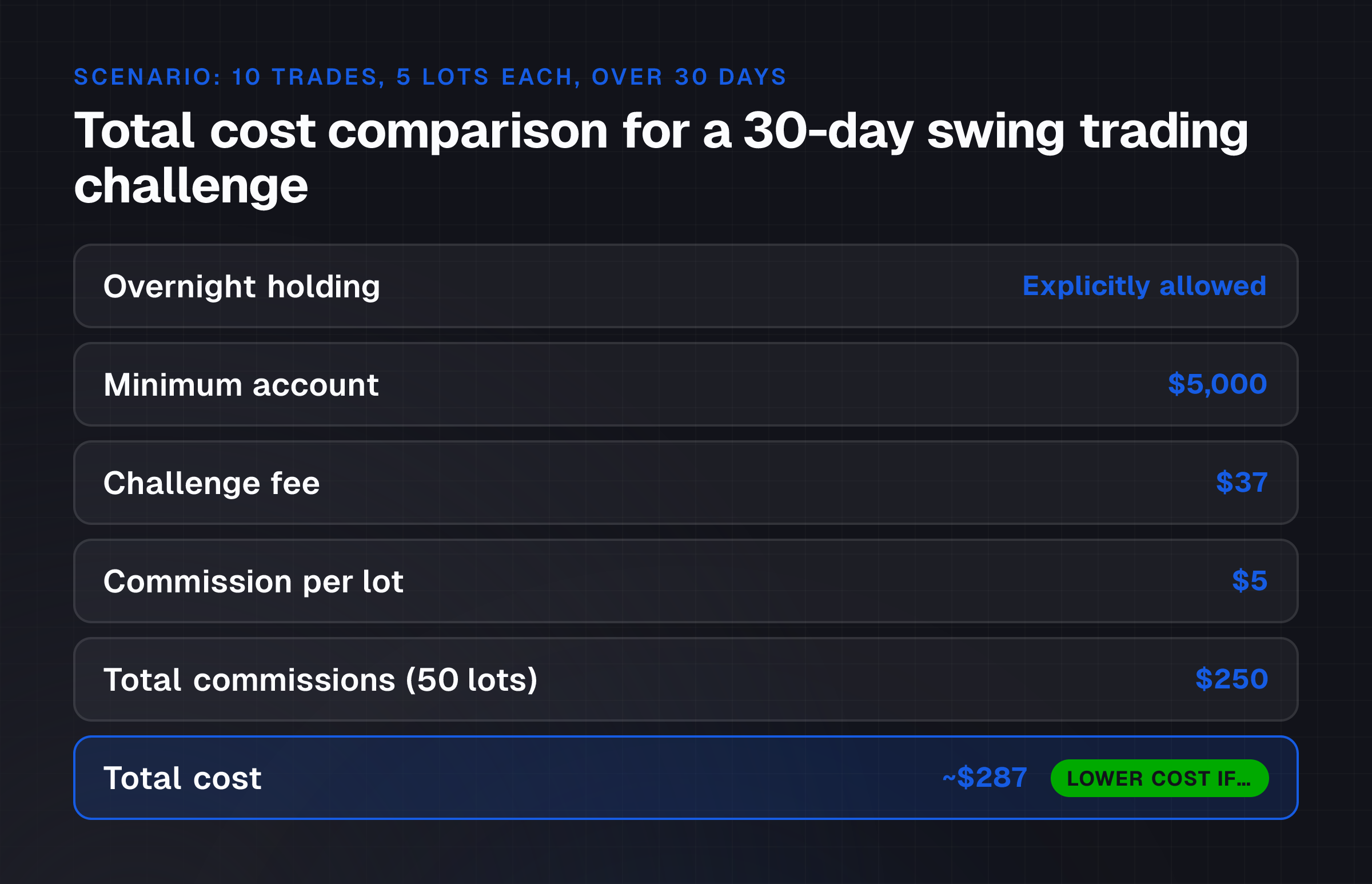
Trader profile: You hold currency pairs over 3-5 days, targeting 1-2% gains per trade. You have $500 to risk on entry fees and want to minimize total commissions over a 30-day challenge.
Firm A (FundedNext)
Overnight holding: Explicitly allowed ("Hold overnight and over the weekend. Your strategy. Your session. Your way," as of October 11, 2026). Daily drawdown reset: Varies by challenge type; standard challenges use daily resets; FNL:001 challenges offer no daily loss limit (released July 1, 2026). Minimum account: $5,000 minimum tier. Challenge fee: $5 per lot commission. Entry calculation: A $5,000 account with a $37 challenge fee (at standard rates) = $37 upfront. Ten 5-lot trades over 30 days = 50 lots total = $250 in commissions. Total cost: ~$287.
Firm B (Blueberry Funded)
Overnight holding: Not explicitly stated in the research; this article does not confirm overnight permission. Daily drawdown reset: Reset methodology not covered in this comparison; research does not detail how Blueberry resets daily drawdown. Minimum account: $2,500 minimum tier (Prime 2-Step challenge). Challenge fee: $37. Entry calculation: A $2,500 account = lower initial commitment. Commission: $7 per lot on FX pairs and gold, on top of the $37 fee.
Outcome: If Blueberry Funded explicitly permits overnight holding (which you would verify directly with the firm), the lower minimum balance makes it cheaper to start for this scenario, though its commission is higher than FundedNext's. If overnight holding is restricted, FundedNext's explicit permission decides it.
Common mistakes or risks: What traders overlook
Assuming overnight holding is allowed unless stated otherwise
Many traders assume prop firms permit overnight positions as a baseline. In fact, many firms restrict intraday trading only or require explicit challenge types for overnight holding. Always verify in writing.
Misunderstanding daily drawdown reset timing
Traders often conflate "daily drawdown" with "maximum drawdown." A daily drawdown of 5% might reset each day, but you still face a maximum drawdown (e.g., 10%) that does not reset. Hitting either limit terminates your account. Clarify both before trading.
Overlooking commission drag on longer positions
A trade held for five days on a firm charging $5 per lot costs you $25 in commissions for a single 1-lot position. Over a 30-day challenge, this adds up. Compare commission-free alternatives if available.
Ignoring country restrictions
Blueberry Funded and Atlas Funded restrict traders from the United States. If you trade from a restricted country, applying wastes your entry fee. Verify your country's status before starting a challenge.
Choosing a firm for low fees alone
Low commissions are attractive, but they mean little if the firm restricts overnight holding or imposes overly tight daily drawdown limits that prevent your strategy from working. Evaluate the full rule set, not just fees.
How to choose or what to do next: A decision framework
Contact each firm's support and ask directly: "Does [specific challenge name] allow overnight and weekend holding?" Document the response. If the answer is "no" or ambiguous, remove that firm from your list.
For remaining firms, ask: "How is daily drawdown calculated and when does it reset?" Specifically, confirm whether the reset is based on the opening balance each day or a rolling high-water mark. If the firm offers a "no daily loss limit" challenge, test it in the demo account first.
List the firms that passed the first two steps. For each, calculate: (minimum account size) × (challenge fee percentage or flat fee) × (1, promo discount %). Rank by lowest total entry cost.
Before funding a real challenge, trade your exact strategy in the firm's demo account for 5-10 simulated days. Verify that overnight positions remain open, that daily drawdown resets work as described, and that you understand the platform. Free prop firm demo accounts are available to practice without risk.
Review Prop firm fees and payouts: the real math and verify total cost of ownership. Factor in not just entry fees and commissions, but also payout methods, withdrawal minimums, and any performance splits. Some firms offer faster payouts, which may justify slightly higher fees if cash flow matters to your business.
Most firms offer promo codes reducing the entry fee by 25-50%. Always apply a code before paying; it directly lowers your cost basis.
Frequently asked questions
What is the difference between daily drawdown and maximum drawdown?
Daily drawdown is the maximum loss you can incur within a single trading day, typically 5%. Maximum drawdown is the largest cumulative loss from your account's peak, often 10-12%, and does not reset. Both limits apply simultaneously. Breaching either terminates your account. For swing traders, understanding the daily reset mechanism is critical because a multi-day position may trigger a daily limit breach on one day even if your overall trade remains within the maximum drawdown.
Can I hold a position over the weekend if overnight holding is allowed?
Yes. If a firm explicitly permits overnight holding, weekend positions are included. Markets close Friday evening and reopen Sunday or Monday (depending on the asset), but you remain exposed to gap risk. Some firms may impose additional restrictions during major news events, though this article does not cover event-specific rules. Verify the firm's policy on holiday and news gaps directly.
Why do some prop firms charge zero commission while others charge per lot?
Commission structures reflect a firm's business model. Firms with zero commission typically recover revenue through wider spreads, lower payout rates, or higher challenge fees. Firms charging per-lot fees may offer tighter spreads or higher payouts. For swing traders, comparing total trading costs, spreads plus commissions over your average position duration, matters more than any single component. Explore how fees and payouts compound to find your real cost.
What happens if I breach the daily drawdown limit mid-trade?
Once you exceed the daily drawdown limit, your account is typically locked or terminated immediately. You cannot close the position or recover any remaining balance. For swing traders, this makes understanding the reset mechanism essential: if your position drops 4% by midday and the daily limit is 5%, you have only 1% left for the remainder of that calendar day. On the next day, the limit resets (if the firm uses daily resets), giving you a fresh 5% budget.
Should I choose a larger minimum account size for more capital?
Not necessarily. The minimum account size affects your initial capital commitment but also limits your allocation during the challenge phase. A $5,000 account is sufficient to test and prove a profitable strategy; once you pass and move to a live-funded account, you may be able to scale up. Starting smaller also reduces your entry cost and lets you focus on execution rather than managing a large balance early on.
How do I verify a firm's rules before applying?
Request written confirmation from support via email for each key rule: overnight holding permission, daily drawdown reset methodology, and country eligibility. Keep these responses. Visit the firm's official website and read the complete challenge terms of service. Test the strategy in a free demo account using the same platform and settings you would use in the real challenge. Don't rely on YouTube reviews or secondhand accounts; direct verification protects you from misunderstanding a rule and losing your entry fee.