Is Scalping Futures Worth It? Profitability & Reality Check

Scalping in futures can be profitable, but it's not a guaranteed path. Success hinges on discipline, low-latency execution, and tight risk management, three factors most retail traders underestimate. The primary obstacle isn't the strategy itself; it's cumulative transaction costs and the structural advantages institutional traders enjoy. Realistic expectations matter: you're accepting small per-trade gains, high trade volume, and significant mental fatigue before you even start.
Key takeaways: Scalping profitability depends on discipline, not just strategy
Scalping generates profit through volume. Each trade yields only a few dollars after commissions and fees.
Transaction costs accumulate rapidly. Commissions, exchange fees, and slippage erase small per-trade gains faster than most expect. Institutional traders hold structural advantages: ultra-low latency, negotiated fees, automated systems retail traders can't match.
Success requires strict adherence to a trading plan, ironclad risk management, and acceptance of constant small losses.
What it means: Understanding scalping in futures markets
Scalping targets small price movements over very short timeframes, typically seconds to a few minutes.
A scalper enters and exits positions aiming for gains of just a few ticks or points per contract. The profit model relies on volume: instead of capturing large trends, you accumulate dozens or hundreds of small wins throughout the trading day. Futures contracts are common scalping vehicles because they offer leverage, tight bid-ask spreads in liquid markets, and the ability to trade highly liquid instruments like the E-mini S&P 500 (ES), Crude Oil (CL), and Gold (GC).
Profitability depends on executing at precise entry and exit prices with minimal delay.
Why it matters: The role of execution speed and costs
Scalping profitability is extremely sensitive to execution costs.
Each trade incurs commissions, exchange fees, and potential slippage, the difference between the expected fill price and the actual execution price. When you're executing hundreds of times daily, these small deductions accumulate significantly. For example, aiming for a 4-tick profit on an E-mini S&P 500 contract ($50 gross) with $4 in round-trip costs leaves $46 net profit per trade. If slippage accounts for even 1 tick against the entry or exit, net profit drops to $38.
You need a high win rate just to offset these constant drains. Institutional traders operate with structural advantages: co-located servers for sub-millisecond execution, negotiated commission rates a fraction of retail costs, and algorithmic systems that identify and execute opportunities faster and more consistently than human traders can.
How it works: The execution process and requirements
Successful scalping follows a structured approach.
Market selection: Choose highly liquid futures with tight spreads and sufficient volume to enter and exit quickly.
Strategy definition: Develop specific entry and exit signals based on price action, order flow, or ultra-short-timeframe indicators; backtest and validate the logic.
Broker and platform choice: Prioritize platforms offering low latency, fast order execution, and competitive per-contract commissions. For traders evaluating prop firms, understanding how prop firm fees and payouts structure your bottom line is critical.
Risk management protocol: Establish a maximum per-trade loss, daily loss limit, and position size calculated from volatility and account capital before trading begins.
Practice and validation: Simulate in a demo environment to refine entry and exit points and stress-test risk parameters.
Real-time execution with discipline: Execute trades according to the plan without emotional deviation.
Scalping demands constant market attention, rapid decision-making, and the ability to cut losses immediately. A single undisciplined trade or emotional response can erase days of accumulated gains.
Example or scenario: A realistic scalping trade breakdown
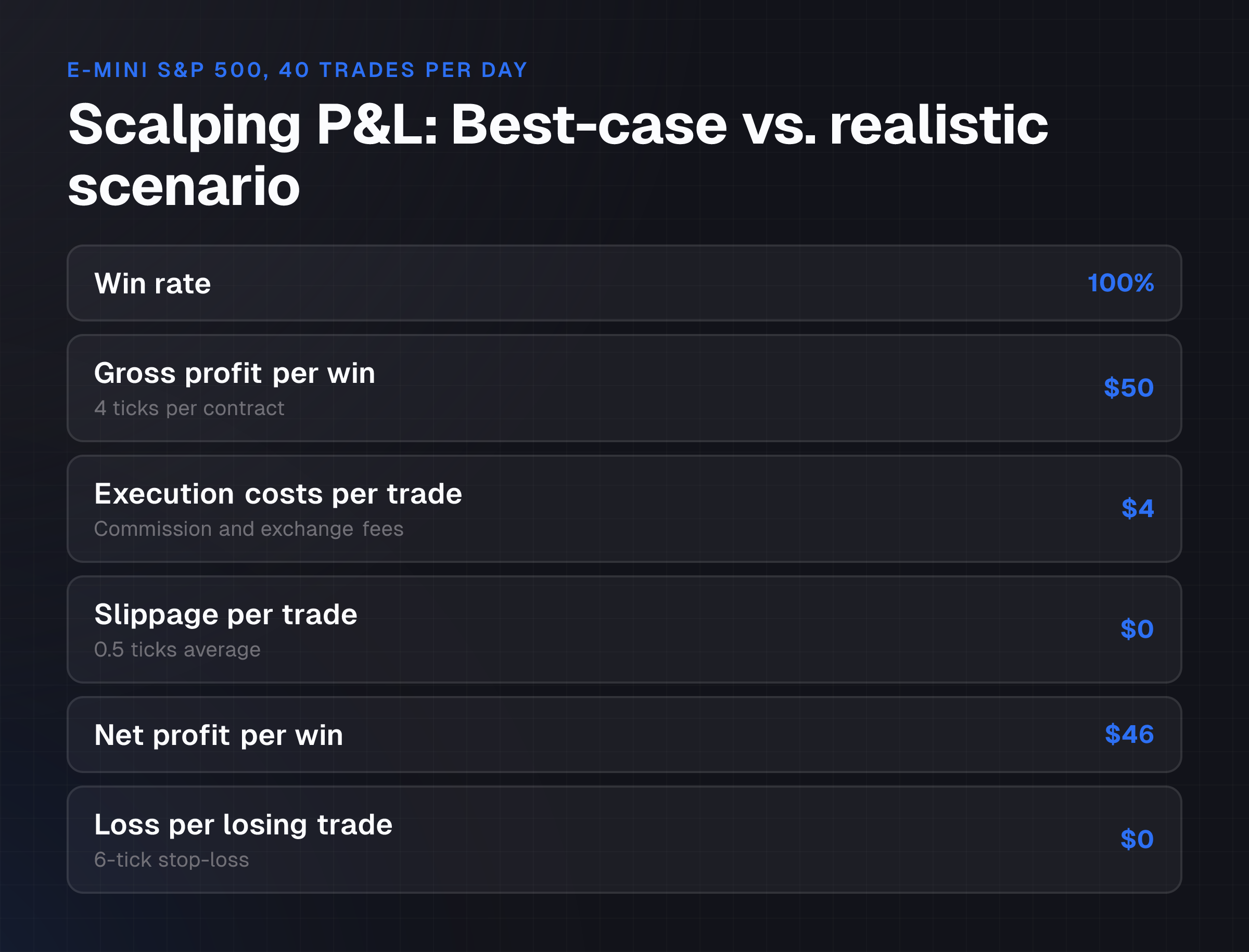
Suppose you're scalping the E-mini S&P 500 with these parameters:
- Entry signal: Price touches a support level identified via order flow.
- Position: 1 contract.
- Target profit: 4 ticks ($50).
- Stop-loss: 6 ticks ($75).
- Execution costs: $4 per round-trip (commission and fees).
You enter at the signal price and exit with a 4-tick gain. Gross profit: $50. Minus execution costs: $46 net profit per trade. Over a trading day, executing 40 such trades yields $1,840 before slippage and account overhead.
But that's best-case.
If slippage averages 0.5 ticks per trade ($6.25 per trade) and the win rate drops to 70%, the actual net is significantly lower:
- 40 trades × 70% win rate = 28 winning trades
- 28 wins × ($46 − $6.25) = 28 × $39.75 = $1,113
- 12 losses × (−$75) = −$900
- Net result: $213 for the day
This illustrates why volume is essential, and why small execution inefficiencies compound into meaningful losses.
Common mistakes or risks: Why most retail scalpers struggle
Underestimating cumulative costs
Retail traders often focus on per-trade profit targets without accounting for the full cost structure. Commissions, exchange fees, and slippage aggregate across hundreds of trades, reducing profitability to break-even or loss levels.
Lack of discipline
Deviating from the trading plan, widening stop-losses, chasing trades, or revenge trading after losses, is one of the primary reasons retail scalpers fail. Emotional decisions override the strategy.
Poor risk management
Overleveraging or using position sizes too large relative to account capital means a few consecutive losses can wipe out the account. Scalping requires starting with realistic position sizing and strict adherence to daily loss limits.
Insufficient capital
Trading with too little capital leaves no buffer for inevitable losses or cost coverage. Realistic starting capital of several thousand dollars is advisable to absorb losses without reckless risk. Many traders explore best prop firms under $500 minimum as a way to access capital, though these accounts come with their own rule constraints.
Ignoring latency and execution delays
Slow internet connections or platforms not optimized for speed can result in slippage that erodes profits. In fast-moving markets or during news events, poor execution becomes catastrophic. Before committing capital, traders should verify what changes after you pass in funded environments.
Trading without a validated edge
Scalping without a clear, statistically tested strategy is gambling. Backtesting and demo trading are essential to confirm that a strategy wins more often than it loses after accounting for all costs.
How to choose or what to do next: Deciding if scalping suits your situation
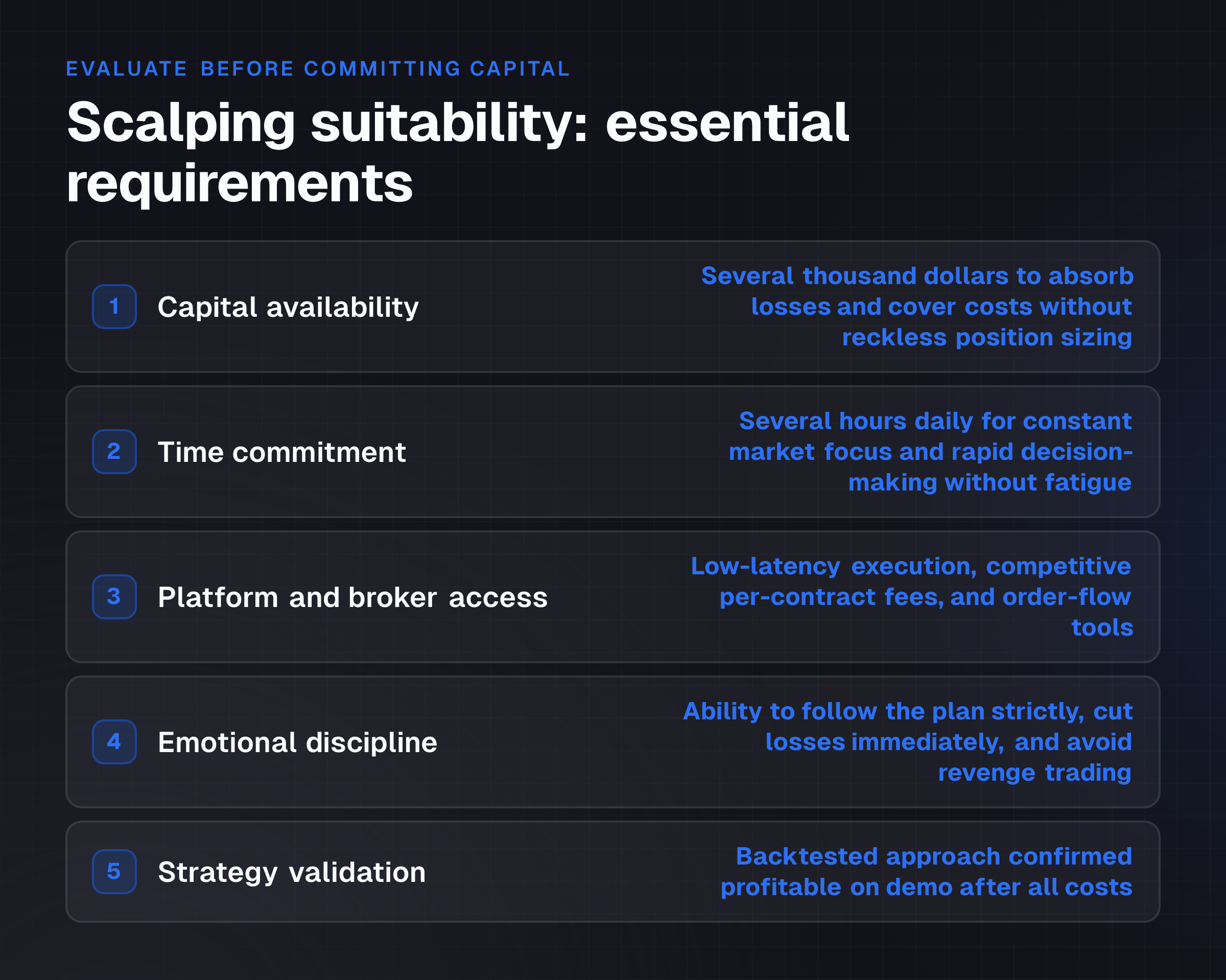
Before pursuing scalping, evaluate these factors.
Capital availability: Do you have at least several thousand dollars to absorb losses and cover costs without risking account ruin?
Time commitment: Can you dedicate several hours daily to constant market focus and rapid decision-making without fatigue-driven errors?
Platform and broker access: Can you access a broker with competitive per-contract fees and a platform offering low-latency execution and order-flow tools?
Emotional discipline: Are you able to follow a trading plan strictly, cut losses immediately, and avoid revenge trading?
Strategy validation: Have you backtested a scalping approach on historical data and validated it on a demo account, confirming profitability after all costs?
If any of these conditions are weak, consider alternative strategies with lower execution requirements. Swing trading or position trading hold positions for days or weeks and are less sensitive to transaction costs.
For traders evaluating prop firms as a platform for scalping, verify the prop firm overnight holding rules and cost model before committing. Many scalpers explore funded accounts to access capital, but understanding payout speed and fee structures determines whether the arrangement is viable.
Frequently asked questions
What is the typical winning percentage for a profitable scalper?
Profitable scalpers often achieve 60-70% win rates or higher due to the strategy's focus on small gains and quick exits. A high win rate alone doesn't guarantee profitability; cumulative per-trade losses from the remaining 30-40% of trades must not exceed cumulative per-trade gains. After accounting for costs, breakeven win rates are often higher than they appear.
How much capital is realistic for starting to scalp futures?
While some brokers allow day trading with minimal margin, a realistic minimum is several thousand dollars to absorb inevitable losses and cover transaction costs without forcing reckless position sizing. Undercapitalization forces larger position sizes to justify the effort, which increases the risk of account ruin from a few consecutive losses.
Can beginners learn to scalp futures successfully?
Beginners can learn the mechanics, but achieving consistent profitability is exceptionally difficult without prior trading experience. Scalping requires real-time decision-making, emotional discipline, and deep familiarity with market microstructure. Most successful scalpers have spent months or years practicing and refining their edge.
Which futures contracts are best for scalping?
Highly liquid contracts with tight spreads are essential: E-mini S&P 500 (ES), Crude Oil (CL), and Gold (GC) are common choices. These markets have sufficient volume to enter and exit quickly without significant price impact. Illiquid contracts result in wider spreads and more slippage, eroding profitability.
What is slippage, and why does it matter for scalpers?
Slippage is the difference between the expected fill price and the actual execution price. In fast-moving markets, especially during news events or with large orders, slippage can be significant. For scalpers targeting 3-5 tick profits, even 1 tick of slippage materially reduces profitability or turns a win into a loss.
How does scalping compare to swing trading or position trading?
Scalping requires constant attention and rapid execution, resulting in high stress and transaction costs. Swing trading (days to weeks) and position trading (weeks or months) reduce execution frequency and are less sensitive to per-trade costs, but they expose traders to overnight risk and larger adverse price moves. The choice depends on time availability, emotional tolerance, and available capital.