How to verify a prop firm's minimum balance requirement
Before you buy a prop firm challenge, confirm its minimum balance requirement, the lowest amount you must maintain throughout trading. This isn't the account size or a promotional price. At most firms, breaching it fails the account. This guide walks you through locating the exact requirement, distinguishing it from promotional offers, and understanding what happens if you fall below it.
Quick answer: Where to find the minimum balance requirement
Your prop firm's minimum balance requirement appears in its official Terms and Conditions, Account Rules, FAQs, or Funded Trader Program sections. That's your primary source. Prioritize directly stated rules over third-party reviews or promotional materials.
The MBR is the floor you must maintain at all times, not what you start with, but what you cannot fall below. If official documentation is unclear, contact the firm's support channels (live chat or email) and request written confirmation.
What you need first
Before you begin verification, have the following ready:
- The firm's official website, not forums, social media, or review sites
- Your account size or tier, MBRs often differ by account size (e.g., $10,000, $25,000, $50,000 accounts)
- Access to the firm's full trading agreement, usually available as a downloadable PDF or in the account dashboard
- A record-keeping method, screenshot or note the MBR and any supporting documentation for your files
Understanding the relationship between account size, promotional offers, and ongoing MBR will help you avoid costly misunderstandings. Each account size typically carries its own MBR, often calculated as a percentage of your starting balance, 5% or 10% below it, for example.
Step-by-step: Verifying your firm's minimum balance requirement
Step 1: Locate the firm's official documentation
Navigate to your prop firm's website and look for these sections in order of priority:
- Terms and Conditions, the legally binding document
- Account Rules or Trading Rules
- FAQs or Knowledge Base
- Pricing or Account Sizes
- Funded Trader Program details
Only use official firm sources. Don't rely on information from forums, social media, or unofficial Discord channels, rules change frequently and third-party sources may be outdated.
Step 2: Distinguish minimum balance requirement from account size
As you read, look for specific language. The MBR and account size aren't the same:
- Account size = the simulated balance you are allocated when you buy a challenge
- Minimum balance requirement = the floor you must never fall below while trading
- Promotional prices = temporarily reduced challenge fees during special offers
Watch for phrases like "minimum equity required," "balance must not drop below," "minimum capital," or "account balance cannot fall below." These signal the MBR. Phrases like "account size" or "starting balance" refer to what you start with, not the ongoing floor.
Here's the key distinction: a promotional offer might reduce your challenge fee, but the underlying MBR for that account tier often remains unchanged. A firm might offer a $25,000 account at a reduced fee during a promotion, yet the MBR may still be $23,750-5% below the standard $25,000 starting point.
Step 3: Understand how drawdown mechanics affect your MBR
The MBR is closely tied to how the firm calculates drawdown. Verify which type applies:
- Absolute drawdown, a fixed percentage or amount below your starting balance
- Trailing drawdown, calculated from your highest peak equity, so it adjusts upward as you trade profitably
- Daily drawdown, a separate limit that may reset each trading day
A maximum drawdown limit often dictates the MBR. If your account starts at $100,000 with a 5% maximum drawdown, your MBR is $95,000. When the firm uses trailing drawdown, the MBR floor moves up as your peak equity increases.
Confirm in the documentation whether the MBR is static or dynamic, and whether daily drawdown limits are more restrictive than the overall MBR in the short term.
Step 4: Confirm the consequences of breaching the MBR
Look for clauses that explicitly state what happens if your account balance falls below the MBR.
Most firms state that breaching the MBR results in immediate account closure and termination of the trading agreement. Some may offer a reset option (sometimes for a fee), but this must be explicitly stated in the rules.
Search for terms like "breach," "violation," "hard breach," "account termination," or "account closure." Document the exact consequence so you understand the stakes. This is a hard breach, a rule violation that ends your agreement without recourse unless the firm explicitly offers an alternative.
Step 5: Seek written clarification if needed
If the documentation remains ambiguous after thorough review, contact the firm's official support.
Use the firm's official channels:
- Live chat support
- Email support (use a monitored support address, not generic contact forms)
- Account manager (if assigned to you)
Request written confirmation of your specific account's MBR, including the starting balance, the MBR floor, and how drawdown is calculated. Save this communication for your records. Don't rely on information from unofficial sources, even if they claim to represent the firm.
Worked example: Comparing two account scenarios
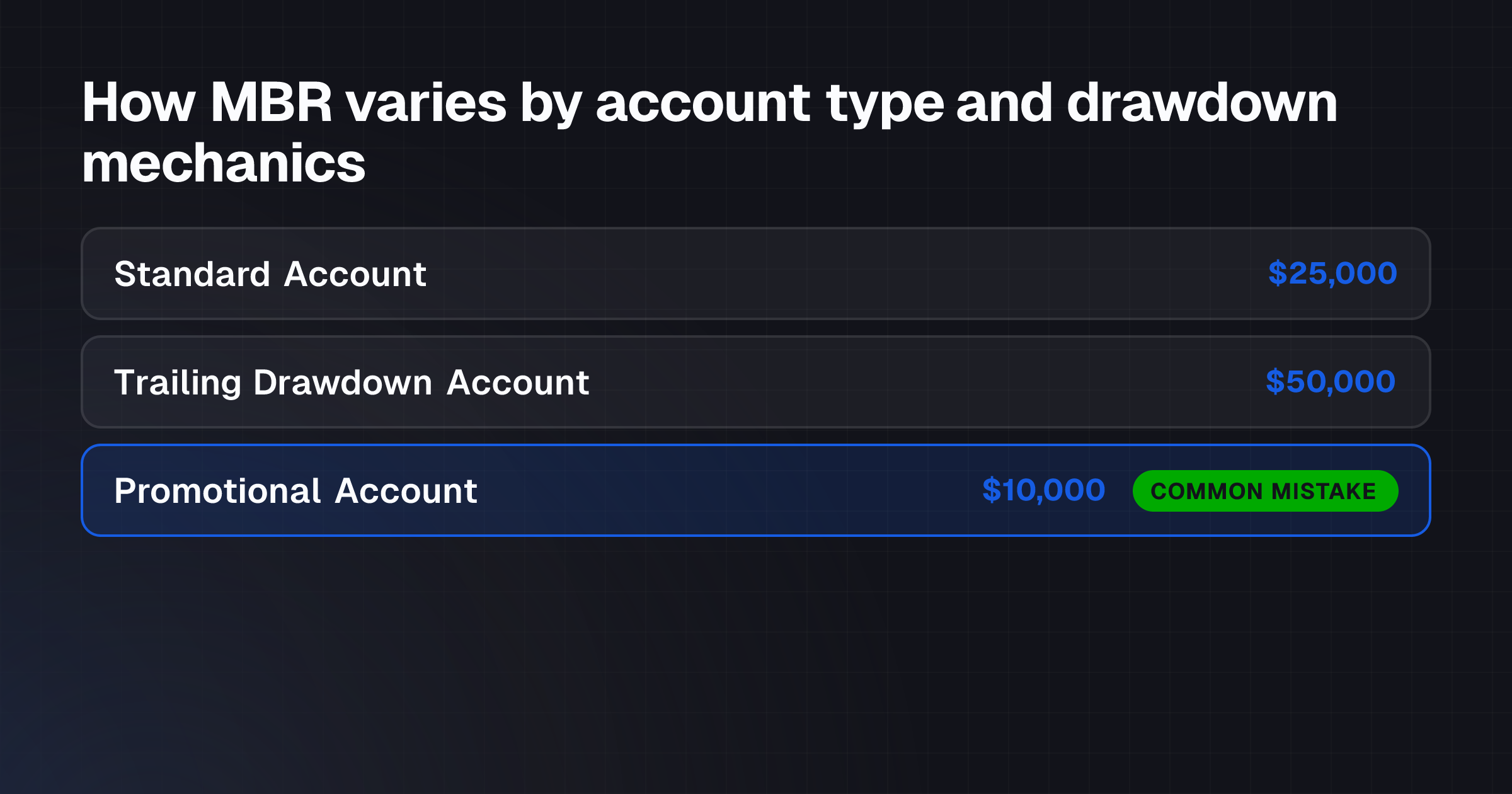
Scenario A: $25,000 Standard Account
- Starting balance: $25,000
- Maximum drawdown: 5%
- Minimum balance requirement: $23,750 (5% below $25,000)
- Drawdown type: Absolute from starting balance
If your account drops to $23,750, you've breached the MBR. The firm closes your account immediately.
Scenario B: $50,000 Account with Trailing Drawdown
- Starting balance: $50,000
- Maximum trailing drawdown: 10%
- Minimum balance requirement: $45,000 (initially), but adjusts upward as peak equity rises
- Drawdown type: Trailing from your highest equity
You trade and reach a peak of $55,000. Your new MBR floor becomes $49,500-10% below $55,000. If your account falls to $49,500, you breach the MBR. But if you later peak at $60,000, the floor rises to $54,000.
Scenario C: Promotional vs. Standard MBR (Common Mistake)
- Promotional offer: $10,000 account at a reduced fee
- Standard MBR for $10,000 tier: $9,500 (5% drawdown)
- The promotional discount applies only to your entry price, not the MBR
You buy the account at the promotional price. Your MBR is still $9,500. The promotion doesn't lower the ongoing requirement.
Common mistakes to avoid
Mistake 1: Assuming promotional minimums lower the ongoing MBR
What happens: You see a promotion offering a $25,000 account at a reduced challenge fee. You assume the MBR is also reduced.
Reality: Promotional pricing typically applies to your entry cost only. The MBR for that account tier remains the same. Always verify the MBR separately from the promotional offer.
Mistake 2: Confusing MBR with daily or trailing drawdown limits
What happens: You focus on the daily drawdown limit (e.g., 2% per day) and ignore the overall MBR (e.g., 5% from starting balance).
Reality: You can breach the daily limit without hitting the MBR, but breaching the MBR always results in account closure. Understand both, as either can terminate your account.
Mistake 3: Skipping the full trading agreement
What happens: You read the FAQ or pricing page and buy a challenge without reviewing the complete terms.
Reality: The trading agreement contains the definitive terms. FAQs and pricing pages may summarize rules but can't override the agreement. Read the full document before buying.
Mistake 4: Relying on outdated information
What happens: You find information from a blog post or forum post from 2024 and assume rules haven't changed.
Reality: Prop firms update their rules regularly. Always verify the MBR on the firm's official website as of the current date. When in doubt, contact support for the most current terms.
Mistake 5: Not accounting for firm-specific variations
What happens: You assume all firms calculate MBR the same way based on industry standards.
Reality: There's no universal standard. MBR calculations, drawdown types, and breach consequences vary significantly between firms. Each firm's rules are unique.
Frequently asked questions
What's the difference between minimum balance requirement and account size?
Account size is the simulated starting balance you are allocated. The minimum balance requirement is the lowest balance you must maintain. A $50,000 account might have a $47,500 MBR (5% drawdown). You start with $50,000 but can't fall below $47,500. Not the same thing.
Can I reset my account if I breach the minimum balance requirement?
Depends on the firm. Most firms immediately close your account with no recourse. Some firms may offer a reset option, but this must be explicitly stated in your trading agreement, often for a fee. Check your firm's specific rules; don't assume a reset is available.
Does the minimum balance requirement change if I make profits?
If your firm uses trailing drawdown, yes, the MBR floor rises as your peak equity increases. With absolute drawdown (fixed from starting balance), the MBR stays the same. Confirm your firm's drawdown type in the official documentation.
Where do I find the minimum balance requirement if the website doesn't list it clearly?
Check the Terms and Conditions, Account Rules, and trading agreement first. If unclear, contact the firm's official support channels (live chat, email, or account manager) and request written confirmation of your account's specific MBR.
Is the minimum balance requirement the same for evaluation and funded accounts?
Varies by firm. Some firms apply the same MBR to both evaluation and funded phases. Others may have different requirements for each phase. Verify this in the firm's rules for your specific account type.
What happens to the balance if I breach the minimum balance requirement?
Evaluation and most funded accounts use simulated capital, so the balance is not yours to withdraw; what you lose is the fee you paid. Check your firm's terms for any profit split still pending.
For a broader overview of how prop firms structure risk and capital requirements across the industry, see What 943 prop firm rule sets reveal about risk caps in 2026. If you're comparing firms by challenge fee, Best prop firms under $500 minimum may also be relevant to your research.