Choosing the Best Prop Firm for Forex: A Data-Driven Guide

Choosing the best prop firm for forex trading depends on matching your strategy to specific rules, costs, and platform support. Four major firms compete for forex traders: Maven Trading, Pipstone Capital, The Prop Trade, and Sure Leverage Funding. Each offers different leverage limits, commission structures, automation policies, and payout speeds. This guide walks you through the selection criteria and shows how to use verified public data to find the firm that fits your trading model.
Quick answer: Best prop firms for forex traders
Best overall: Pipstone Capital
Best for beginners: Maven Trading
Best for high leverage: Maven Trading and Pipstone Capital (tied)
Best for scaling: The Prop Trade
Best for EA/algo traders: Pipstone Capital
Best for lower fees: Pipstone Capital
Last verified: 20 November 2026
How we ranked these
This ranking evaluates four firms across eight weighted criteria that matter most to forex traders.
Platform compatibility determines whether your existing setup works. MetaTrader 5, cTrader, TradeLocker, Match-Trader, each has different execution speeds and automation tools.
Leverage for forex amplifies both returns and drawdown risk. Higher leverage means more efficient use of margin, but it also accelerates losses when trades move against you.
Commission per lot is the raw cost per standard lot. Lower commission reduces drag on high-frequency strategies, especially scalping.
EA and copy trading policies dictate whether automated strategies are permitted and under what conditions. Some firms ban third-party bots; others restrict automation to challenge phases only.
Payout methods and reliability cover speed and accessibility of withdrawals. Bank transfer, crypto, stablecoins, each method has different settlement times and fee structures.
Rules transparency means clarity on daily drawdowns, maximum drawdowns, profit targets, and consistency requirements. Vague rules create enforcement surprises.
Scaling potential looks at maximum single account size and cumulative allocation limits for account growth. If you're profitable, can you compound into larger positions?
Account accessibility counts restricted countries. Fewer restrictions mean broader access.
Firms scoring high on platform choice, low commission, and clear automation policies rank higher for forex traders specifically. Beginners prioritize lower leverage and clear rules. Scaling traders prioritize allocation ceilings. Algo traders prioritize EA support and platform diversity.
Quick comparison table
| Firm | Platform | Max Leverage | Commission/lot | EA Allowed | Max Single Account | Scaling Ceiling | Restricted Countries |
|---|---|---|---|---|---|---|---|
| Pipstone Capital | MT5, cTrader, Match-Trader | 100:1 | $0 | Yes | $100,000 | $400,000 | 20 |
| Maven Trading | MT5, Match-Trader | 100:1 | $2 | No | $100,000 | $1,000,000 | 25 |
| The Prop Trade | cTrader, MT5, TradeLocker | 50:1 | Not disclosed | Yes (own only) | $100,000 | $2,000,000 | 32 |
| Sure Leverage Funding | MT5, TradeLocker | 100:1 | Not disclosed | Yes (EA phase only) | $200,000 | $400,000 | 9 |
Best for lower fees: Pipstone Capital
Pipstone Capital charges zero commission per lot and offers raw spreads, making it the lowest-cost option for frequent traders.
Most forex scalpers and day traders prioritize minimizing per-trade friction. A $0 commission structure eliminates that variable entirely, letting you focus on spread and slippage instead.
Key data:
- Commission: $0 per lot
- Spread type: Raw
- Payout methods: Bank transfer, crypto
- Platforms: MetaTrader 5, cTrader, Match-Trader
- Max allocation: $100,000 single account; $400,000 scaling ceiling
- EA/copy trading: Both permitted
- Restricted countries: 20
Drawback: Maximum scaling allocation is $400,000, lower than Maven Trading's $1,000,000 or The Prop Trade's $2,000,000. If you're profitable and want to compound into significantly larger funded accounts, you'll hit the ceiling faster here.
Best for beginners: Maven Trading
Maven Trading combines moderate leverage, clear challenge rules with low daily drawdown limits, and a buy-now-pay-later option that lowers entry cost.
Beginners benefit from strict daily loss limits. Maven's Instant Challenge allows a 2-4% daily drawdown depending on the program, which enforces discipline and prevents catastrophic losses early in the learning curve. Transparent profit targets remove guesswork.
Key data:
- Leverage: 100:1 (forex)
- Challenge options: 1-step and 2-step programs with $50k, $100k account sizes
- Minimum daily drawdown: 2-4% depending on challenge type
- Profit split: 70-80%
- Payout frequency: 24 hours to 10 business days (varies by program)
- Platforms: MetaTrader 5, Match-Trader
- EA/copy trading: Copy trading permitted (own accounts only, manual)
- Restricted countries: 25
Drawback: No Expert Advisor automation. Traders using algorithmic strategies must seek another firm. Manual copy trading limits scalability for multi-account strategies.
Best for high leverage: Maven Trading and Pipstone Capital (tied)
Both firms offer maximum 100:1 leverage for forex, matching the highest available across this group.
Pipstone's raw spread structure and zero commission make it technically more efficient at high leverage. But Maven's buy-now-pay-later program lowers the barrier to accessing 100:1 funding, which matters if upfront capital is tight.
Key data (Maven Trading):
- Leverage: 100:1
- Commission: $2 per lot
- Daily drawdown: 2-4%
- Profit split: 70-80%
Key data (Pipstone Capital):
- Leverage: 100:1
- Commission: $0 per lot
- Spread type: Raw
Drawback (Maven): Maven's $2 per lot commission adds up on high-frequency strategies. Not ideal for scalpers who trade dozens of lots per session.
Drawback (Pipstone): Lower scaling ceiling ($400,000 vs. Maven's $1,000,000) may constrain profitable traders seeking larger allocations.
Maven Trading review | Pipstone Capital review
Best for scaling: The Prop Trade
The Prop Trade offers the highest scaling ceiling at $2,000,000. This allows traders to grow from a $100,000 account to significantly larger funded positions over time.
If you're profitable and planning to reinvest profits and expand allocation, this matters. Most prop firms cap total allocation well below $1 million; The Prop Trade doubles that ceiling.
Key data:
- Scaling ceiling: $2,000,000 (highest)
- Max single account: $100,000
- Leverage: 50:1 (lowest in this group)
- Platforms: cTrader, MetaTrader 5, TradeLocker
- EA/copy trading: Both permitted (EAs must be trader's own work; commercial or third-party bots banned)
- Payout methods: USDT (ERC20, TRC20, BEP20), USDC (ERC20), Bitcoin, Nigerian local bank transfer
- Restricted countries: 32
Drawback: Maximum leverage is 50:1, half that of Maven and Pipstone, which limits margin efficiency on high-leverage strategies. Lower leverage reduces potential returns on the same capital and forces larger account sizes to achieve the same position sizing.
Best for EA/algo traders: Pipstone Capital
Pipstone Capital permits Expert Advisors without restriction on funded accounts, supports cTrader (which features cBot automation), and allows copy trading.
This is the only firm in this group with no conditional limits on EA usage during the funded phase. Sure Leverage allows EAs during the challenge but bans them once you're funded. The Prop Trade permits EAs but only if you wrote the code yourself, no commercial bots.
Key data:
- EA allowed: Yes (unrestricted)
- Copy trading: Permitted
- Platforms: MetaTrader 5, cTrader (supports cBot), Match-Trader
- Commission: $0 per lot (reduces overhead for high-frequency bots)
- Max leverage: 100:1
Drawback: Scaling ceiling of $400,000 may feel constraining for successful algo traders seeking to scale allocations beyond that level.
Prop firms that allow Expert Advisors
How to choose: Defining your criteria
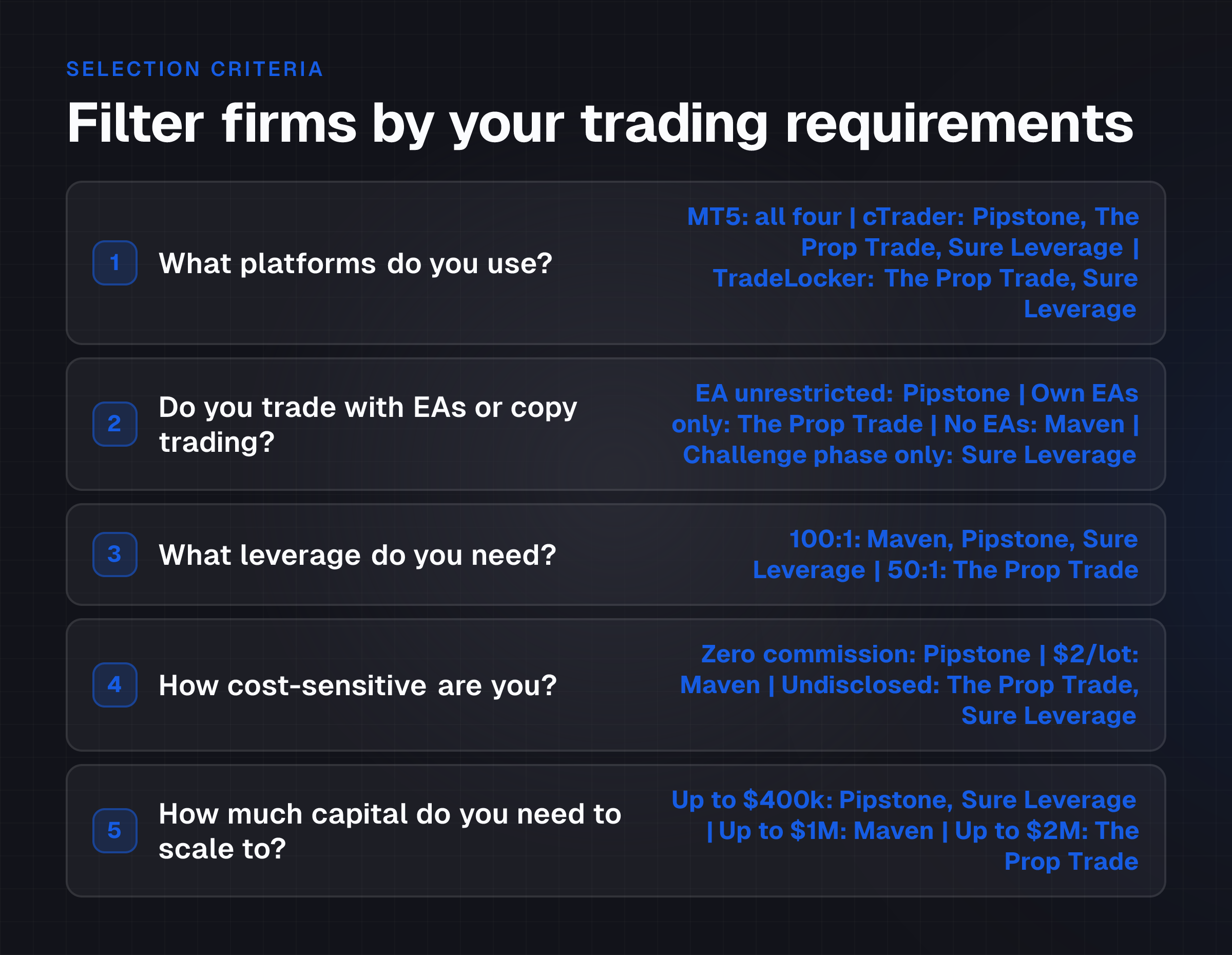
Start by identifying your trading model, then filter firms against the criteria that matter most.
1. What platforms do you use?
All four firms support MetaTrader 5.
If you require cTrader (more common in Europe and for copy trading), filter to Pipstone, The Prop Trade, or Sure Leverage. If you use TradeLocker, you're limited to The Prop Trade or Sure Leverage. Match-Trader is available at Maven and Pipstone.
2. Do you trade with Expert Advisors or copy trading?
EA traders: Choose Pipstone Capital (unrestricted) or The Prop Trade (own EAs only). Avoid Maven Trading (no EAs). Sure Leverage allows EAs only during the challenge phase, not on funded accounts.
Copy traders: All four firms permit copy trading; refer to prop firms that allow copy trading for detailed conditions.
3. What leverage do you need?
High leverage (100:1): Maven Trading, Pipstone Capital, or Sure Leverage Funding.
Moderate leverage (50:1): The Prop Trade.
4. How cost-sensitive are you?
Zero commission: Pipstone Capital ($0 per lot, raw spreads).
Low commission: Maven Trading ($2 per lot, standard spreads).
Commission not disclosed: The Prop Trade and Sure Leverage Funding.
5. How much capital do you need to scale to?
Under $500k: All four firms viable.
$500k, $2M: Prioritize Maven Trading (up to $1M) or The Prop Trade (up to $2M).
6. Is your country restricted?
Check the firm's restricted country list. The fewest restrictions are with Sure Leverage Funding (9 restricted countries), followed by Pipstone Capital (20), Maven Trading (25), and The Prop Trade (32).
Frequently asked questions
What is the difference between max single account and scaling ceiling?
Max single account is the largest funded account you can purchase upfront. Scaling ceiling is the total allocation you can grow to across multiple accounts as your profits accumulate.
For example, Maven Trading allows you to buy a $100,000 account but scale your total allocation up to $1,000,000 over time if you remain profitable and pass additional evaluations or meet their scaling criteria.
Do these firms offer demo accounts or paper trading?
This article doesn't cover whether each firm offers demo or paper trading accounts. Check the official firm websites for evaluation account options.
What happens if I hit the maximum drawdown?
When you exceed the daily or maximum drawdown limit set by your challenge or funded account, your account is typically paused or closed, and you forfeit your capital.
Review each firm's official rules before opening an account. Drawdown limits vary widely: Maven's Instant Challenge allows a 2% daily drawdown; Pipstone's varies by program.
Can I trade during news releases (high volatility)?
Maven Trading and Pipstone Capital both permit news trading.
The Prop Trade and Sure Leverage Funding rules on news trading aren't detailed in this comparison. Contact the firms directly to confirm their news trading policies before you trade around major economic releases.
What is the difference between raw spreads and standard spreads?
Raw spreads are the market bid, ask prices with no markup; you pay commission on top.
Standard spreads are the firm's marked-up prices; commission is typically included or lower. Raw spread plus commission can be cheaper than standard spreads at higher volumes, but more expensive at low volumes. Run the math for your typical lot size before choosing.
How long does a payout typically take?
Payout speed varies by method and firm.
Maven Trading promises 24 hours to 10 business days depending on the program. Pipstone and The Prop Trade use bank transfer or crypto; crypto typically settles faster. Refer to data study: prop firm payout speed 2026 for detailed payout benchmarks.