FunderPro Futures vs GOAT Funded Futures: Which is better?
·
FunderPro Futures and GOAT Funded Futures both run futures prop challenges with 100x leverage and scalable account sizes, but the similarities end there. FunderPro leans on a subscription model and copy trading for bigger allocations. GOAT runs a straightforward tiered challenge system, fixed fees, fast payouts, multiple challenge flavors. We've pulled pricing, drawdown structures, profit splits, and platform specs to figure out which one fits your style and how much risk you're willing to stomach.
Side-by-side comparison
| Feature | FunderPro Futures | GOAT Funded Futures |
|---|---|---|
| Country | Malta | Hong Kong SAR China |
| Website | funderprofutures.com | goatfundedfutures.com |
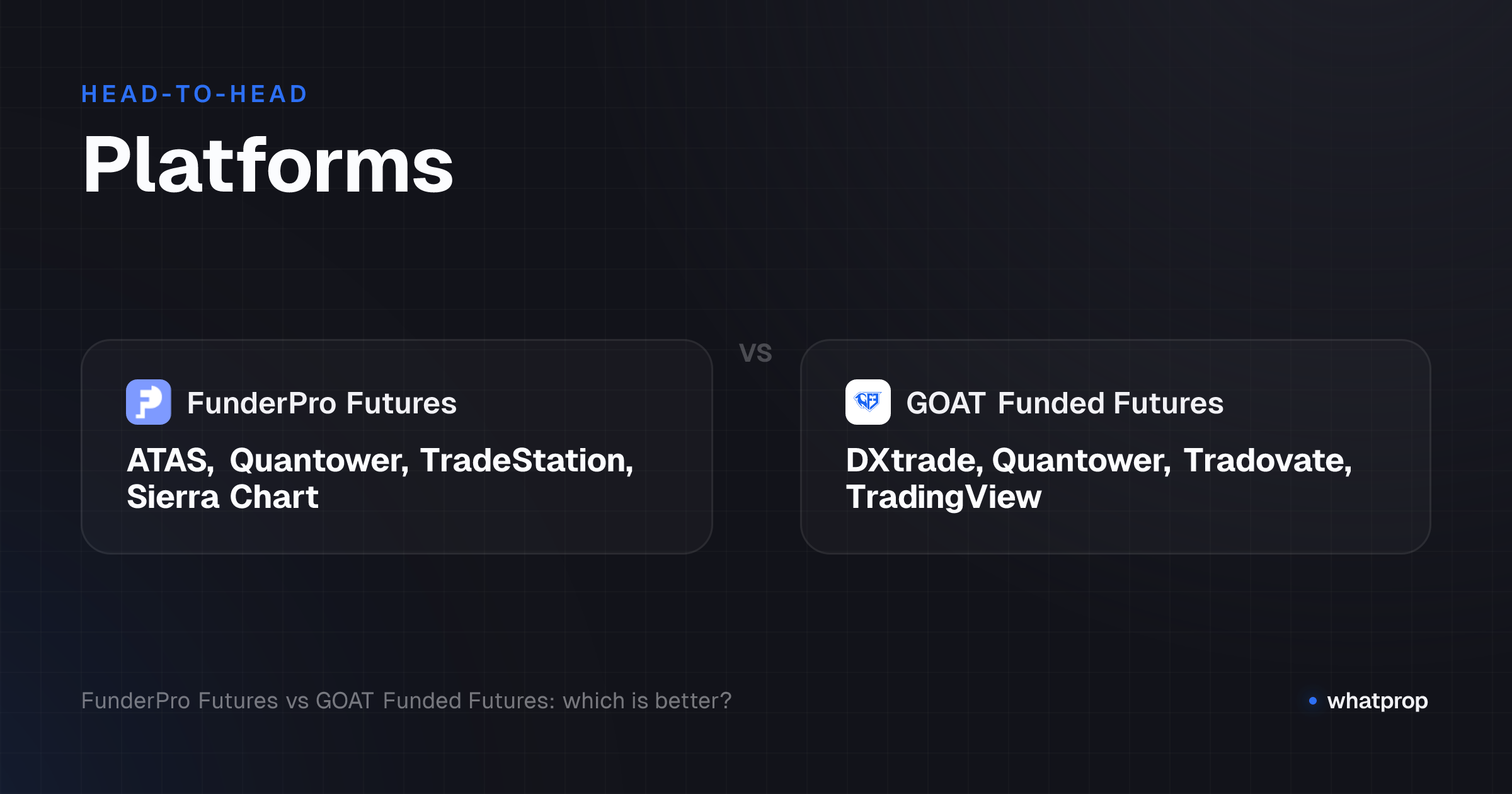
| Platforms | ATAS, Quantower, TradeStation, Sierra Chart | DXtrade, Quantower, Tradovate, TradingView |
| Payout methods | Withdrawal, Crypto, E Wallet | Crypto, Withdrawal, Bank Transfer, E Wallet, Rise |
How we evaluate
This comparison evaluates both firms across pricing, challenge rules, drawdown limits, profit splits, payout speed, platforms, automation support, and rule transparency. Data comes from each firm's official website, published challenge pages, and support documentation as of November 2025. Where specific details, FunderPro's exact profit splits or evaluation rules, for instance, aren't publicly available, we've noted them as unpublished or unclear rather than estimating. No affiliate incentives, paid testing, or first-hand trading influenced the analysis.
- Regulation & trust20%
- Challenge cost & value20%
- Payouts & profit split20%
- Trading platforms15%
- Leverage & risk rules15%
- Support & transparency10%
Scorecard


- RegulationTie
- Challenge CostsGOAT Funded Futures
- Profit Split TransparencyGOAT Funded Futures
- Payout SpeedGOAT Funded Futures
- Rule TransparencyGOAT Funded Futures
- EA/Automation SupportGOAT Funded Futures
- Max Account AllocationGOAT Funded Futures
- Copy Trading AccessFunderPro Futures
Where each firm wins
- Fixed, transparent pricing ($93-$775) vs. FunderPro's unpublished subscription model
- 100% profit splits on Instant Funding and EOD challenges; FunderPro's profit split terms unclear
- 2-business-day payouts for Instant Funding; FunderPro's payout timeline not stated
- All challenge rules, drawdown limits, and profit targets published; FunderPro lacks public evaluation criteria
- EAs and algorithmic strategies explicitly allowed; FunderPro prohibits EAs
- $750K max allocation vs. FunderPro's $500K single account
- Copy trading access to 5x $200K funded accounts for up to $1M in capital (vs. GOAT's limit on self-copying only)
- No profit target requirement for copy trading accounts (GOAT requires 6% target on most challenges)
- Multiple promotional periods offering no activation fee or large discounts
Quick verdict
Pick FunderPro Futures if you're after flexible, long-haul copy trading and don't mind paying a monthly subscription to unlock bigger account sizes.
Pick GOAT Funded Futures if you want transparent per-challenge pricing, quick payouts, and tighter but clearer profit targets.
The core split? FunderPro uses a subscription activation model with potential access to $1,000,000 in funded capital through copy trading. GOAT charges fixed challenge fees-$93 to $775, for immediate 1-step funded accounts with 100% profit splits on instant funding.
Last verified: 2025-11-27
At-a-glance comparison table
| Feature | FunderPro Futures | GOAT Funded Futures |
|---|---|---|
| Country | Malta | Hong Kong SAR China |
| Website | https://funderprofutures.com | https://goatfundedfutures.com |
| Trading Platforms | ATAS, Quantower, TradeStation, Sierra Chart | DXtrade, Quantower, Tradovate, TradingView |
| Max Leverage | 100 | 100 |
| Max Allocation | $500K single; $1M via 5x copy trading | $750K |
| Payout Methods | Withdrawal, Crypto, E Wallet | Crypto, Withdrawal, Bank Transfer, E Wallet, Rise |
| Payment Methods | Credit Card, Crypto | Crypto, Bank Transfer, Paysagi |
| EA/Automation | No | Yes (with conditions) |
| Copy Trading | Yes | Yes (own trades only) |
Methodology and data freshness
We compared verified public rules, official pricing pages, and platform support info from both firms' websites as of November 2025. Pricing, challenge rules, drawdown thresholds, and payout methods reflect the most recent publicly stated offers. Account allocation, leverage, and platform availability come straight from each firm's official catalog. Where specific details, profit-split percentages for all FunderPro programs, for instance, aren't uniformly published, we've noted them as unclear and recommend you confirm with support before funding a challenge. No paid testing or affiliate incentives shaped this analysis.
Pricing and account sizes
FunderPro Futures
FunderPro runs on a subscription model, not fixed per-challenge fees. You pay monthly until you get funded, then hit a one-time activation fee. Recent promos have waived the activation fee entirely (November 2025 Black Friday offer). The exact per-account pricing tiers? Not uniformly detailed in public materials, though discounts, 20% off all challenges in August 2025, for example, have popped up. Maximum single allocation is $500,000. Copy trading 5 funded $200K accounts can push you to $1,000,000 in capital.
This subscription approach works for traders willing to commit to a monthly payment schedule in exchange for flexible, long-term access. But the lack of transparent per-tier pricing on the public site makes upfront cost comparison nearly impossible. You'll need to confirm current pricing and activation fees with FunderPro support before enrolling.
GOAT Funded Futures
GOAT publishes fixed per-challenge pricing across three account sizes and three challenge types.
Instant Funding (1-step, 100% profit split, no profit target, 2-day payouts):
- $50K: $325
- $100K: $575
- $150K: $775
EOD Challenge (1-step, 100% profit split, 6% profit target, on-demand payouts):
- $50K: $93-$95
- $100K: $140-$149
- $150K: $185-$289
Flex Challenge (1-step, 80% profit split, 6% profit target):
- $50K: $95
- $100K: $149
- $150K: $289
Active promo codes, SUMMER50, BOGO50, offer 50% discounts. GOAT's pricing is fully transparent and published on their challenges page, so you can calculate entry cost versus potential payout before you click buy.
Entry cost advantage: GOAT's cheapest EOD challenge at $50K runs $93-$95. FunderPro's total cost depends on how many months you pay before getting funded. For a trader who wants to pass a challenge quickly and know the exact fee upfront, GOAT is cheaper and clearer. No question.
Evaluation rules
FunderPro Futures
FunderPro's specific evaluation rules, profit targets, drawdown limits, consistency requirements, aren't detailed in public research. The firm has mentioned daily rewards with an 80% split for $100 profit, but it's unclear whether this applies to all challenge types or specific programs. This lack of published challenge rules is a transparency gap. Before you enroll, request the full rules document from FunderPro support to understand exactly what drawdown percentage, profit target, and minimum trading days apply.
GOAT Funded Futures
GOAT publishes detailed rules for each challenge type.
Instant Funding:
- 3% max drawdown, 3% daily drawdown, no profit target, no minimum trading days.
EOD Challenge:
- 6% profit target, 4% max drawdown (some variants 3%), 2.5% daily drawdown, consistency rule (50% applied on some challenges), minimum 2 trading days, no time limit.
Flex Challenge:
- 6% profit target, 3-4% max drawdown, 2.5% daily drawdown, no specific minimum trading days stated.
News trading is allowed for most challenges. Some EOD challenges support on-demand payouts. This level of rule clarity is a significant advantage if you want to avoid surprises and tailor your strategy to exact drawdown and profit thresholds.
Decision point: If you need crystal-clear rules before risking capital, GOAT Funded Futures is substantially more transparent. FunderPro traders should verify evaluation criteria with support before funding.
Drawdown and risk rules
FunderPro Futures
Drawdown percentages for FunderPro aren't published in available materials. This is a material gap. You need to know your max intra-day drawdown, max cumulative drawdown, and any daily loss limits before you trade. The absence of this information makes it difficult to assess risk and plan position sizing. Request these details directly from FunderPro support.
GOAT Funded Futures
GOAT's drawdown structure is granular and transparent.
- Max drawdown (cumulative loss from peak): 3% (Instant Funding), 3-4% (EOD & Flex challenges).
- Daily drawdown (single-day loss): 2.5% (EOD & Flex), 3% (Instant Funding).
An Instant Funding trader can lose 3% intraday or 3% cumulatively, whichever hits first, before the account halts. EOD and Flex traders have a 2.5% daily limit and 3-4% cumulative limit. These tight limits protect the firm and severely limit your position size and risk per trade. They also make blowouts quick if you underestimate volatility or hold losers.
Risk implication: Both firms offer 100x leverage, but GOAT's published drawdown rules mean you can calculate exact position sizing before you start. FunderPro's opacity creates execution risk. Traders who rely on assumed drawdown levels without confirmation may face surprise account halts.
Payouts and profit split
FunderPro Futures
FunderPro's profit split isn't uniformly stated across all programs. An announcement mentions an 80% split for daily rewards when a trader makes $100 in profit, but it's unclear if this is the standard split for all funded accounts or a limited promotion. This ambiguity is a significant transparency issue.
Withdrawal methods include Withdrawal, Crypto, and E Wallet. Payment-in methods are Credit Card and Crypto. Payout frequency and minimum withdrawal amounts aren't stated in available materials.
GOAT Funded Futures
GOAT's profit splits are explicit and tied to challenge type.
- Instant Funding: 100% profit split, payouts in 2 business days.
- EOD Challenge: 100% profit split, on-demand payouts (or standard frequency not fully specified).
- Flex Challenge: 80% profit split, payout frequency not fully detailed.
Withdrawal methods include Crypto, Withdrawal, Bank Transfer, E Wallet, and Rise. Payment-in methods are Crypto, Bank Transfer, and Paysagi. The 2-business-day payout window for Instant Funding is faster than typical prop firm timelines and a genuine advantage for traders who want rapid access to profits.
Payout winner: GOAT Funded Futures offers 100% profit splits on higher-tier challenges and verified 2-business-day payouts for Instant Funding. FunderPro's profit split terms are unclear outside of specific promotions.
Trading platforms and instruments
FunderPro Futures
Available platforms: ATAS, Quantower, TradeStation, Sierra Chart.
Instruments: Focuses on futures trading.
Automation: EAs aren't allowed.
Copy trading: Copy trading is allowed, with the unique option to copy trade 5x $200K accounts for up to $1M in funded capital.
FunderPro's platform roster is solid for discretionary futures traders. TradeStation and Sierra Chart are institutional-grade charting tools. Quantower and ATAS are popular among retail scalpers and swing traders. The prohibition on EAs limits algorithmic traders but aligns with many prop firms' risk controls.
GOAT Funded Futures
Available platforms: DXtrade, Quantower, Tradovate, TradingView.
Instruments: Focuses on futures trading.
Automation: EAs are allowed, provided they reflect your own trading and don't exploit latency, data feed anomalies, or system vulnerabilities. Own automated strategies and copy trading of your own positions across your own accounts are permitted. Copying other traders' positions is prohibited.
Platform overlap: Both firms support Quantower. GOAT adds Tradovate, a popular NinjaTrader alternative, and TradingView integration. FunderPro emphasizes TradeStation and Sierra Chart. For algo traders, GOAT's explicit EA allowance is a major difference. FunderPro's prohibition rules out any systematic trading.
Platform winner: GOAT Funded Futures wins for automation-focused traders. FunderPro suits manual traders who prefer institutional charting tools.
Trust, transparency, and restrictions
FunderPro Futures
- Regulation & licensing: Based in Malta; specific regulatory status not detailed in research.
- Transparency: Challenge pricing, evaluation rules, drawdown limits, and profit splits aren't uniformly published. This is the firm's weakest point. Traders must contact support to confirm key terms.
- Account access: Copy trading access to larger accounts ($1M potential) is a notable feature but adds operational complexity, managing 5 linked accounts.
- Support availability: Not detailed in research.
GOAT Funded Futures
- Regulation & licensing: Based in Hong Kong SAR China; specific regulatory status not detailed in research.
- Transparency: All challenge types, pricing, rules, drawdown thresholds, and profit splits are published. Rules detail what happens on loss, profit target achievement, and payout frequency. This is GOAT's strength.
- Restrictions on copying: GOAT explicitly prohibits copying other traders' positions, though you can copy your own trades. This reduces systemic risk from herd liquidations.
- Support availability: Help portal and Discord community mentioned; specific SLA not stated.
Transparency winner: GOAT Funded Futures publishes far more detailed rules and pricing. FunderPro's lack of transparent evaluation criteria and profit-split terms is a material drawback for traders who want to know their exact risk before funding.
Winner by category
| Category | Winner | Why |
|---|---|---|
| Challenge Cost | GOAT Funded Futures | Fixed, transparent pricing ($93-$775) vs. FunderPro's unpublished subscription model. |
| Profit Split | GOAT Funded Futures | 100% splits on Instant & EOD; FunderPro's terms unclear outside promotions. |
| Payout Speed | GOAT Funded Futures | 2-business-day payouts for Instant Funding vs. FunderPro's unstated timeline. |
| Leverage & Max Allocation | GOAT Funded Futures | $750K max vs. FunderPro's $500K single ($1M via copy trading complexity). |
| Automation Support | GOAT Funded Futures | EAs explicitly allowed; FunderPro prohibits them. |
| Rule Transparency | GOAT Funded Futures | All rules published; FunderPro lacks public evaluation criteria. |
| Platform Choice | Tie | FunderPro: TradeStation & Sierra Chart for charting; GOAT: Tradovate & TradingView for accessibility. |
| Account Access Flexibility | FunderPro Futures | Copy trading 5x $200K accounts for $1M in capital (if you can manage the setup). |
Disclosure: This comparison draws on verified public materials from both firms' official websites. Neither firm paid for this analysis, and no affiliate relationships influenced the verdict. For the latest pricing and offers, visit FunderPro Futures or GOAT Funded Futures.
GOAT Funded Futures wins on transparency, cost clarity, and speed. FunderPro appeals only to experienced traders committed to copy trading.
GOAT Funded Futures is the recommended choice for most traders. It publishes transparent pricing-$93 to $775 entry, explicit 100% profit splits on top tiers, 2-business-day payouts for Instant Funding, detailed evaluation rules, higher max allocation ($750K), and explicit EA support. If you want to know your exact risk and cost before you trade, GOAT is the clear winner.
FunderPro's subscription model, unpublished challenge rules, unclear profit splits outside of promotions, and EA prohibition make it a poor fit for traders seeking clarity and cost transparency. The copy-trading feature, up to $1M capital via 5x $200K accounts, is the firm's only meaningful advantage, but it doesn't justify trading blind without knowing the exact drawdown limits, evaluation criteria, or profit-split percentage.
For risk-aware traders, FunderPro's lack of published rules is disqualifying. If you're seriously considering FunderPro, contact their support team and request full documentation on challenge rules, drawdown percentages, profit splits, and payout timelines before committing. GOAT Funded Futures' published transparency and verified 2-business-day payouts eliminate that friction.
Frequently asked questions
What's the difference between Instant Funding and the EOD Challenge at GOAT?
Instant Funding is a 1-step account with 100% profit split, no profit target, tight 3% max/daily drawdown, and 2-business-day payouts. EOD Challenge requires you to hit a 6% profit target before payout, allows 3-4% max drawdown and 2.5% daily drawdown, and offers on-demand payouts. Instant Funding is riskier, tighter drawdown, but faster. EOD requires more aggressive trading but gives you time and a clear profit goal.
Does FunderPro allow Expert Advisors (EAs)?
No. FunderPro explicitly prohibits EAs. GOAT Funded Futures allows EAs provided they reflect your own trading and don't exploit latency or system vulnerabilities. If you trade algorithmically, GOAT is the only choice between these two firms.
Can I copy-trade with both firms?
Yes, but the rules differ. FunderPro allows copy trading and specifically offers 5x $200K funded accounts for up to $1M in capital. GOAT allows you to copy your own trades across your own accounts but prohibits copying other traders' positions. FunderPro's copy-trading feature is more liberal but adds account management overhead.
How long do payouts take?
GOAT Funded Futures guarantees 2 business days for Instant Funding payouts and on-demand for EOD challenges. FunderPro's payout timeline isn't published in available materials. Contact FunderPro support for specifics before funding an account.
Which firm has better rule transparency?
GOAT Funded Futures publishes all challenge rules, drawdown limits, profit targets, and consistency requirements on its website. FunderPro doesn't publish challenge evaluation rules or drawdown percentages publicly. GOAT is substantially more transparent. FunderPro traders should request the full rules document before committing.