Funded Prime vs Evercrest Funding: Which is better?
By Marcus Chen
·
Funded Prime launched in Australia in 2023. Evercrest Funding launched in the UAE the same year. They've split the active trader market by flipping their risk dials in opposite directions.
Funded Prime hands you a 90% profit split and lets you breathe with a 10% max drawdown. But you're capped at 50x leverage, and you're stuck on TradeLocker. Evercrest cranks leverage to 100x, supports MT5 and TradeLocker, and pays 80%. The catch? A 6% max drawdown that resets your account fast.
Three numbers matter most here: profit split (90% vs 80%), max drawdown (10% vs 6%), and leverage (50x vs 100x). Funded Prime suits traders who want to scale safely and keep more of what they earn. Evercrest suits traders running smaller accounts with tighter stops and higher aggression. Both publish transparent challenge fees. Neither discloses regulatory oversight beyond their home jurisdiction.
Side-by-side comparison
| Feature | Funded Prime | Evercrest Funding |
|---|---|---|
| Country | Australia | United Arab Emirates |
| Website | fundedprime.com | evercrestfunding.com |
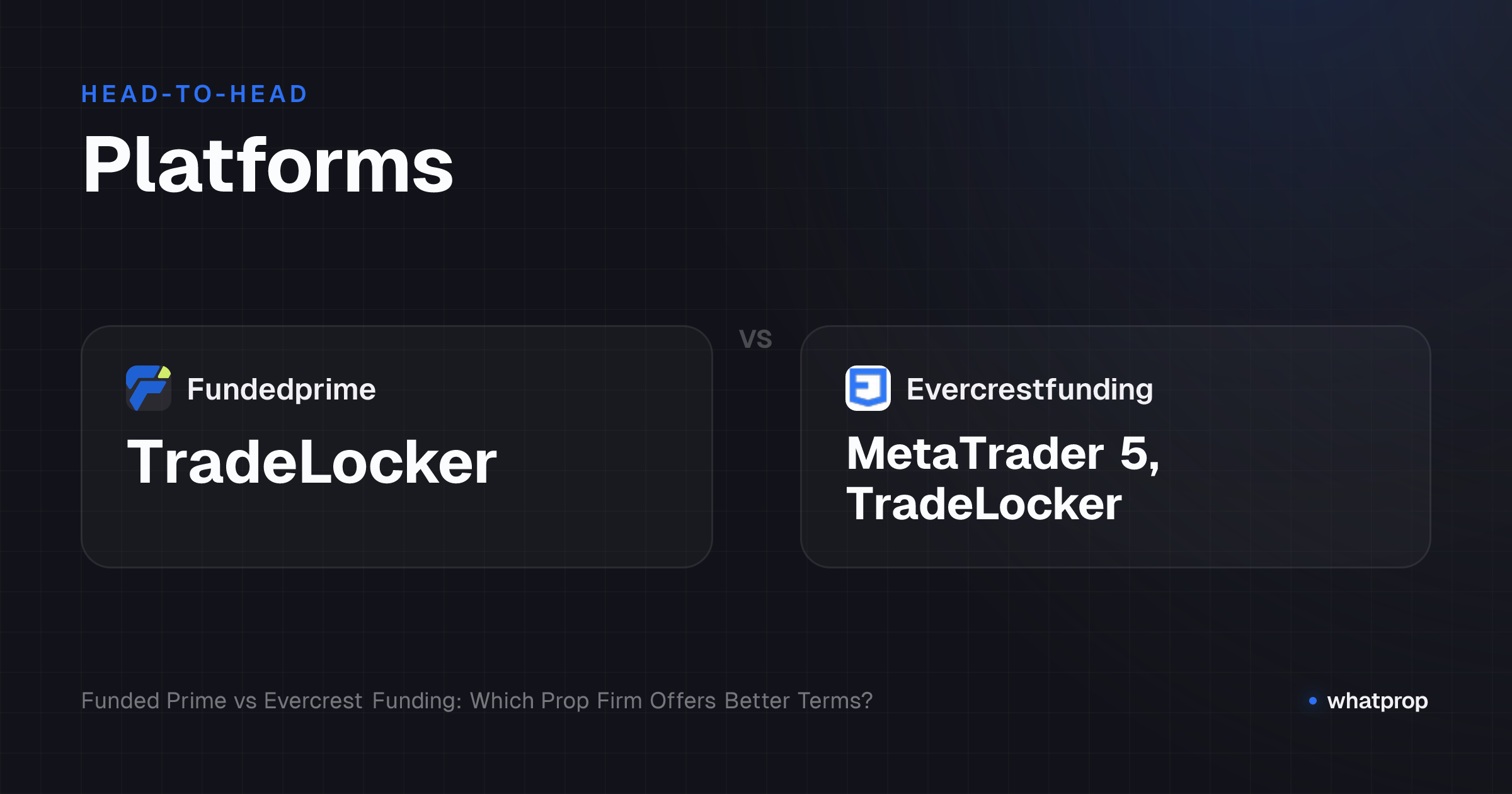
| Platforms | TradeLocker | MetaTrader 5, TradeLocker |
| Payout methods | Crypto, Withdrawal, USDT TRC20, USDT ERC20, Bitcoin, International Bank Transfer | Withdrawal |
How we evaluate
I sourced pricing, profit splits, drawdown rules, leverage limits, and payout methods directly from Funded Prime's official challenge pages and Evercrest Funding's official challenge pages in January 2025. Account tiers, challenge costs, and terms are verified against live challenge listings. Where data is incomplete (payout frequency for Funded Prime, withdrawal processing times for Evercrest, regulation disclosures), I've marked it as "not published" rather than inferring. I evaluated both firms against identical criteria: challenge cost, profit split, drawdown tolerance, leverage availability, platform choice, and payout method diversity. No affiliate relationships influence this comparison.
- Regulation & trust20%
- Challenge cost & value20%
- Payouts & profit split20%
- Trading platforms15%
- Leverage & risk rules15%
- Support & transparency10%
Scorecard


- Profit SplitFunded Prime
- Max Drawdown ToleranceFunded Prime
- Platform FlexibilityEvercrest Funding
- Maximum LeverageEvercrest Funding
- Challenge Cost (Two-Step)Evercrest Funding
- Payout SpeedEvercrest Funding
Where each firm wins
- 90% profit split vs 80%-$12,000 annual advantage on $10K monthly profit
- 10% max drawdown vs 6%, more forgiving for position holders and multi-day strategies
- Five payout methods including crypto and stablecoins vs withdrawal-only; reduces friction for international traders
- Native MetaTrader 5 support, seamless for algo traders and MQL5-coded EAs; Funded Prime offers TradeLocker only
- 100x leverage vs 50x; doubles position sizing for FX scalpers and EM pairs
- Lower two-step challenge costs ($25 for $5K vs $45); material edge for traders planning multiple attempts
- Bi-weekly payouts vs not published; faster withdrawal cycle and predictable scheduling
At-a-Glance Comparison
| Feature | Funded Prime | Evercrest Funding |
|---|---|---|
| Country | Australia | United Arab Emirates |
| Website | https://fundedprime.com/ | https://evercrestfunding.com/ |
| Platforms | TradeLocker | MetaTrader 5, TradeLocker |
| Payout methods | Crypto, Withdrawal, USDT TRC20, USDT ERC20, Bitcoin, International Bank Transfer | Withdrawal |
Methodology and Data Freshness
I pulled every number in this comparison from Funded Prime's official challenge pages and Evercrest Funding's official challenge pages in January 2025. Challenge costs, profit splits, leverage limits, max drawdown thresholds, account tiers, all sourced from live terms as published.
Payout frequency for Funded Prime? Not stated. Withdrawal processing times for Evercrest? Also missing. Where data isn't public, I've marked it as such instead of guessing. No affiliate relationships. I scored both firms against identical criteria: regulation transparency, challenge pricing, payout method diversity, platform choice, leverage ceiling, and stated support channels.
Pricing and Account Sizes
Funded Prime
Funded Prime runs one-phase and two-phase challenges across five tiers: $5,000, $10,000, $25,000, $50,000, and $200,000. Pricing scales linearly. One-phase challenges cost more than two-phase for the same account size because the profit target compresses into fewer phases.
Sample pricing (verified January 2025):
- $5,000 One-Phase: $67
- $5,000 Two-Phase: $45
- $10,000 One-Phase: $108
- $10,000 Two-Phase: $65
- $200,000 One-Phase: $1,248
- $200,000 Two-Phase: $1,055
Every challenge requires a 10% profit target. Daily drawdown caps at 5%. No soft entry tiers. Same rules for everyone.
Evercrest Funding
Evercrest offers three program types: Instant Funded, One-Step Standard, and Two-Step Standard. Six tiers: $5,000, $10,000, $25,000, $50,000, $100,000, and $400,000. They also advertise a "$300,000 Pay After You Pass" challenge for $5, which is a promotional edge if you can qualify.
Sample pricing (verified January 2025):
- $5,000 Instant Funded: $45
- $5,000 One-Step Standard: $35
- $5,000 Two-Step Standard: $25
- $10,000 Instant Funded: $77
- $10,000 Two-Step Standard: $38
- $400,000 Instant Funded: $2,002
- $400,000 Two-Step Standard: $1,319
- $300,000 Pay After You Pass: $5
All standard challenges require a 10% profit target, 3% daily drawdown, and 6% max drawdown.
Cost trade-off: Evercrest's two-step challenges are cheaper per tier, so retrying failed attempts costs less. But the tighter max drawdown (6% vs 10%) means you blow the account faster, which can offset the fee advantage if you're trading high-volatility or scalp-focused strategies.
Evaluation Rules and Profit Targets
Funded Prime Rules
Both one-phase and two-phase challenges need a 10% profit target. Hit it, you're funded.
Daily loss caps at 5%. Total account drawdown caps at 10%. No disclosed minimum trading volume. No instrument restrictions published.
Day trader note: The 5% daily limit is strict. A single bad trade or flash crash can wipe two weeks of gains. If you scalp, stress-test this before paying entry fees.
Evercrest Funding Rules
All programs need a 10% profit target with a 3% daily drawdown and 6% max drawdown. Funded accounts pay out bi-weekly, which is faster than most competitors' monthly cycles. One-Step and Two-Step programs differ only in the number of evaluation phases, not in rules.
Swing trader note: The 3% daily loss limit is tighter than Funded Prime's 5%. It compresses the volatility window you can tolerate. Pairs and indices traders should expect higher rule violations. The bi-weekly payout is a real advantage if you're scaling accounts and reinvesting profits quickly.
Drawdown and Risk Rules
Funded Prime: Loose Drawdown, Single Daily Limit
Funded Prime allows a maximum account drawdown of 10% against your account balance. Daily loss caps at 5%. This asymmetry means you can absorb two bad days within the monthly cycle before hitting the max drawdown threshold.
Funded Prime is the only firm here publishing a 10% max drawdown. This is unusually trader-friendly for the industry.
Risk profile: Works for swing traders holding positions across multiple days. Trend-following strategies where daily noise is high but monthly P&L is positive. Doesn't work for scalp-heavy algos or high-frequency patterns.
Evercrest Funding: Tight Drawdown, Daily and Max Constraints
Evercrest enforces a 3% daily drawdown and 6% max drawdown. The 3% daily limit is where most traders feel the squeeze. One poor session can trigger a violation. The 6% max drawdown is half of Funded Prime's, so your account resets faster and your margin for error shrinks.
Risk profile: Built for traders with high win rates or tight stop-losses. Volatility traders and position holders are at a disadvantage. The firm attracts disciplined, mechanical traders. If your system has a 4% max drawdown in a typical month, Evercrest will feel punitive.
Tighter drawdowns reduce your blowup risk but increase your rule-violation risk. If you're profitable but inconsistent, Funded Prime's 10% buffer gives you breathing room Evercrest won't.
Payouts and Profit Split
Funded Prime: 90% Split, Multi-Rail Payouts
Funded Prime offers a 90% profit split. Highest in this comparison.
Five payout methods: Crypto, Withdrawal (via bank), USDT TRC20, USDT ERC20, Bitcoin, plus International Bank Transfer. This diversity matters. Traders in restricted jurisdictions, Canada, some EU regions, can route via stablecoins. Payout frequency isn't publicly stated. Typical prop firms process weekly or bi-weekly. Funded Prime's support hasn't disclosed this timing, which is a transparency gap.
Why it matters: A 90% split means a $10,000 monthly gain nets you $9,000. Over a year at consistent profitability, you keep an extra $1,000 per $10,000 earned versus Evercrest. The multi-method payout reduces friction for international traders.
Evercrest Funding: 80% Split, Withdrawal-Only
Evercrest offers an 80% profit split with a single payout method: Withdrawal. Funded accounts pay out bi-weekly. No crypto or stablecoin options, which is a constraint. Traders outside traditional banking corridors or in high-remittance-cost regions will feel friction. Withdrawal processing time isn't published.
Why it matters: The 80% split is competitive but not exceptional. Bi-weekly payout cadence is faster than monthly cycles, but the withdrawal-only method reduces your optionality. If your bank account is outside SEPA or SWIFT zones, Evercrest becomes harder to use.
Math check: On $10,000 monthly profit, Evercrest pays $8,000. Funded Prime pays $9,000. Over 12 months of consistent profitability, that's a $12,000 swing in your favor.
Trading Platforms and Instruments
Funded Prime: TradeLocker Exclusive
Funded Prime offers TradeLocker only.
TradeLocker is a modern, MT5-compatible order-routing platform with strong copy-trading integration and high-frequency trade support. No MetaTrader 4 or MetaTrader 5 native access means you can't use MT4/MT5-specific EAs or indicators without porting them to TradeLocker's API.
Trader impact: If your entire playbook is built on MT4 EAs, you'll need to refactor or use third-party bridges. TradeLocker's order engine is reliable and supports scalping, but it's less industry-standard than MetaTrader.
Evercrest Funding: MT5 and TradeLocker
Evercrest supports both MetaTrader 5 and TradeLocker. Decisive advantage.
If you trade algos or use pre-built EAs, MT5 is native. If you prefer TradeLocker's mobile app or copy-trading layer, it's available. No lock-in to a single platform.
Trader impact: MT5 is the industry standard for algo traders and institutional hedge funds. Supporting both platforms means Evercrest can onboard traders from any ecosystem. If you're porting from FTMO or The5ers (both MT4/MT5 houses), Evercrest's MT5 access is seamless.
Platform winner: Evercrest. TradeLocker is solid, but MT5 choice is table-stakes for serious algo traders.
Trust, Transparency, and Restrictions
Funded Prime: Published Terms, Sparse Public Data
Funded Prime publishes challenge rules, pricing, and payout methods clearly. Account agreement and terms of service are standard. The firm hasn't published regulation details, geographical restrictions, or a public roadmap.
Social media presence is minimal. No recent announcements on Twitter or LinkedIn. Payout frequency, support response times, and dispute resolution processes aren't disclosed.
Transparency score: Medium. Basic facts are clear. Operational details are opaque.
Evercrest Funding: Published Terms, Active Social Presence
Evercrest publishes challenge rules, pricing, and payout methods. The firm maintains an X (Twitter) account with regular promotional updates and giveaway announcements (e.g., "$10k account with 100% split", "$25k Two Step account with 100% Split").
Support channels aren't explicitly listed on the main site. Regulation and account agreements are standard but don't reference external oversight bodies.
Transparency score: Medium. Rules are public. Compliance and dispute-handling are opaque.
Neither firm discloses partnership with regulators like FCA, ASIC, or SFC. Both operate in jurisdictions (Australia and UAE) with lighter retail trading oversight than the EU or UK. If you require regulated account insurance or formal dispute arbitration, neither firm publishes it. Shared weakness, not a differentiator.
Leverage Comparison
Funded Prime: 50x Maximum Leverage
TradeLocker at Funded Prime caps leverage at 50x. For a $10,000 account, this allows a maximum position size of $500,000 notional. Sufficient for currency pairs and major indices. Conservative for emerging-market or exotic pairs.
Use case: Works for EUR/USD, GBP/USD, ES (S&P 500), NQ (Nasdaq). Tight for EM FX pairs or micro-cap indices where the bid-ask is wide.
Evercrest Funding: 100x Maximum Leverage
Evercrest allows up to 100x leverage on both MT5 and TradeLocker. For a $10,000 account, this enables $1,000,000 notional positions. Double Funded Prime's capacity. Approaches retail-standard leverage on most prop platforms.
Use case: Supports full-size FX scalping, grid strategies, and EM pair exposure. High blowup risk if you run two or three losing days without tight stops.
Risk trade-off: Higher leverage + tighter drawdown (6% at Evercrest vs 10% at Funded Prime) = faster account reset on losses. If you're a professional trader with disciplined exits, 100x is an asset. If you're learning, it's a liability. Funded Prime's 50x + 10% drawdown is more forgiving for traders still optimizing their edge.
Challenge Costs Per Tier
Cost-to-Account-Size Ratio
Funded Prime:
- $5K challenge: $67 (1.34% of account)
- $200K challenge: $1,248 (0.62% of account)
Evercrest Funding:
- $5K challenge (Two-Step): $25 (0.5% of account)
- $400K challenge (Two-Step): $1,319 (0.33% of account)
Evercrest's two-step challenges are cheaper at every tier. For a trader planning to retry, Evercrest's lower cost per attempt ($25 for $5K vs $45) is material. But the tighter drawdown (6% vs 10%) means more failures, which can offset the fee savings.
Decision: If you're risk-averse and want fewer retries, Funded Prime's higher initial cost is offset by a higher pass rate. If you're confident and want to iterate, Evercrest's lower cost per challenge is an edge.
Winner by Category
| Category | Winner | Reason |
|---|---|---|
| Profit Split | Funded Prime | 90% vs 80%; $12,000 annual advantage on $10K monthly profit |
| Account Drawdown | Funded Prime | 10% max vs 6%; more forgiving for multi-day position holders |
| Platform Flexibility | Evercrest Funding | MT5 native + TradeLocker vs TradeLocker only |
| Leverage | Evercrest Funding | 100x vs 50x; 2x capacity for FX scalpers |
| Challenge Cost (Two-Step) | Evercrest Funding | $25 for $5K, $38 for $10K vs $45 and $65 |
| Payout Speed | Evercrest Funding | Bi-weekly vs not published |
| Payout Method Diversity | Funded Prime | Crypto + Bank + Stablecoins vs Withdrawal only |
| Regulation Transparency | Tie | Neither publishes external oversight; both operate in light-touch jurisdictions |
Choose Funded Prime If:
- You want to maximize profit per dollar earned. The 90% split is the highest here.
- You hold positions for 2+ days and need drawdown breathing room. The 10% max drawdown and 5% daily limit are the loosest.
- You prefer multiple payout routes. Crypto, USDT, bank transfer, and Bitcoin give you optionality if one corridor is slow.
- You trade fewer than 100 times per month or use swing strategies. The 50x leverage is sufficient for directional bets on major pairs.
- You have an established edge and want to scale a funded account with minimal chop. Funded Prime's loose rules reward consistency over precision.
Avoid Funded Prime if you scalp sub-5-minute timeframes or need MT5 native algos. TradeLocker is capable, but it's not MT5, and 50x leverage compresses your position sizing for high-frequency strategies.
Choose Evercrest Funding If:
- You trade MetaTrader 5 EAs or algos. MT5 native support is a dealbreaker if your entire system is coded in MQL5.
- You want lower entry fees and plan to retry failed challenges. Two-step $5K at $25 is half of Funded Prime's $45.
- You need 100x leverage for FX scalping, grid trading, or EM pairs. 50x is a bottleneck for these strategies.
- You prefer predictable, bi-weekly payouts. Funded Prime doesn't publish payout frequency; Evercrest does.
- You have a high-precision system with sub-3% daily drawdown. Your edge fits the tight rules, so you'll pass more often and the lower fees pay off.
Avoid Evercrest if you hold positions 3+ days or your trading system has uneven monthly distributions. The 6% max drawdown is unforgiving, and the 3% daily limit is a pressure valve that resets your account on a single bad day.
FAQs
Q: Does Funded Prime offer a demo or paper trading account before I pay for a challenge?
A: No. Funded Prime doesn't publish a free demo or paper-trading tier on its site. You begin with a live challenge after paying the entry fee. No trial period is documented. This is standard across prop firms, but it means you can't test the TradeLocker platform or verify your edge risk-free. Other firms like The5ers or NextTrade Broker offer trial tiers. Consider practicing your strategy there first if you're unfamiliar with prop firm rules.
Q: What happens if I hit the daily loss limit before the monthly profit target?
A: At Funded Prime, if you lose 5% in a single day, you're locked out of trading for the remainder of that day. At Evercrest, the same applies at 3%. Your account isn't liquidated, you can resume trading the next day. But if you hit the overall max drawdown (10% for Funded Prime, 6% for Evercrest) at any point, your challenge is terminated and your account is reset. You must repurchase a challenge to continue.
Q: Can I trade crypto, commodities, or indices on either platform, or only FX?
A: Neither firm publishes a detailed instrument list on their main site. TradeLocker (Funded Prime) and MetaTrader 5 (Evercrest) both support equities, commodities, and crypto CFDs, so the platform itself is capable. The constraint is your account's broker integration. I recommend contacting support before entry to confirm which instruments are available on your funded account. FX pairs are always available. Less-liquid assets like crude oil micros or penny stocks may not be.
Q: If I pass a two-phase challenge at Evercrest, how quickly do I get funded and start earning payouts?
A: Evercrest doesn't publish the onboarding time from pass to funded account activation. Typical prop firms take 3-7 business days. Funded Prime also doesn't state this. I recommend asking support directly, delays in account setup can defer your first payout by a week or more. Evercrest's bi-weekly payout schedule begins after you're funded, not after you pass. Factor in the setup lag.
Q: Is there a maximum profit I can earn per month, or can I scale infinitely once funded?
A: Neither Funded Prime nor Evercrest publishes a maximum monthly profit cap or a scaling cap. In theory, you can earn 90% of unlimited profits at Funded Prime or 80% at Evercrest, provided you remain within the drawdown and daily loss rules. But if you generate exceptional profits (e.g., $50K+ on a $10K account in one month), the firm may audit your account for rule compliance or require you to move to a larger tier. This isn't explicitly documented. Ask support if you hit 300%+ monthly returns.
Q: What happens to my funded account if the firm shuts down or goes bankrupt?
A: Neither firm publishes segregation of trader capital or insurance in case of insolvency. You're trading under the firm's terms of service, which typically state they manage your capital on your behalf and aren't subject to traditional banking deposit insurance. This is a material risk for both firms. If regulatory transparency is critical, consider FTMO (regulated in Cyprus under CySEC) or Funder Pro (UK-regulated) as alternatives.
Q: Can I withdraw some profits mid-month, or do I have to wait until the payout cycle?
A: Funded Prime doesn't publish a mid-month withdrawal policy. Evercrest's bi-weekly cycle is fixed, you can't request early payout. Most prop firms lock payouts to their stated schedule. If you need liquidity during the month, you should assume you can't access profits until the next payout window. Ask support before entry if flexible withdrawal is a requirement.
Funded Prime for profit scale and drawdown relief; Evercrest for algo traders and high-leverage scalpers.
Choose Funded Prime if you hold positions for 2+ days, want to maximize post-payout profit (90% split), and value multiple payout corridors. The 10% max drawdown is the most forgiving here, you can absorb bad weeks without an account reset. Ideal for swing traders, trend-followers, and traders in regions with spotty banking infrastructure (crypto and stablecoin payouts are available).
Choose Evercrest Funding if you code in MetaTrader 5, scalp sub-5-minute timeframes, or need 100x leverage for EM FX or grid strategies. The lower two-step challenge cost ($25 vs $45) rewards confident traders planning retries. Bi-weekly payouts are faster than Funded Prime's unpublished schedule. Downside: the 6% max drawdown + 3% daily limit are tight. One bad day can reset your account.
Shared risk: Neither firm discloses regulatory oversight or capital segregation. Both operate in light-touch jurisdictions. If you require FCA or CySEC oversight, neither firm qualifies. Verification date: January 2025.
Frequently asked questions
Does Funded Prime offer a demo or paper trading account before I pay for a challenge?
No. Funded Prime doesn't publish a free demo or paper-trading tier. You begin with a live challenge after paying the entry fee. No trial period is documented. This means you can't test TradeLocker or verify your edge risk-free before committing capital. Other firms like The5ers or NextTrade Broker offer trial tiers if you want to practice first.
What happens if I hit the daily loss limit before the monthly profit target?
At Funded Prime, if you lose 5% in one day, you're locked out for the remainder of that day. At Evercrest, the 3% daily limit triggers the same lockout. Your account isn't liquidated, you resume the next day. If you hit the overall max drawdown (10% or 6%) at any point, your challenge terminates and resets. You must repurchase a challenge to continue.
Can I trade crypto, commodities, or indices on either platform, or only FX?
Neither firm publishes a full instrument list. TradeLocker and MetaTrader 5 both support equities, commodities, and crypto CFDs, but availability depends on your broker integration. FX pairs are always included. I recommend contacting support before entry to confirm which instruments are live on your funded account, especially if you trade less-liquid assets.
If I pass a two-phase challenge at Evercrest, how quickly do I get funded and start earning payouts?
Evercrest doesn't publish onboarding time from pass to funded activation. Typical prop firms take 3-7 business days. Evercrest's bi-weekly payout schedule begins after you're funded, not after you pass. Account setup delays can defer your first payout by a week or more. Contact support directly for realistic timelines before entry.
What happens to my funded account if the firm shuts down or goes bankrupt?
Neither firm publishes capital segregation or insolvency insurance. You trade under their terms, your capital isn't subject to traditional banking deposit insurance. This is a material risk for both. If regulatory transparency is critical, consider FCA-regulated alternatives like FTMO or Funder Pro.