Is Lucid Trading worth it for psychology coaching in 2026?

As of November 2026, Lucid Trading does not offer real-time psychological feedback or live coaching as part of its standard offerings. The firm focuses on providing funded futures accounts after traders complete a one-step evaluation. If psychological support is essential to your trading approach, you'll need to source it externally or confirm directly with the firm whether custom arrangements exist beyond publicly listed programs.
Many traders assume proprietary trading firms include mentorship and emotional coaching as standard benefits. Most prop firms concentrate on evaluation criteria, platform access, and profit-sharing structures rather than developmental psychology services.
Quick answer: What Lucid Trading actually includes
Lucid Trading provides futures trading evaluation and funded account access. The firm supplies trading platforms, risk management rules, and a 90% profit split on funded accounts, but does not list real-time psychology feedback or live coaching on its publicly available program pages. As of November 2026, no announcements from the firm indicate these services are part of standard packages.
The objection: Why traders expect psychology support from prop firms
Newer traders often enter the prop firm space believing that comprehensive professional support includes mental discipline coaching and emotional feedback. This expectation makes sense. Successful trading demands emotional resilience, risk awareness, and psychological consistency under pressure. Many traders reason that if a firm provides capital and a trading environment, psychological guidance should logically follow.
The reality is different.
Proprietary trading firms operate on a capital-provision and profit-sharing model. They evaluate whether you can trade profitably within their rules, then share the gains. Developmental services, especially personalized coaching, fall outside their core business and are rarely bundled without explicit mention.
What is actually true: Lucid Trading's core structure
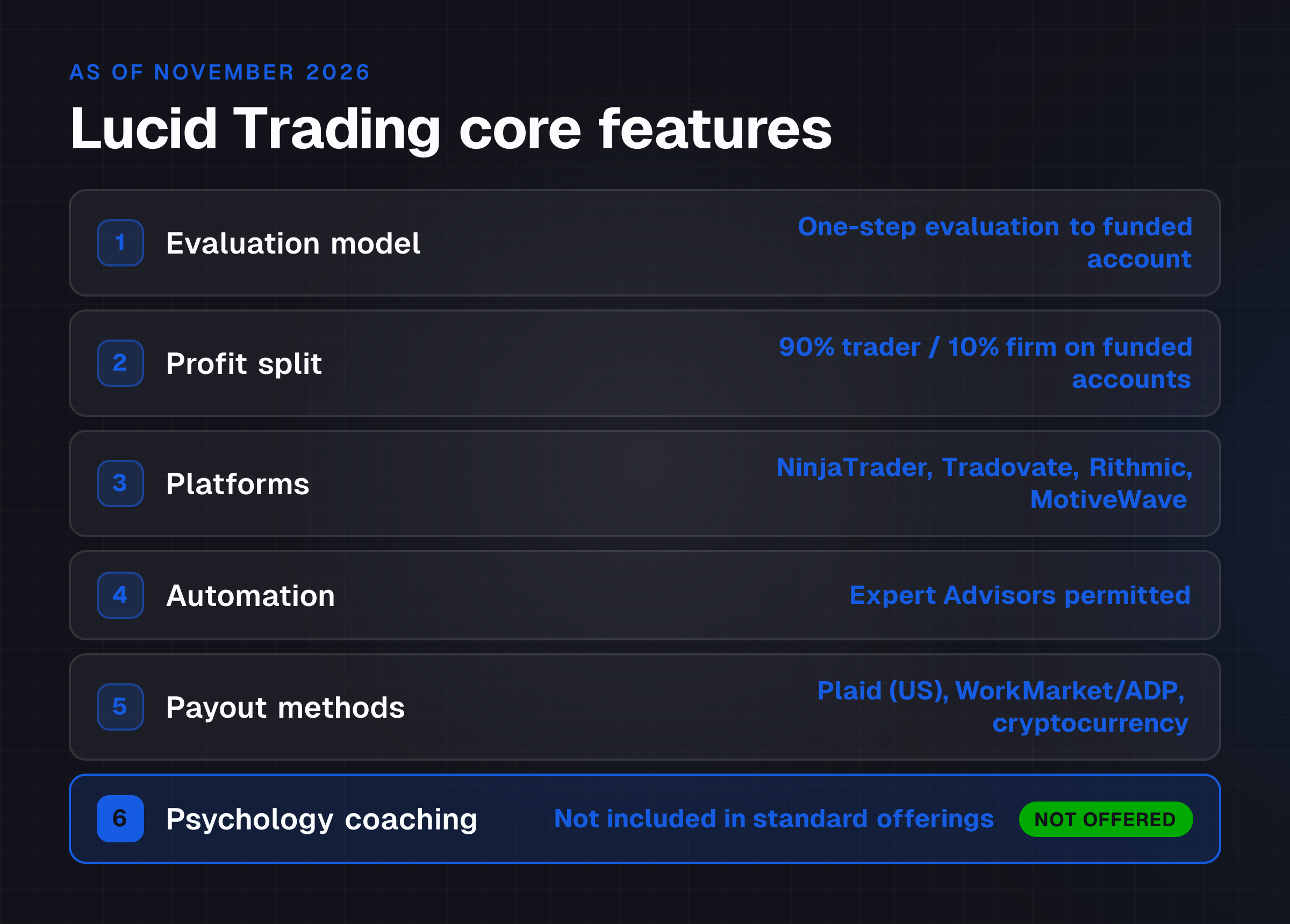
Lucid Trading operates a one-step evaluation model for futures traders. Founded in 2020, the firm has built its offering around direct evaluation access rather than multi-tier progression or coaching infrastructure.
Evaluation and funded accounts:
Single evaluation phase leading to a funded account upon passing. No multi-step hurdles. A 90% profit split on funded accounts once you're through. Support for automated trading via Expert Advisors on compatible platforms.
Trading platforms and assets:
Lucid Trading supports NinjaTrader, Tradovate, Rithmic, and MotiveWave. Traders can access futures across indices, energies, metals, currencies, agricultural products, commodities, grains, meats, and treasuries. Automated strategies are permitted.
Risk management rules and payouts:
Challenge rules include daily drawdown and maximum drawdown limits. Typical examples: a 2.4% daily drawdown and 2% maximum drawdown on certain programs. Traders must hit profit targets, often 3% on select programs, while staying within these boundaries.
Lucid Trading offers multiple payout methods: instant bank transfers via Plaid for US traders, WorkMarket by ADP for US and international traders (via bank transfer or PayPal), and cryptocurrency payouts in Bitcoin, Ethereum, USDT, and USDC for international traders.
Absence of stated psychology services:
Lucid Trading's FAQ, terms, and product pages do not mention real-time psychological feedback, live coaching, or behavioral analysis as included services. Community features (such as Discord participation) exist for peer discussion, but formal coaching is not documented as a standard offering.
What to do next: Securing psychology support alongside prop trading
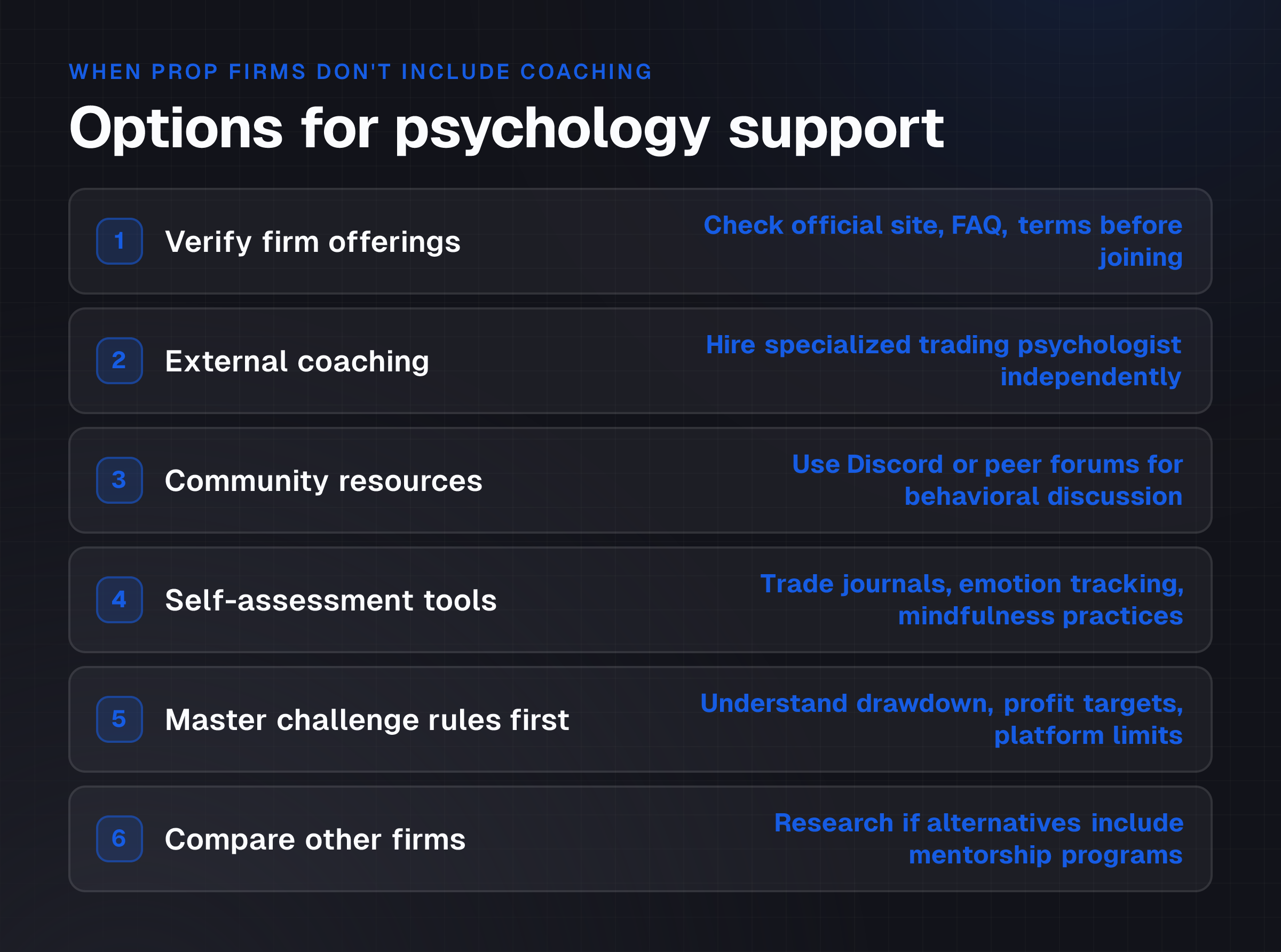
If real-time feedback and coaching are priorities for your trading success, here's a structured approach.
Verify firm offerings directly. Check the official website, FAQ, and terms of service before joining. Never assume services are included unless explicitly stated. For Lucid Trading, confirm current offerings by visiting their official site or contacting support.
Source external coaching independently. Many trading psychologists and specialized coaches focus exclusively on behavioral analysis, emotional control, and decision-making under stress. These professionals can offer tailored guidance outside the prop firm ecosystem. Look for coaches with verifiable track records working with traders.
Use community resources as a supplement. Lucid Trading maintains an active Discord community where traders discuss challenges, share trade reviews, and offer peer support. While not formal coaching, community interaction can address psychological concerns around trading decisions and emotional patterns.
Implement self-assessment tools. Trade journaling, post-trade reviews focused on emotional triggers, and mindfulness practices help identify your own behavioral patterns. Software tools designed to track trading behavior can reveal psychological trends over time.
Prioritize challenge rules and structure. Before seeking external coaching, ensure you fully understand the firm's evaluation criteria, daily and max drawdown, profit targets, minimum trading days, and platform constraints. A clear grasp of these fundamentals is foundational, regardless of psychological support. Lucid Trading has specific daily and maximum drawdown limits; mastering these rules comes first.
Compare if psychology support is non-negotiable. If coaching is essential, research whether other firms offer built-in mentorship. Check the prop firm directory for comparison. For example, For Traders offers different challenge structures and asset coverage; verify whether their programs include behavioral support before committing.
Frequently asked questions
Does Lucid Trading offer mentorship programs?
Lucid Trading's publicly available materials do not list formal mentorship or coaching as standard offerings. The firm focuses on providing evaluated access to funded futures accounts, trading platforms, and profit-sharing structures. Community engagement via Discord is available, but this is peer-based discussion rather than professional mentorship.
What platforms does Lucid Trading support, and do they allow automation?
Lucid Trading supports NinjaTrader, Tradovate, Rithmic, and MotiveWave. Expert Advisors (automated trading strategies) are allowed on these platforms. This is useful if you rely on systematic trading approaches rather than manual psychology-dependent decisions.
How much does a Lucid Trading evaluation cost?
Evaluation fees vary by program tier. For example, a 50K program costs $100 and is non-refundable. Check the Lucid Trading review page for current pricing on all available evaluation options, as programs and fees may change.
Can I withdraw profits weekly, and what payment methods are available?
Lucid Trading offers multiple payout methods: Plaid for instant US bank transfers, WorkMarket by ADP for US and international traders (bank transfer or PayPal), and cryptocurrency (BTC, ETH, USDT, USDC) for international traders. Withdrawal frequency and payout timing vary by method; confirm current withdrawal schedules on their official site.
What drawdown and profit target rules apply to Lucid Trading challenges?
Rules vary by program. Typical examples include a daily drawdown limit of 2.4% and a maximum drawdown of 2%, with profit targets around 3%. Exact rules depend on the specific evaluation you choose. Review the full rules for your selected program before paying the evaluation fee.
If psychology support is crucial, which alternative prop firms should I consider?
The prop firm directory and comparison resources can help you evaluate firms by their stated offerings. Many firms focus on rules and payouts rather than coaching. If mental training is non-negotiable, prioritize external coaching providers alongside any prop firm partnership, and confirm during onboarding whether the firm offers any customized support beyond standard packages.