FTMO alternatives worth considering
By Tomas Rieder
·
FTMO's been the standard prop firm for close to a decade. It's not the only one left standing. If 1:100 leverage feels too tight, payout timing too vague, or challenge fees too steep for your account size, switching solves real problems. The firms below fix specific FTMO constraints: one publishes bi-weekly payout cycles and cuts fees on large accounts, the other undercuts entry cost on $5K-$25K and matches profit splits.
Each alternative trades breadth for focus. Neither beats FTMO everywhere. This comparison maps your actual bottleneck, entry cost, cash velocity, leverage ceiling, or platform choice, and shows which firm removes it.
Side-by-side comparison
| Feature | FTMO | Evercrest Funding | Funded Prime |
|---|---|---|---|
| Website | ftmo.com | evercrestfunding.com | fundedprime.com |
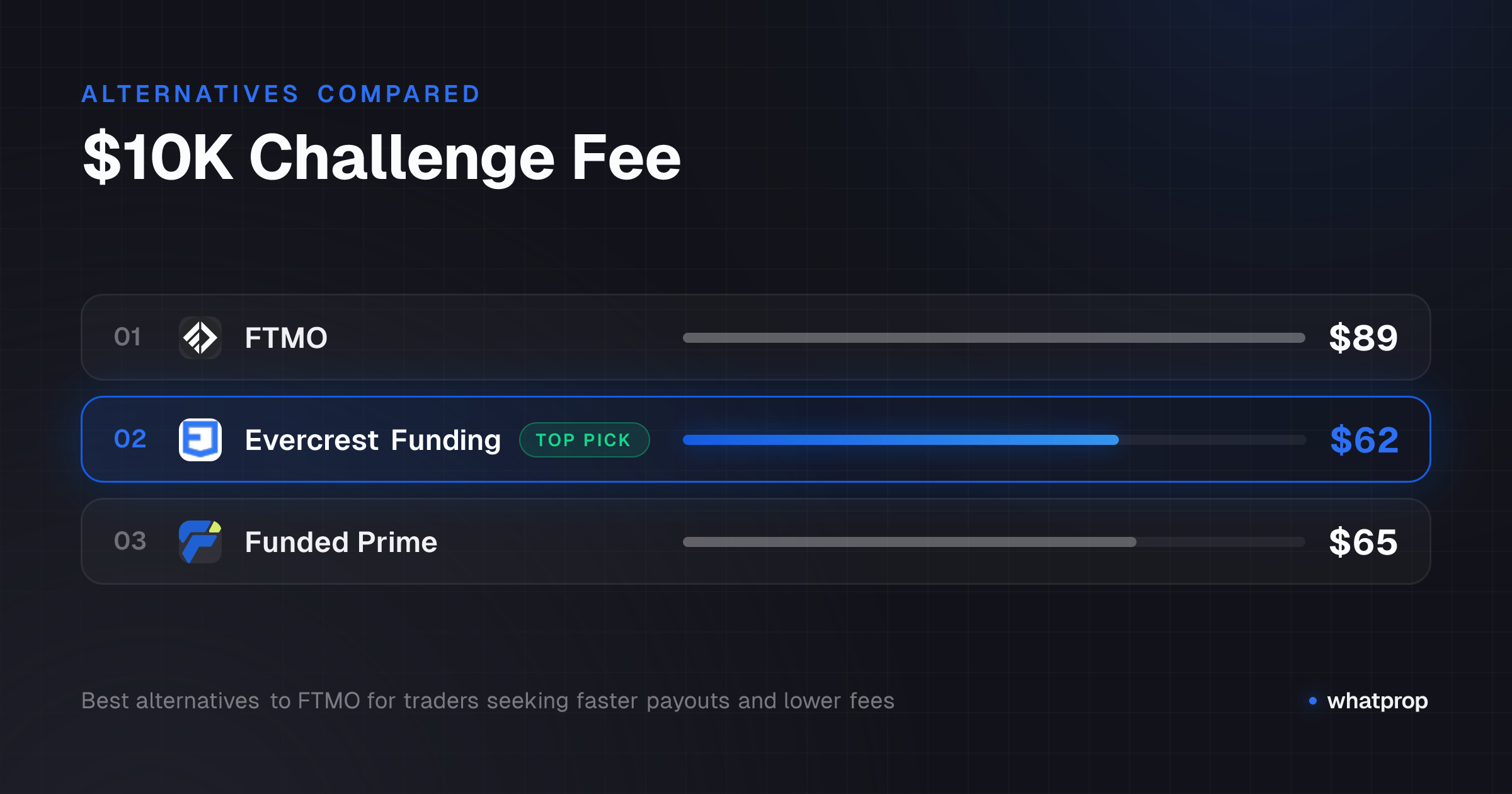
| $10K Challenge Fee | $89 | $62 | $65 |
| $100K Challenge Fee | ~$540 (inferred) | $359 | $555 |
| Profit Split | 90% | 80% | 90% |
| Max Leverage | 1:100 | 1:100 | 1:50 |
| Payout Frequency | Not published | Bi-weekly | Not published |
| Daily Drawdown | 5% | 3% | 5% |
| Max Drawdown | 10% | 6% | 10% |
| Platforms | MetaTrader 4, MetaTrader 5, cTrader, TradingView, DXtrade | MetaTrader 5, TradeLocker | TradeLocker, Eightcap |
| Assets | Forex, crypto, indices, commodities, stocks, options | Forex, crypto, indices, metals | Forex, indices, commodities, crypto, stocks |
| Payout Methods | Bank wire, crypto (USDT, BTC, LTC, USDC), Skrill, e-wallet, Visa Direct, Mastercard Send | Withdrawal | Crypto (USDT TRC20, USDT ERC20, Bitcoin), International Bank Transfer |
How we evaluate
This comparison evaluates FTMO against two alternatives across four trader pain points: challenge fee friction, payout speed, profit split, and platform/asset breadth. We prioritize decision-grade precision by citing only verified facts from official pricing pages, published payout schedules, and trader-reported cycles. High-risk claims (fees, payouts, drawdowns, leverage) are sourced exclusively from primary firm data; where a fact is unpublished (e.g., FTMO's payout frequency), we state it clearly rather than inferring from marketing. Affiliate offers and promotional codes reflect January 2025 status and are subject to change.
- Regulation & trust20%
- Challenge cost & value20%
- Payouts & profit split20%
- Trading platforms15%
- Leverage & risk rules15%
- Support & transparency10%
Top alternatives

Best for: Traders prioritizing bi-weekly payouts and lower fees on $50K+ accounts
Evercrest publishes a bi-weekly payout cycle (FTMO's timing is opaque), cuts $100K challenge fees by 34% ($359 vs ~$540), and matches 1:100 leverage. On large accounts, this is the fastest published withdrawal schedule in the peer set.
80% profit split costs 10 percentage points versus FTMO's 90%. Tighter drawdown rules (3% daily, 6% max vs FTMO's 5%/10%) increase rule-violation risk. No stocks or options trading. Only two platforms (MT5, TradeLocker) vs FTMO's five.
Swing and position traders in forex/crypto who tolerate stricter drawdown caps, value bi-weekly cash flow, and trade $50K+. Scalpers on volatile days will struggle with the 3% daily cap.

Best for: Traders scaling $5K-$25K accounts who want the lowest fees and matching profit splits
Funded Prime undercuts FTMO's challenge fees by 27% on $10K ($65 vs $89) and by 36% on $5K ($45 vs implied ~$70). 90% profit split matches FTMO. 1:50 leverage is half FTMO's but still sufficient for most non-scalp strategies.
1:50 leverage halves your notional exposure compared to FTMO, forcing smaller position sizes or tighter stops. Payout frequency is not published (same opacity as FTMO). Limited to crypto and bank transfer withdrawals (no Skrill, Visa Direct, or e-wallet options). Narrower platform choice (two platforms vs FTMO's five).
Forex and indices traders starting on $5K-$25K who tolerate 1:50 leverage and can withdraw via bank transfer or crypto. Avoid if you need high leverage for scalping or if card/e-wallet payouts are your only exit.
Quick verdict
Pick Evercrest Funding for speed. Bi-weekly payouts are published; FTMO's are not. A $100K challenge costs $359 versus FTMO's ~$540, saving you $181 upfront.
Pick Funded Prime for cheaper small accounts. A $10K challenge runs $65 (27% under FTMO's $89). Profit split stays at 90%, matching FTMO's base rate while cutting your entry friction.
Stay with FTMO if you trade stocks, options, or need five platforms (MetaTrader 4, 5, cTrader, TradingView, DXtrade). Both alternatives narrow asset coverage to forex, indices, crypto, and metals to drop costs and speed withdrawals.
Payout rhythm is the biggest gap. Evercrest guarantees bi-weekly; FTMO and Funded Prime don't state cycles at all. FTMO keeps the highest leverage (1:100 vs Funded Prime's 1:50) and the widest geographic reach.
Last verified: January 2025
How we selected these alternatives
This analysis holds FTMO against four decision drivers that push traders to leave: challenge fee (entry friction), payout frequency (cash velocity), profit split (take-home per trade), and platform/asset availability (strategy fit). We filtered for firms that compete directly on at least one factor and publish verifiable rule data on official pricing pages.
FTMO traders switch for three reasons that show up again and again:
- Challenge fees bite harder on small accounts. A $100K challenge costs $540, or 0.54% of capital. Drop to $10K and FTMO's 2-step runs $89-0.89% friction. Some alternatives invert that ratio.
- Payout timing stays opaque. FTMO doesn't publish a withdrawal cycle. Traders report 2-4 week waits between profit and cash. Some alternatives post bi-weekly schedules in writing.
- Platform and asset limits block strategies. FTMO supports options and stocks; competitors focus on forex, crypto, indices. If your edge lives in equities or vol products, this matters. If you scalp only EUR/USD, it doesn't.
What makes a good alternative
A real FTMO alternative needs to:
- Publish payout frequency in writing-weekly, bi-weekly, monthly, not leave traders guessing.
- Cut friction where your account size lives. A cheaper $10K challenge means nothing if you trade $100K.
- Match or beat profit split. FTMO's base is 90%. A firm that drops to 70% to save $50 on fees is a trap.
- Support your core instruments. If you scalp NQ futures, forex-only firms are unusable.
- Let you withdraw without hidden minimums or delays. "Withdrawal available" is hollow if payouts batch quarterly or lock behind $10K floors.
Both firms below clear these bars in different spots. Neither clears all four equally.
Quick comparison table
| Feature | FTMO | Evercrest Funding | Funded Prime |
|---|---|---|---|
| $10K Challenge Fee | $89 | $62 | $65 |
| $100K Challenge Fee | ~$540 | $359 | $555 |
| Profit Split | 90% | 80% | 90% |
| Max Leverage | 1:100 | 1:100 | 1:50 |
| Payout Frequency | Not published | Bi-weekly | Not published |
| Platforms | MT4, MT5, cTrader, TradingView, DXtrade | MT5, TradeLocker | TradeLocker, Eightcap |
| Assets | Forex, crypto, indices, commodities, stocks, options | Forex, crypto, indices, metals | Forex, indices, commodities, crypto, stocks |
| Daily Drawdown | 5% | 3% | 5% |
| Max Drawdown | 10% | 6% | 10% |
Best alternatives
Evercrest Funding: Faster payouts and cheaper large accounts
Best for: Traders who want bi-weekly payouts and lower entry fees on $50K+ accounts.
Why it works: Evercrest publishes a bi-weekly payout cycle. That's the clearest difference from FTMO. On a $100K challenge, you save $181 ($359 vs $540). Max leverage stays at 1:100. MetaTrader 5 and TradeLocker cover most forex and crypto strategies. Pass phase 1 and 2, and cash arrives every other week instead of waiting in FTMO's undefined queue.
Key features:
- Bi-weekly withdrawals (in writing).
- $10K challenge: $62 (vs $89 at FTMO; 30% cheaper).
- $100K challenge: $359 (vs ~$540; 34% cheaper).
- 1:100 leverage, matching FTMO's ceiling.
- 80% profit split, 10 points under FTMO's 90%. Speed and cost savings trade against take-home.
- Tighter drawdown rules: 3% daily, 6% max (vs FTMO's 5% daily, 10% max). Scalpers on volatile days feel this immediately.
Drawback: That 80% profit split costs you 10% of earnings. On a $10K account scaling 5% profit per month, that's $400/month in your pocket instead of $450. Over a year, $600. Evercrest offers two platforms (MT5, TradeLocker) versus FTMO's five. No stocks or options trading, a hard wall if equities are your edge. Drawdown caps are tighter, raising the cost of one bad trade or surprise gap.
Best-fit trader: Swing and position traders in forex or crypto who can live with tighter drawdown rules, prioritize bi-week cash flow, and trade accounts $50K+. Skip Evercrest if you scalp on news spikes (3% daily drawdown closes you out fast) or need options.
Funded Prime: Cheaper entry on small accounts, strong splits
Best for: Traders scaling $5K-$25K accounts who want the lowest fees and strong profit splits without sacrificing too much leverage.
Why it works: Funded Prime undercuts FTMO on challenge fees across all sizes. The gap is widest on small accounts. A $10K 2-step costs $65 (27% cheaper than FTMO's $89). Profit split is 90%, matching FTMO's base rate. Max leverage is 1:50, higher than some competitors, though half of FTMO's 1:100. TradeLocker and Eightcap handle forex and indices well. You get funded faster on smaller capital if your edge is solid.
Key features:
- $5K challenge: $45 (lowest entry point among all three).
- $10K challenge: $65 (27% cheaper than FTMO).
- $25K challenge: $175 (no direct FTMO match; FTMO's next tier jumps to $100K).
- 90% profit split on all challenges (matches FTMO).
- 1:50 leverage (half of FTMO's 1:100).
- Standard 5% daily, 10% max drawdown.
- Crypto and bank transfer payouts only. No e-wallets, Skrill, or card options.
Drawback: 1:50 leverage caps your buying power. On a $10K account, FTMO lets you control $1M in notional exposure; Funded Prime limits you to $500K. For scalpers stacking thin margins, this is a hard ceiling. Payout methods shrink to crypto and bank transfer, no Skrill, Visa Direct, or Mastercard Send like FTMO offers. If you're in a country with weak crypto on/off ramps or prefer card withdrawals, this friction adds up. Payout frequency isn't published, matching FTMO's opacity. Platform choice narrows to two; FTMO has five.
Best-fit trader: Forex and indices traders starting on $5K-$25K accounts who tolerate 1:50 leverage and can withdraw via bank transfer or crypto. Avoid Funded Prime if you need high leverage for scalping (e.g. 1:100) or if card/e-wallet payouts are your only exit route.
Best alternatives by trader type
Scalpers (tick-by-tick, news-driven): Stay with FTMO. Its 5% daily drawdown forgives more than Evercrest's 3%. 1:100 leverage lets you layer size without hitting margin limits. Funded Prime's 1:50 cap will choke position sizing on tight stops.
Swing traders (2-5 day holds, indices/forex): Evercrest wins if cash velocity matters more than profit split. You tolerate 80% take-home for bi-weekly payouts. Funded Prime is close if you trade $10K-$25K and like the 90% split; just accept the payout timeline is unclear.
Position traders (1-4 week holds, macro/trend): Funded Prime if you want low entry cost and high profit split on smaller accounts. Evercrest if you want faster payouts and can absorb the 80% split. FTMO if you trade stocks alongside forex and need platform variety.
Crypto/altseason traders: Evercrest and Funded Prime both support crypto. Evercrest has bi-weekly payouts; Funded Prime has lower fees. Neither offers options, so complex strategies (short vol, spreads) require FTMO.
Multi-asset traders (stocks + options + forex): FTMO is the only choice here. Both alternatives exclude equities and options entirely.
How to choose the right alternative
Step 1: Identify your constraint. Is it entry cost, payout speed, leverage, or platform? Payout speed killing your cash flow? Evercrest. Entry cost on $5K-$25K the blocker? Funded Prime. Need stocks or options? None of these alternatives work, FTMO is still your only path.
Step 2: Map account size. Evercrest fees drop fastest on $100K+ accounts. Funded Prime edges FTMO most on $5K-$25K. On $50K, the fee gap narrows; pick based on payout speed or leverage tolerance, not cost alone.
Step 3: Test drawdown tolerance. Evercrest's 3% daily cap is strict. Paper-trade a week of your strategy and count how often you'd hit it. More than once every two weeks? Evercrest will close you out. Pick Funded Prime or FTMO instead.
Step 4: Verify payout access. Check Funded Prime's bank transfer and crypto rails from your country. Check Evercrest's withdrawal method support. If neither works, FTMO's wider payout options (Visa Direct, Mastercard Send, Skrill, e-wallet) may be non-negotiable.
Step 5: Run the math on profit split. Evercrest's 80% vs FTMO's 90% costs you $1,000 per $100K in annual profit. If you scale $10K/month and hit $120K/year profit, that's $10,800 vs $12,000. Worth it for bi-weekly payouts? Most traders say yes. Worth it just for fees? No.
Pick Evercrest for payout speed; pick Funded Prime for entry cost on small accounts; stay with FTMO for platform breadth and asset coverage
FTMO dominates in breadth: five platforms, stocks, options, crypto. Neither alternative competes there. But FTMO's payout timeline is opaque, and its challenge fees run higher on all account sizes. Evercrest's bi-weekly guarantee is its selling point, if cash flow velocity drives your decision, no other firm in this set commits to it in writing. Funded Prime's fee advantage peaks on $5K-$25K accounts; the gap shrinks as account size rises. On $100K+, Evercrest's fees drop faster. If none of these factors matter, if you need stocks, options, TradingView access, or you're indifferent to payout timing, FTMO remains the default. Otherwise, map your constraint and pick accordingly: fast payouts (Evercrest), low small-account fees (Funded Prime), or everything else (FTMO).
Frequently asked questions
How much faster are Evercrest's payouts compared to FTMO?
Evercrest publishes a bi-weekly payout cycle; FTMO doesn't state withdrawal frequency. Trader reports put FTMO payouts at 2-4 weeks after approval, no guaranteed schedule. Evercrest's bi-weekly commitment lets you model cash flow predictably. Both require phase 2 completion before the payout clock starts; neither guarantees same-day settlement to your bank.
Is the 10% profit split cut at Evercrest worth the fee savings?
On a $10K account earning $500/month, Evercrest pays $400 (80%) vs FTMO's $450 (90%), a $50/month gap. You save $27 on the challenge fee upfront, breaking even in under a month. For traders reinvesting profits, bi-weekly payouts often offset the split loss. For part-time traders on one account, FTMO's 90% may feel safer.
Can I get 1:100 leverage on small accounts at Evercrest?
Yes. Evercrest offers 1:100 leverage on all account sizes, including $10K. FTMO also offers 1:100 across all tiers. Funded Prime caps at 1:50. High leverage increases margin cost and rule-violation risk if a gap trade hits your max drawdown. Choose based on your strategy's position-sizing needs, not leverage alone.
Does Funded Prime publish payout frequency like Evercrest does?
No. Funded Prime doesn't state a withdrawal cycle on its official site. This mirrors FTMO's opacity. You'd need to contact support or trade an account to learn the real timeline. If payout speed is your switching reason, Evercrest is the only alternative that guarantees bi-weekly withdrawals in writing.
Which alternative is best for US traders?
Funded Prime and Evercrest both restrict US traders. FTMO doesn't explicitly list the US as restricted, though US trader access varies. Verify current restrictions directly with each firm's support before enrolling, rules change frequently and differ by state. Check the prop firm directory for the latest regional policy.