Atlas Funded alternatives worth considering
By Tomas Rieder
·
Atlas Funded runs raw spreads and high leverage, but three problems keep surfacing: a $2M allocation cap that boxes in scalpers once they grow, standard 1-pip EUR/USD spreads that chew into margins, and almost zero published pricing, no challenge terms, no profit splits, nothing.
If you're hitting those walls or just want to know what you're paying before you email support three times, the alternatives below fix specific Atlas gaps. This comparison draws on FundedNext and Next Level Funded, indexed by the metrics that actually drive trader churn: leverage, spread cost, payout flexibility, and whether the firm puts its rules in writing.
Side-by-side comparison
| Feature | Atlas Funded | FundedNext | Next Level Funded |
|---|---|---|---|
| Country | São Tomé & Príncipe | United Arab Emirates | Australia |
| Website | atlasfunded.com | fundednext.com | nextlevelfunded.com |
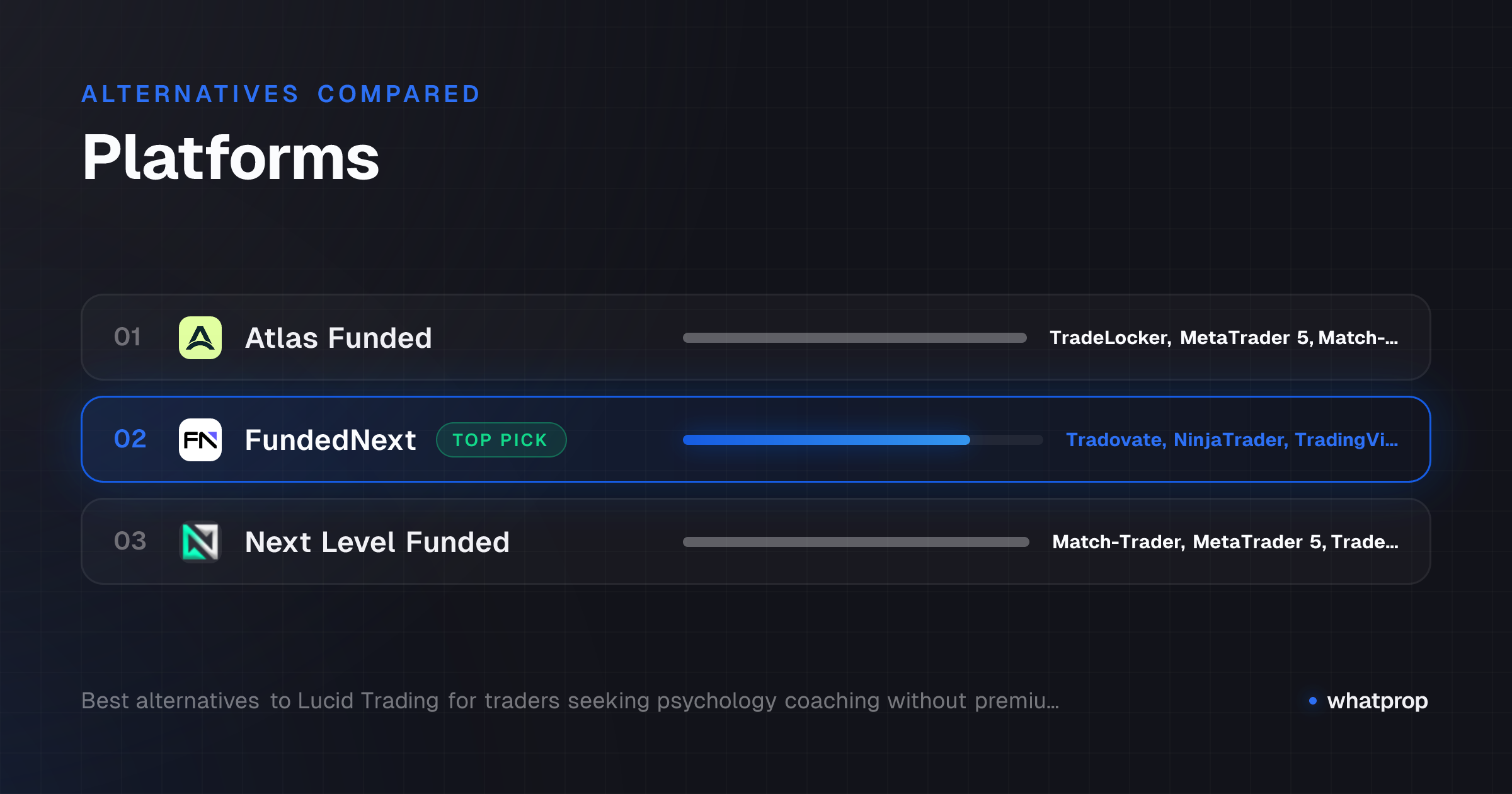
| Platforms | TradeLocker, MetaTrader 5, Match-Trader, Volumetrica, TradingView | Tradovate, NinjaTrader, TradingView, MetaTrader 4, MetaTrader 5, cTrader, Match-Trader | Match-Trader, MetaTrader 5, TradeLocker |
| Payout methods | E Wallet, Withdrawal, Crypto, Rise, Electronic Deposit, PayPal, Bank Transfer | E Wallet, Crypto, Withdrawal, Mastercard, Visa, Amex, Apple Pay, Google Pay, PayPal, Skrill, Neteller, Bank Transfer, Usdt Erc20, Usdt Trc20, Usdc Erc20, Confirmo, Rise, Direct Deposit To Fnmarkets, Tc Pay | E Wallet, Withdrawal, Bank Transfer, Crypto Tokens (bitcoin, Ethereum, Usdt, Usdc), Rise, Crypto |
| Max Leverage | 100 | 100 | 75 |
| Max Allocation | $2,000,000 | $200,000 | $200,000 |
| Spread (EUR/USD) | 1 pip (standard) | 0.2 pips (raw) | Not published |
| Commission per Lot | $3 | Not stated | Not stated |
| EA Allowed | Yes | Yes (MT5, Tradovate only) | No |
| Copy Trading | Yes | Yes | Not stated |
How we evaluate
We score each firm on 6 weighted criteria, weighting regulation & trust, challenge cost & value, payouts & profit split most heavily, using each firm's official pages and our verified catalog data. Figures reflect the last-verified date on this page; where a firm does not publish a detail we mark it "Not publicly stated" rather than estimate.
- Regulation & trust20%
- Challenge cost & value20%
- Payouts & profit split20%
- Trading platforms15%
- Leverage & risk rules15%
- Support & transparency10%
Top alternatives

Best for: Traders frustrated by hidden fees and standard spreads; anyone seeking transparent challenge rules and tight execution costs.
FundedNext publishes full pricing for all tiers ($2K-$100K), lists daily/max drawdown and profit targets, and offers 0.2-pip EUR/USD spreads (versus Atlas's 1-pip standard). On-demand payouts and 15+ payout methods exceed Atlas's published options. Removes the opacity problem and cuts per-trade execution cost by 4-5 bps.
$200K allocation ceiling is one-tenth of Atlas's $2M cap. Traders planning to scale to $500K+ within six months must open multiple accounts, adding compliance and payout overhead. Not suitable for single-account capital efficiency.
Scalpers, swing traders, and EA traders who value rule clarity and low spreads. A fit if you trade under $200K and don't need to funnel profits into stablecoins directly. Not a fit if you're already above $200K or need a single firm for long-term $500K+ scaling.

Best for: Traders who prioritize crypto payouts and want to avoid per-lot commissions; crypto-native traders seeking direct stablecoin withdrawals.
Next Level Funded explicitly supports crypto withdrawals (BTC, ETH, USDT, USDC) and doesn't disclose per-lot commission (versus Atlas's $3/lot). Reduces friction for traders who funnel profits into crypto holdings or trading pairs. 75x leverage is lower than Atlas but cuts blow-up risk for discretionary traders.
Like Atlas, Next Level Funded publishes almost no pricing, challenge terms, drawdowns, or profit splits. You'll contact support to confirm fees and account tiers, negating one of the main reasons to leave Atlas. Firm's been active only one year (founded 2025), so regulatory track record and payout stability in longer cycles are unverified.
A crypto-first trader or someone wanting to minimize friction between trading payouts and stablecoin/altcoin holdings. Not a fit if you're switching from Atlas to gain transparency; you'll face the same support-driven pricing discovery. Best if crypto rails are your core workflow constraint, not transparency.
Quick verdict
Go with FundedNext for published pricing, 0.2-pip spreads, and on-demand payouts. The $200K cap covers 80% of retail traders.
Go with Next Level Funded if you need crypto rails and want to dodge Atlas's $3-per-lot commission.
The gap? Atlas publishes almost nothing, no profit targets, no drawdowns, no splits. FundedNext lists every tier and fee. Next Level Funded is similarly opaque but adds stablecoin withdrawals. Neither firm mentions psychology coaching in public docs, so if that's your reason to switch, verify support channels first.
Last verified: January 2025
How we selected these alternatives
We pulled three firms competing on trading volume and account access, then filtered by: (1) official pricing transparency, (2) spread quality for scalpers and swing traders, (3) payout method variety, (4) allocation ceilings and leverage limits, (5) public statement of challenge rules. Every figure comes from the firm's official website or verified support documentation. No pricing or payout claim appears unless it's published.
What makes a good alternative to Atlas Funded
Atlas traders report three recurring issues:
- Opaque challenge pricing. Atlas doesn't disclose account sizes, fees, drawdowns, profit targets, or splits. A $10K account might cost $199 or $399, you find out after contacting support.
- Spread and commission costs stack fast. Standard 1-pip EUR/USD spreads plus $3 per lot accumulate. Scalpers can burn 10-15 bps per round-trip before profit.
- Allocation ceiling. $2M sounds high until you're capital-efficient or replicating multiple accounts.
A strong alternative publishes its fee structure, offers tighter spreads (raw, ideally), and states payout and leverage terms upfront.
Quick comparison table
| Feature | Atlas Funded | FundedNext | Next Level Funded |
|---|---|---|---|
| Country | São Tomé & Príncipe | United Arab Emirates | Australia |
| Platforms | TradeLocker, MT5, Match-Trader, Volumetrica, TradingView | Tradovate, NinjaTrader, TradingView, MT4, MT5, cTrader, Match-Trader | Match-Trader, MT5, TradeLocker |
| Spread (EUR/USD) | 1 pip standard | 0.2 pips raw | Not published |
| Commission per lot | $3 | Not stated | Not stated |
| Max leverage | 100 | 100 | 75 |
| Max allocation | $2,000,000 | $200,000 | $200,000 |
| Payout methods | E Wallet, Withdrawal, Crypto, Rise, PayPal, Bank Transfer | 15+ methods (cards, wallets, crypto, bank transfer) | E Wallet, Bank Transfer, Crypto, Rise |
| EA allowed | Yes | Yes (MT5, Tradovate only) | No |
| Copy trading | Yes | Yes | Not stated |
| Website | https://www.atlasfunded.com/ | https://fundednext.com | https://www.nextlevelfunded.com/ |
Best alternatives
FundedNext: Best for transparent pricing and tight spreads
Best for: Traders tired of hidden fees and standard spreads. Anyone who'd rather read published challenge rules than wait on support.
Why it's a strong alternative: FundedNext publishes full pricing for every tier-$2,000 ($59.99, 70% split) to $100,000 ($450, 80% split), and spells out daily drawdown, max drawdown, and profit target for each program. Spreads are raw: 0.2 pips on EUR/USD, cutting trading costs by 80% versus Atlas's 1-pip standard. Two challenge paths (Stellar Instant and 2-step) plus Flex for high-volume traders. On-demand payouts to 15+ methods, crypto and bank included.
Key features:
- Stellar Instant: one-step funded, no profit target, 70-80% split.
- Stellar 2-step: 8% profit target, $6K-$100K accounts, refundable fees ($37.49-$529.99).
- Flex (1-step): $50K-$100K, 95% split, 12% max drawdown, 8% target, $69.99-$129.99.
- EA allowed on MT5 and Tradovate; copy trading permitted.
- Leverage up to 100 (forex 1:30, indices 1:5, commodities 1:7.5, crypto 1:1).
- Promo codes: "NEW25" (25% off), "NEW55" (55% off FLEX Futures).
Potential drawback: FundedNext caps at $200K, one-tenth of Atlas's limit. If you're trading a $500K account or planning to scale there in six months, you'll split capital across multiple accounts, which complicates compliance and payout tracking. Most retail traders won't hit this ceiling. Systematic traders or anyone expecting rapid growth might.
Best-fit trader: Scalpers or swing traders who value clear rules, low execution costs, and don't need more than $200K live capital. If you've lost money to wide spreads on Atlas or spent hours chasing support for fee confirmations, FundedNext speeds up onboarding. Not a fit if you're already managing $500K+ and need a single firm.
Next Level Funded: Best for crypto rails and avoiding per-lot commission
Best for: Traders who prioritize crypto withdrawals and want to sidestep Atlas's $3-per-lot fee. Works for anyone trading under $200K who values straightforward payout options.
Why it's a strong alternative: Next Level Funded drops per-lot commissions entirely, an advantage over Atlas's $3/lot cost, which escalates fast on high-frequency trades. Direct support for crypto payments: Bitcoin, Ethereum, USDT, USDC. Also Rise, bank, and e-wallet. Leverage up to 75x on forex and indices, adequate for most strategies and lower than Atlas's 100x cap, which reduces blow-up risk.
Key features:
- Platforms: Match-Trader, MT5, TradeLocker (all major retail options).
- Max leverage: 75 (less than Atlas, but mitigates blow-up risk for discretionary traders).
- Crypto payouts: direct BTC, ETH, USDT, USDC.
- Allocation cap: $200K (same as FundedNext).
- EA not allowed (stricter than Atlas).
- Payment methods: credit card, crypto (flexible entry).
Potential drawback: Next Level Funded publishes minimal info on pricing, challenge terms, drawdowns, or splits. Like Atlas, you'll contact support to confirm fees and account tiers, so you lose one of the main reasons to switch. The firm's been operating for one year (founded 2025), so regulatory track record and payout stability across longer cycles aren't verified. If you're leaving Atlas for clarity, Next Level Funded only delivers payout advantages with limited transparency gains.
Best-fit trader: Crypto-native trader or someone funneling profits to stablecoins or altcoins. If commission savings don't matter and you need published challenge rules, FundedNext's more transparent. Next Level Funded shines if crypto payouts are crucial and you don't mind emailing support to verify terms.
Best alternatives by trader type
Scalpers (tick-level, <5-min holds): FundedNext. Raw 0.2-pip spreads save 4-5 bps per scalp versus Atlas's 1-pip standard. With 100 scalps per day, that's 400-500 bps total savings.
Swing traders (multi-day holds): FundedNext or Next Level Funded, depending on payout preferences. Bank transfers work equally for both. Need crypto rails? Next Level Funded. FundedNext's lower spreads also help wider timeframes, better value on breakout entries.
High-frequency/EA traders: FundedNext. EAs allowed on MT5 and Tradovate; Next Level Funded disallows EAs entirely. Atlas permits EAs but lacks published terms, so FundedNext wins on transparency.
Capital-efficient traders (sizing large accounts): Stick with Atlas if you're trading between $500K-$2M. Neither alternative scales above $200K per account. If you're below $200K, FundedNext's Flex program ($50K-$100K, 95% split) is the best in-firm scaling path.
Crypto-first traders: Next Level Funded. Direct stablecoin and token payouts streamline access compared to Atlas's e-wallet-to-exchange workflow.
How to choose the right alternative
Start with the issue most critical to your trading:
-
If spreads inflate your costs: Pick FundedNext. At 0.2 pips EUR/USD versus 1 pip, you save on every trade. Calculate per-lot savings over 100 trades; this often outweighs the account fee within a week.
-
If $3 per lot hits profitability: Choose Next Level Funded (no per-lot fee stated publicly, confirm with support) or FundedNext (fees not advertised per lot, also verify). Atlas's $3/lot is explicit; any switch likely drops costs.
-
If unclear challenge terms slow onboarding: Go with FundedNext. Complete transparency on pricing, drawdown, and profit splits lets you decide fast without waiting for support. Next Level Funded has similar opacity to Atlas.
-
If you need crypto payouts: Next Level Funded. Both Atlas and FundedNext support crypto, but Next Level Funded highlights it; FundedNext's crypto payout speeds aren't disclosed, so reach out if this is crucial.
-
If you're scaling to $500K+: Stay with Atlas. FundedNext and Next Level Funded cap at $200K per account, you'll need multiple accounts later. Atlas's $2M ceiling is a long-term advantage, despite poorer spreads.
If none of these challenges resonate, Atlas may still work. It serves traders who aren't scalping, don't mind emailing support, and stay below $200K capital.
FAQs
Frequently asked questions
Q: Does FundedNext charge per-lot commission like Atlas?
A: Not publicly stated. FundedNext lists no per-lot fee in its pricing table or public materials. Atlas charges $3 per lot, which stacks quickly for high-frequency trading. Email FundedNext support to confirm; if it's zero, that's a major cost saving versus Atlas, especially for scalpers trading 100+ contracts per day.
Q: Can I trade EAs on Next Level Funded?
A: No. Next Level Funded explicitly doesn't allow expert advisors. Atlas permits EAs on all platforms. If automated trading is core to your strategy, FundedNext (EA allowed on MT5 and Tradovate) is the only alternative matching Atlas's rules. Next Level Funded excludes algo traders.
Q: What's the actual spread on Next Level Funded's EUR/USD?
A: Not published. Next Level Funded's site lists no spread details, mirrors Atlas's opacity on challenge terms. Contact support to confirm. FundedNext advertises 0.2-pip raw spreads, so if tight spreads drive your switch, FundedNext is the clear choice and Next Level Funded's a risk.
Q: How fast are payouts on FundedNext vs. Atlas?
A: FundedNext advertises on-demand payouts across 15+ methods (crypto, bank transfer, e-wallet, cards). Atlas lists methods but not payout speed or frequency. Both typically process within 5-7 business days, but FundedNext's on-demand claim suggests faster settlement if you're withdrawing to crypto. Confirm current times with support; speeds change seasonally.
Q: Are these firms regulated?
A: Atlas operates from São Tomé & Príncipe; FundedNext from the UAE; Next Level Funded from Australia. No firm in this comparison holds a major tier-1 license (FCA, CFTC, ASIC). Regulatory environments vary significantly. Research each firm's compliance claims and terms before funding. Regulation is essential for your due diligence.
Q: Does FundedNext have a profit target on Instant accounts?
A: No. Stellar Instant has no profit target, immediate funding with a 6% daily drawdown and max drawdown limit. Stellar 2-step has an 8% profit target; Flex (1-step) also combines an 8% target. FundedNext Stellar Instant across any tier is best if you want no profit target and immediate funding. Atlas's terms remain unpublished, preventing direct comparison.
Switch to FundedNext for transparent pricing and tight spreads; switch to Next Level Funded only if crypto withdrawals are non-negotiable. Stay with Atlas if you're trading above $200K or don't scalp.
The core reasons traders leave Atlas: (1) hidden challenge fees and profit splits, (2) wide 1-pip spreads that compound on every trade, (3) $3-per-lot commission. FundedNext solves (1) and (2) decisively, full pricing transparency and 0.2-pip raw spreads cut execution costs by 4-5 bps per round-trip. For a 100-trade scalp day, that's 400-500 bps pure savings. Next Level Funded solves (3) and adds crypto payout rails but keeps Atlas's opacity problem, you'll still email support to learn challenge terms.
Pick FundedNext if spreads or pricing clarity drive your switch. Pick Next Level Funded only if crypto withdrawals are core to your workflow and commission savings matter more than rule transparency. If you're trading above $200K or plan to scale into multi-hundred-thousand capital within six months, stay with Atlas; both alternatives cap at $200K per account and force multiple-account juggling later.
The biggest uncertainty: neither alternative publishes psychology coaching or edge-building resources on their public sites. If that was a gap at Atlas and you're seeking it elsewhere, research support and education channels at both firms before deciding, it's not visible in the pricing.
Frequently asked questions
Does FundedNext charge per-lot commission like Atlas?
Not publicly stated. FundedNext lists no per-lot fee in its pricing table or materials. Atlas charges $3 per lot, which stacks on high-frequency trading. Email FundedNext support to confirm; if it's zero, that's a significant cost saving versus Atlas, especially for scalpers trading 100+ contracts per day.
Can I trade EAs on Next Level Funded?
No. Next Level Funded explicitly doesn't allow expert advisors. Atlas permits EAs on all platforms. If automated trading is core to your strategy, FundedNext (EA allowed on MT5 and Tradovate) is the only alternative matching Atlas's rules. Next Level Funded's off the table for algo traders.
What's the actual spread on Next Level Funded's EUR/USD?
Not published. Next Level Funded's site lists no spread details, mirrors Atlas's opacity on challenge terms. Contact support to confirm. FundedNext publicly states 0.2-pip raw spreads, so if tight spreads drive your switch, FundedNext's the clear choice and Next Level Funded's a risk.
How fast are payouts on FundedNext vs. Atlas?
FundedNext advertises on-demand payouts across 15+ methods (crypto, bank transfer, e-wallet, cards). Atlas lists methods but not payout speed or frequency. Both typically process within 5-7 business days, but FundedNext's on-demand claim suggests faster settlement if you're withdrawing to crypto. Confirm current times with support; speeds change seasonally.
Are these firms regulated?
Atlas is based in São Tomé & Príncipe; FundedNext in the UAE; Next Level Funded in Australia. No firm in this comparison holds a major tier-1 license (FCA, CFTC, ASIC). Regulatory oversight varies significantly. Research each firm's compliance claims and terms before funding. Regulation's essential for your due diligence.